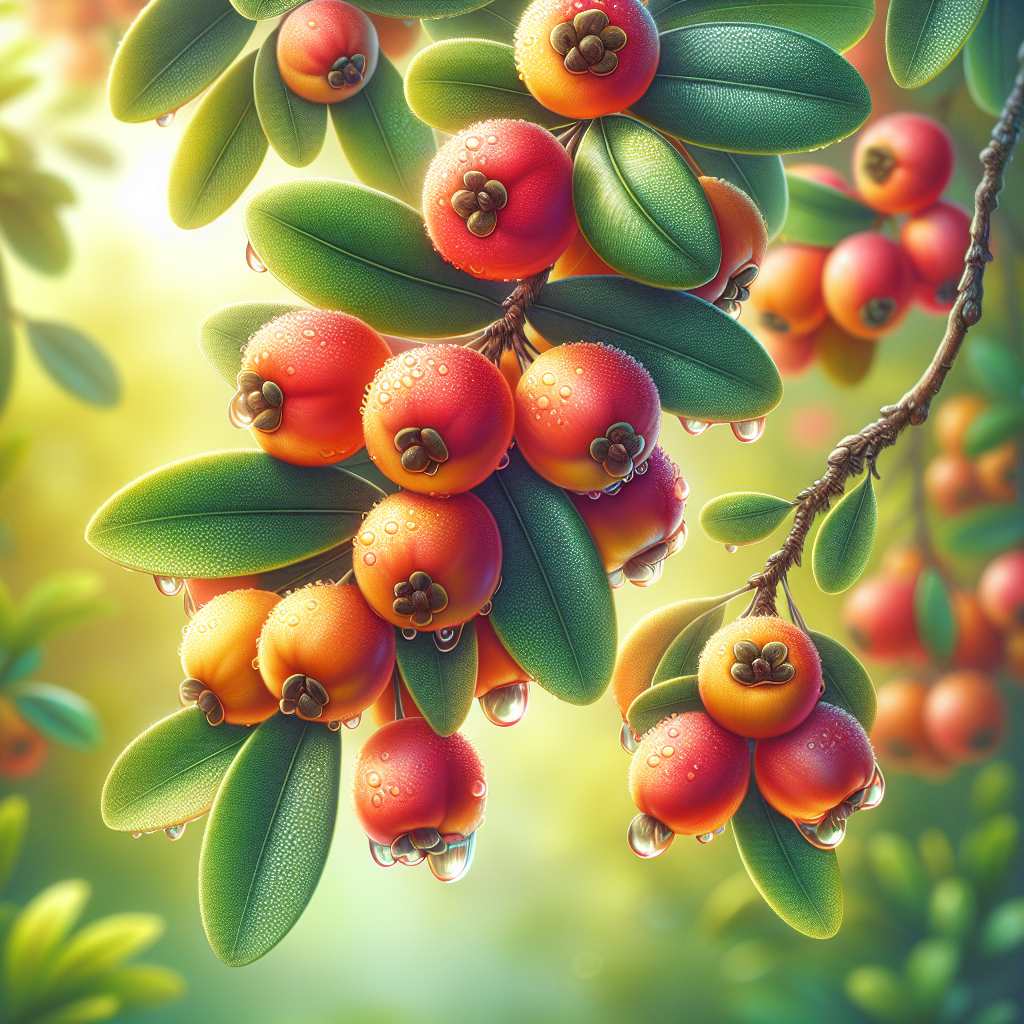
Introduction to Pitangatuba (Eugenia selloi)
Pitangatuba, scientifically known as Eugenia selloi, is an underappreciated gem among tropical fruit trees, native to the coastal regions of Brazil. Often called Brazilian cherry or pitanga-tuba, this Myrtaceae family member produces clusters of small, glossy orange-red fruits with a unique pineapple-strawberry flavor profile—sweet, tangy, and intensely aromatic. Unlike its more common relative, the Surinam cherry (Strawberry Guava (crop)), Pitangatuba offers superior disease resistance and a more compact growth habit, making it ideal for small farms, home orchards, and permaculture systems.
Farmers and gardeners are increasingly drawn to Pitangatuba for its dual-purpose appeal: bountiful edible yields and year-round ornamental beauty. Mature trees can produce 20-50 kg of fruit annually, with peak harvests in late summer to fall. The fruits are rich in vitamin C, antioxidants, and essential oils, positioning them as a niche market crop for fresh sales, value-added products like jams, liqueurs, and herbal teas. In subtropical zones (USDA 9-11), it serves as a low-maintenance alternative to high-input fruits like Mango (crop) or Avocado (crop). This guide provides professional-grade protocols for propagation, care, and management to maximize productivity while minimizing inputs. For small-scale growers combating summer heat stress, check this Why Summer Heatwaves Are Silently Killing Small Farm Yields - And 7 Organic Strategies to Fight Back resource.
Botanical Profile of Pitangatuba (Eugenia selloi)
Eugenia selloi is an evergreen shrub or small tree reaching 4-8 meters in height, with a dense, rounded canopy of opposite, lanceolate leaves (10-15 cm long) that are dark green, glossy, and leathery. New growth flushes bronze-red, adding visual interest. The tree's bark is smooth and grayish, peeling in patches on older specimens. Flowers emerge in spring as clusters of 4-petaled white blooms (1 cm diameter), fragrant with notes of clove and honey, attracting pollinators like bees and butterflies.
Fruits develop rapidly, maturing in 60-90 days to 1.5-2.5 cm diameter spheres. Skin is thin, tough, and glossy orange-red at peak ripeness; flesh is juicy, orange, with 1-2 small seeds. Brix levels range 12-18°, balancing sugar and acidity (pH 3.5-4.0). Unlike seeded pitangas, Pitangatuba seeds are small and easily separated. The tree is dioecious or self-fertile in many clones, with superior cultivars like 'Seleção Brazil' yielding larger fruits. Root system is fibrous and shallow, extending 2-3 times the canopy width, making it sensitive to mechanical damage but tolerant of brief drought. Lifespan exceeds 30 years with proper care, with first fruits in 2-4 years from seed or 1-2 from grafts.
Soil, pH, and Climate Requirements for Pitangatuba (Eugenia selloi)
Pitangatuba thrives in well-drained, fertile loamy sands or clay-loams with 2-5% organic matter. Avoid heavy clays prone to waterlogging, which invite root rot (disease). Optimal pH is 5.5-6.8; test soil annually and amend with dolomite lime if below 5.5 or sulfur if above 7.0. Incorporate 5-10 kg compost per square meter pre-planting, focusing on mycorrhizal inoculants for enhanced phosphorus uptake.
Climatically, it demands frost-free subtropical conditions: 18-32°C daytime averages, with minima above 10°C. Full sun (6-8 hours) is essential for fruit coloration and flavor; partial shade reduces yields by 30-50%. Annual rainfall of 1000-2000 mm is ideal, supplemented by drip irrigation during dry spells (20-40 L/tree/week for matures). High humidity (60-85%) promotes flowering but risks fungal issues—ensure 20-30% canopy airflow. Wind protection is critical; plant as hedgerows or windbreaks with Guava (crop). Mulch with 10 cm pine bark or coconut coir to retain moisture and suppress weeds. In marginal zones, use microclimates or high tunnels. Salt tolerance is moderate (EC <4 dS/m), suiting coastal plantings.
Step-by-Step Planting & Propagation
Propagation Methods
- Seeds: Extract from ripe fruits, wash, and sow fresh in 50:50 sand:compost mix at 25-30°C. Germination: 2-4 weeks, 70-90% rate. Pot up at 10 cm height; field transplant at 30-50 cm.
- Air-layering: Ideal for clones. Wound 2-year branches (1-2 cm dia.), apply rooting hormone (IBA 2000 ppm), wrap in moist sphagnum. Roots in 6-8 weeks; success 80-95%.
- Grafting: Cleft or veneer onto E. uniflora rootstock for vigor. Success 85%; done in spring.
- Cuttings: Semi-hardwood (10 cm) with 3000 ppm IBA; 50% rooting under mist.
Planting Protocol
- Site prep: Dig 50x50x50 cm pits, fill with 40% compost, 20% perlite, triple superphosphate (50g/pit).
- Spacing: 4-5 m in-row, 6 m between for trees; 2-3 m for hedges.
- Plant in early rainy season: Set at soil line, stake, mulch heavily.
- Initial irrigation: 10-20 L every 3 days for 6 months. Fertilize at 4 weeks: NPK 10-10-10 (100g/tree). Expect 1-2 m growth year 1.
Care & Maintenance regimes for Pitangatuba (Eugenia selloi)
Watering: Deep, infrequent; maintain 60-80% field capacity. Deficit irrigate post-fruit set for flavor intensity. Fertilization: Annual regime—spring: NPK 12-6-18 (500g/tree); summer: micronutrient foliar (Zn, Mn, B); fall: compost (10 kg/tree). Tissue test yearly targeting 2.5% N, 0.3% P. Pruning: Annual post-harvest: Remove deadwood, open center to 30% light penetration. Tip prune young trees for bushiness. Weed Control: Mulch + shallow cultivation; cover crops like Clover (crop). Training: Espalier or hedge for high-density (1000 trees/ha). Monitor for biennial bearing; thin flowers if overloaded.
Pests, Diseases & Organic Management
Key Pests: Aphids (pest), Scale insects (pest), fruit flies—neem oil (2%) weekly sprays. Mealybugs: alcohol-soap dips on branches. Diseases: Anthracnose (disease), Phytophthora (disease)—copper fungicide (pre-monsoon), elevate beds 30 cm. Powdery mildew (disease): potassium bicarbonate. Integrated Strategies: Beneficials (ladybugs, predatory mites), sanitation, reflective mulches. For broader pest insights, see Why 90% of Small Farms Fail at Pest Management - And 8 Organic Fixes That Actually Work. Rotate with non-hosts like legumes.
Harvesting, Curing & Optimal Storage
Harvest when fruits fully orange-red, 1-2 weeks post-color change; yield peaks over 4-6 weeks. Hand-pick clusters to avoid skin tears; 3-4 passes/tree. Average 0.5-1 kg/branch. Post-Harvest: Cool to 10-15°C within 4 hours; hydrocool for 2 min. Sort by size/color. Storage: Fresh: 12-18 days at 12°C, 85-90% RH. Ripen off-tree at 20°C. Process: Juice (yield 70%), freeze (-18°C, 12 months), dry (50°C, 24h). Market Tips: Sell fresh in punnets; value-add as sorbets, cordials.
Companion Planting for Pitangatuba (Eugenia selloi)
Pair with nitrogen-fixers like pigeon pea for soil enrichment, herbs such as Thyme (crop) or Marigold (crop) for pest repulsion. Underplant with Pineapple (crop) for ground cover and shade tolerance. Avoid water-hungry crops like Watermelon (crop). Benefits: Enhanced pollination, biodiversity, microclimate moderation. Learn more in this Fall Companion Planting Guide: Boost Yields and Soil Health for Small Farms and Gardens.