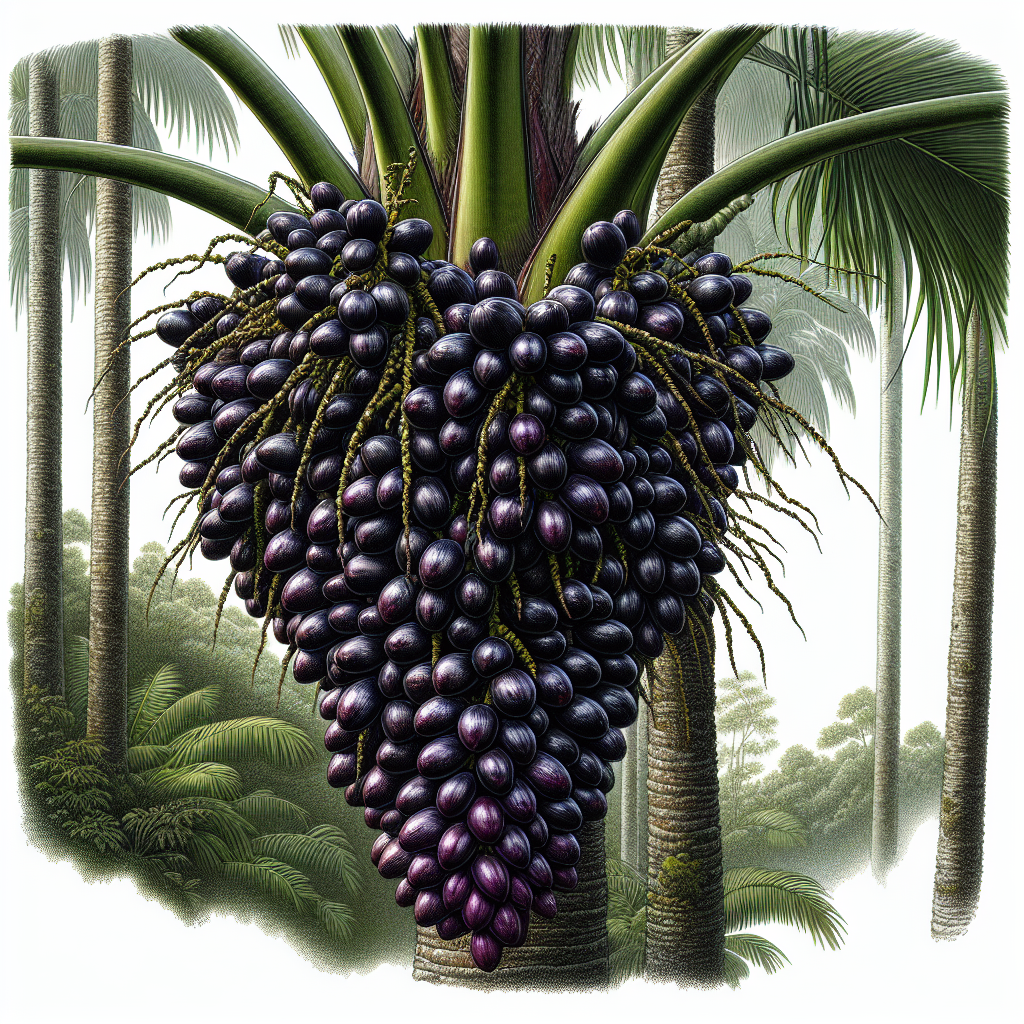
Introduction to Pataua (Oenocarpus bataua)
Pataua, scientifically known as Oenocarpus bataua, stands as one of the most promising underutilized palms in tropical agroforestry. Native to the lush rainforests of Central and South America, from Nicaragua to Brazil, this dioecious palm thrives in humid lowland ecosystems, reaching heights of 20-30 meters with a slender, solitary trunk up to 50 cm in diameter. Its crown of pinnate fronds spans 3-5 meters, creating a striking silhouette against the canopy.
The palm yields clusters of small, black-purple fruits rich in high-quality oil (up to 50% content), comparable to olive oil in nutritional profile, packed with oleic acid, tocopherols, and antioxidants. The immature fruits serve as a beverage source when fermented, while the palm heart is a delicacy similar to coconut. Pataua wood is durable for construction, and the palm supports biodiversity in mixed cropping systems. With growing demand for sustainable superfoods, Pataua cultivation offers small farms a lucrative, low-maintenance crop. For detailed insights on Why Companion Planting Feels Like Guesswork for Small Farms - And How AI Makes It Foolproof, explore agroforestry synergies.
Global interest surges due to its resilience to poor soils and climate adaptability, making it ideal for reforestation and permaculture. Yields peak at 10-20 kg of fruit per infructescence every 1-2 years after 8-10 years of growth, with oil extraction viable at small scales using cold-pressing methods. This guide equips growers with proven protocols for propagation, maintenance, and harvest, drawing from ethnobotanical knowledge and modern trials in Ecuador, Peru, and Colombia.
Botanical Profile of Pataua (Oenocarpus bataua)
Oenocarpus bataua belongs to the Arecaceae family, subfamily Arecoideae, tribe Cocoseae. It exhibits monopodial growth with a single, unbranched trunk marked by prominent leaf scars and a fibrous sheath at the base. Leaves are 3-4 m long, with 100-150 linear pinnae per side, glaucous beneath, arranged spirally. Inflorescences emerge from the lower trunk, pendulous, 1-2 m long, with hundreds of rachillae bearing bisexual flowers (staminate and pistillate phases).
Fruits are ellipsoid drupes, 2-3 cm long, 1.5 cm wide, with a thin exocarp, fibrous mesocarp rich in oil, and a single large seed. Germination produces a elongated eophyll followed by spear leaves. The palm is shade-tolerant in youth, transitioning to canopy dominance. Phenology aligns with wet seasons: flowering January-March, fruiting June-September in the Amazon basin.
Genetic diversity spans subspecies like O. bataua bataua (lowlands) and O. bataua oleifera (oil-rich variants). Pollinators include bees and beetles; seed dispersers are birds, bats, and rodents. Root system is fibrous, shallow (top 50 cm), with adventitious roots aiding stability in wet soils. For more on tropical palm cultivation, reference banana systems, sharing humidity needs.
Soil, pH, and Climate Requirements for Pataua (Oenocarpus bataua)
Pataua demands tropical humid climates: average temperatures 24-28°C, no frost, rainfall 2000-4000 mm/year evenly distributed, humidity >80%. It tolerates short dry spells (<3 months) but excels in perhumid zones (2000+ mm). Altitude: 0-1000 m ASL; avoid slopes >30% to prevent erosion. USDA zones 10b-12.
Soils: well-drained, deep loams or clays; tolerates poor fertility, aluminum toxicity, and compaction common in Amazon Oxisols and Ultisols. Optimal texture: sandy loam to clay loam; avoid waterlogging >48 hours. Organic matter >3% enhances growth; pH 4.5-6.5 (acid-tolerant). Test for P, K, Ca, Mg; amend with lime if pH <4.5 (rarely needed). Mycorrhizal associations boost nutrient uptake, especially P.
Site prep: clear weeds, incorporate 10-20 t/ha green manure like gliricidia. Mulch with palm fronds to retain moisture. In agroforestry, space 6x6 m under taller canopies like coffee. Monitor groundwater; ideal 1-2 m depth.
Step-by-Step Planting & Propagation
Seed Propagation (Primary Method): Collect ripe infructescences from healthy females (verify via fruit load). Depulp seeds in water (floaters discard), dry shade 3-7 days. Viability: 60-80%, store 2-3 months at 4°C. Germination 30-90 days at 30°C, 80% RH; pre-treat with GA3 (500 ppm) for 24h boosts to 90%.
- Sow in 50% sand:50% compost beds, 2 cm deep, 10x10 cm spacing. Shade 50%, irrigate to field capacity.
- Transplant spear-leaf stage (3-6 months, 15-20 cm) to bags (20x30 cm) with 1:1:1 topsoil:sand:compost.
- Harden 3-6 months (70% shade to full sun), then field plant rainy season.
Vegetative Propagation: Rare; tissue culture emerging (embryogenic callus from immature inflorescences). Rooting 40-60% with auxins (IBA 2000 ppm).
Field Planting: Dig 50x50x50 cm pits, fill with 5 kg compost + 100g rock phosphate. Plant 5-7 m spacing (143-400/ha), stake females centrally for pollination (1 male:10 females). Mulch 10 cm thick. Survival >85% with irrigation first year.
Care & Maintenance regimes for Pataua (Oenocarpus bataua)
Irrigation: Supplemental only first 2 years; 20-40 L/palm/week dry spells. Drip systems efficient in plantations.
Fertilization: Year 1-3: 100g N, 50g P2O5, 100g K2O/palm annually, split 3x. Mature: 200-400g NPK 10-20-20 + micronutrients (Zn, B). Foliar Fe if chlorosis.
Pruning: Remove dead fronds at 45° angle; avoid trunk wounds. Thin inflorescences if overcrowded.
Weeding: Manual first 2 years; mulch suppresses. Intercrop with cassava or legumes years 1-5.
Monitoring: Annual growth (1-2 m/year trunk); fruit set indicates health. Agroforestry thins at 10 years for light penetration.
Pests, Diseases & Organic Management
Pests: Rhino ceros beetle (larvae bore trunk base)—use neem oil drenches, pheromone traps. Red palm weevil—early detection via frond wilt, inject entomopathogenic nematodes. Leaf feeders (caterpillars)—Bt kurstaki sprays. Rodents chew seeds—traps, repellents.
Diseases: Bud rot (Phytophthora)—improve drainage, copper fungicides organic-approved. Leaf spots (Cercospora)—potassium silicate foliar. Root rot—avoid flooding, Trichoderma inoculants.
IPM: Beneficials: birds, predatory beetles. Neem/azadirachtin rotations. For strategies, see Why 90% of Small Farms Fail at Pest Management - And 8 Organic Fixes That Actually Work. Sanitation key.
Harvesting, Curing & Optimal Storage
Harvest infructescences when 80% fruits black (20-30 kg each), using poles or ladders. Cut with machete, lower gently. Fruits ripen off-tree 3-7 days.
Processing: Depulp mechanically; ferment pulp 24-48h for oil extraction (yield 20-30%). Dry seeds 10-12% MC for storage. Palm heart: fell select palms, extract core (5-10 kg).
Storage: Fruits: 10-15°C, 85% RH, 2-4 weeks. Oil: dark bottles, 18 months shelf life. Seeds: 4°C, 70% viability 6 months. Market fresh, oil, or heart.
Companion Planting for Pataua (Oenocarpus bataua)
Pataua excels in agroforestry: understory with cacao, coffee; overstory for banana, papaya. Nitrogen-fixers like pigeon pea, hairy vetch improve soil. Shade-tolerant: ginger, turmeric. Repellents: marigold vs nematodes. Multi-strata systems boost yields 30-50%.