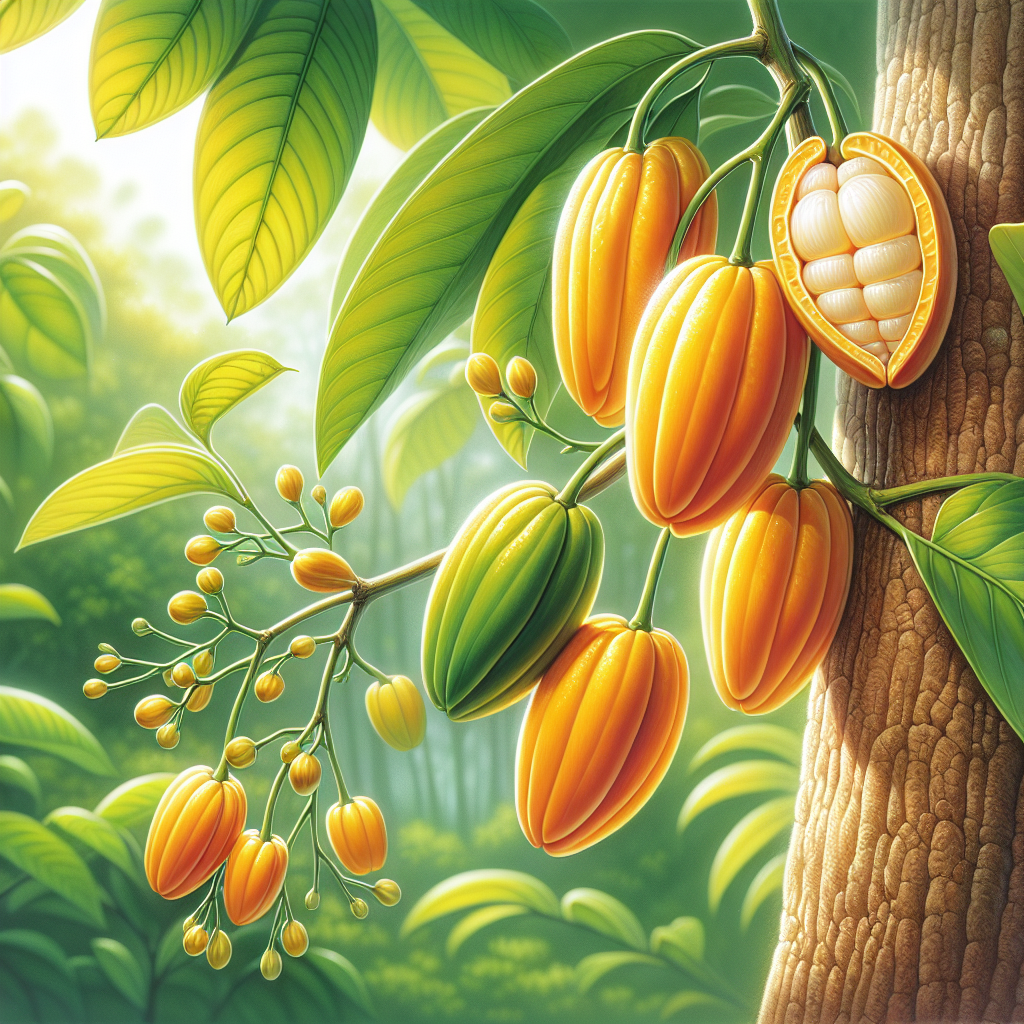
Introduction to Nam Nam (Cynometra cauliflora)
Nam Nam (Cynometra cauliflora), also known as Buni or Nam-nam, is an exotic tropical fruit tree celebrated for its distinctive cauliflorous habit—fruits emerge directly from the main trunk and older branches, creating a stunning visual display. Native to Malaysia, Indonesia, Thailand, and the Philippines, this underutilized crop produces small, yellow-orange pods filled with translucent, juicy arils that deliver a sweet-tart flavor reminiscent of a mix between lychee, rambutan, and green apple. The fruit's high water content (over 90%) makes it refreshing and ideal for fresh consumption, juices, salads, or desserts in Southeast Asian cuisines.
Growing Nam Nam offers small-scale farmers and home gardeners a profitable niche crop with low maintenance once established. Trees can bear fruit year-round in optimal conditions, yielding 50-100 kg per mature tree annually. Its resilience to humid tropics and tolerance for light shade positions it as a valuable addition to agroforestry systems, intercropping well with crops like banana or mango. As demand rises in international markets for unique tropical fruits, mastering Nam Nam cultivation can unlock premium pricing. For detailed propagation insights, see our comprehensive Soil Health Mastery guide.
Botanical Profile of Nam Nam (Cynometra cauliflora)
Cynometra cauliflora belongs to the Fabaceae family (Leguminosae subfamily Caesalpinioideae), a genus of about 150 species of tropical trees. It is an evergreen, slow-growing tree reaching 5-15 meters in height with a dense, rounded canopy up to 10 meters wide. The trunk is straight, often buttressed at maturity, with smooth gray-brown bark. Leaves are compound, pinnate, with 4-6 pairs of glossy, elliptical leaflets (5-10 cm long) that are dark green above and paler beneath.
The hallmark feature is cauliflory: small, white to yellowish flowers (1-2 cm) appear in dense racemes directly on the trunk and main branches from March to June, pollinated primarily by bees and other insects. Fruits develop 3-4 months later as oblong pods (3-6 cm long, 2-4 cm wide), turning from green to bright yellow-orange at maturity. Each pod contains 1-3 white, gelatinous arils surrounding a single hard seed, weighing 20-50 grams total. The aril is the edible portion, crisp and juicy with 12-18% sugars, vitamin C, and antioxidants.
Trees exhibit a taproot system with extensive lateral roots, aiding drought tolerance once established. Nam Nam is diploid (2n=32) and propagates true-to-type via seeds or grafting. In cultivation, it lives 50+ years, with peak productivity from years 5-20. Related to guava in flavor profile but structurally unique, its pods split open easily for eating.
Soil, pH, and Climate Requirements for Nam Nam (Cynometra cauliflora)
Nam Nam thrives in fertile, well-drained loamy soils rich in organic matter, with sandy loam or clay loam ideal (50-70% sand, 20-30% silt, 10-20% clay). Avoid heavy clays prone to waterlogging, as roots are susceptible to rot. Optimal soil pH is 5.5-7.0, slightly acidic to neutral; test and amend with lime if below 5.5 or sulfur if above 7.5. Incorporate 10-20 kg compost per planting hole for micronutrients like zinc and boron, crucial for flowering.
Climatically, it demands tropical lowlands (0-800m elevation) with average temperatures of 24-32°C; avoid below 15°C, which halts growth, or above 38°C prolonged, causing sunscald. Annual rainfall of 1500-2500 mm is perfect, evenly distributed, with high humidity (70-90%). It tolerates short dry spells (2-3 months) but benefits from irrigation during fruit set. USDA zones 10b-12; in subtropical areas, protect from frost. Full sun (6-8 hours daily) promotes vigorous growth, though 30% shade cloth aids young trees. Windbreaks are essential in exposed sites to prevent flower drop. Pair with coconut for wind protection in orchards.
Step-by-Step Planting & Propagation
Seed Propagation
- Collect ripe pods from healthy trees; extract seeds (viability 80-90% for 2-3 weeks).
- Clean and sow fresh in 50% sand:50% compost mix, 1 cm deep, 10x10 cm spacing.
- Germinate in 70-80% shade at 25-30°C; emerge in 10-20 days. Water lightly to keep moist.
- Transplant seedlings at 30-40 cm (3-4 months) to 20L pots.
Grafting (Preferred for Uniformity)
- Use cleft or veneer grafting on 1-2 year rootstock (success 70-85%).
- Scion from pencil-thick branches with 2-3 buds; graft in rainy season.
- Union in 3-4 weeks; plant at 4-6 months.
Planting
- Site prep: Dig 50x50x50 cm holes, fill with topsoil + 20 kg manure + 100g superphosphate.
- Space 8-10m apart (100 trees/ha); plant at same depth as nursery.
- Stake and mulch 10 cm thick (coconut husk ideal). Irrigate 20-30L/week first year.
- Prune lower branches year 1 for trunk form. Expect fruit in 3-5 years.
Care & Maintenance regimes for Nam Nam (Cynometra cauliflora)
Young trees need 50-100L water/week, reducing to 20-30L for matures; drip irrigation optimizes use. Fertilize 3-4 times/year: NPK 15-15-15 at 500g/tree year 1, increasing to 2-3 kg/tree mature (split applications). Foliar spray micronutrients (Zn, B, Mn) at bud break. Prune post-harvest: remove deadwood, watersprouts, and trunk suckers to enhance cauliflory and light penetration.
Weed circle 2m radius mechanically first 2 years; mulch suppresses later. Thin dense flower clusters to 10-20/panicle for larger fruits. Intercrop legumes like pigeon pea for nitrogen fixation. Monitor for nutrient deficiencies: yellow leaves indicate iron (pH check); small fruits signal potassium lack. Annual canopy volume pruning maintains 5-7m height for harvest access. In high-rain areas, elevate grafts above soil.
Pests, Diseases & Organic Management
Pests: Fruit flies and pod borers attack ripening pods; use yellow sticky traps and neem oil (2-3 ml/L weekly). Aphids cluster on new growth—blast with water or insecticidal soap. Scale insects on trunk: rub with alcohol-soaked cloth or introduce ladybugs. Monitor for mealybugs with pruning and beneficial insects.
Diseases: Anthracnose causes pod rot in wet weather—improve air flow, apply copper fungicide (preventive). Phytophthora root rot from poor drainage: use raised beds, solarize soil. Leaf spots (Alternaria): remove infected parts, mulch with Trichoderma.
Organic IPM: Companion plant marigold for nematodes; neem cake soil drench. For deeper pest strategies, explore Why 90% of Small Farms Fail at Pest Management. Biological controls like Bacillus thuringiensis for caterpillars yield 80-90% control.
Harvesting, Curing & Optimal Storage
Harvest when pods turn 80% yellow-orange (firm aril inside); twist or clip with secateurs to avoid trunk damage. Peak seasons May-August, October-December; yield 20-50 pods/tree year 3+, up to 200 mature. Pick every 3-5 days to catch optimal ripeness.
No curing needed; rinse gently. Store at 10-13°C, 85-90% RH for 3-4 weeks (shelf life 7-10 days room temp). For market, pack in ventilated crates; arils separate easily for processing into juice (yield 60-70%). Postharvest dips in 1% calcium chloride extend vase life.
Companion Planting for Nam Nam (Cynometra cauliflora)
Nam Nam pairs excellently in permaculture systems. Underplant with shade-tolerant ginger or turmeric for ground cover and soil enrichment. Nitrogen-fixers like clover or Gliricidia boost fertility. Repel pests with thyme or yarrow borders. Avoid water-hungry crops like sugarcane. Tall companions like durian provide windbreaks. For more, check Fall Companion Planting Guide. Benefits: 20-30% yield increase via microclimate moderation.