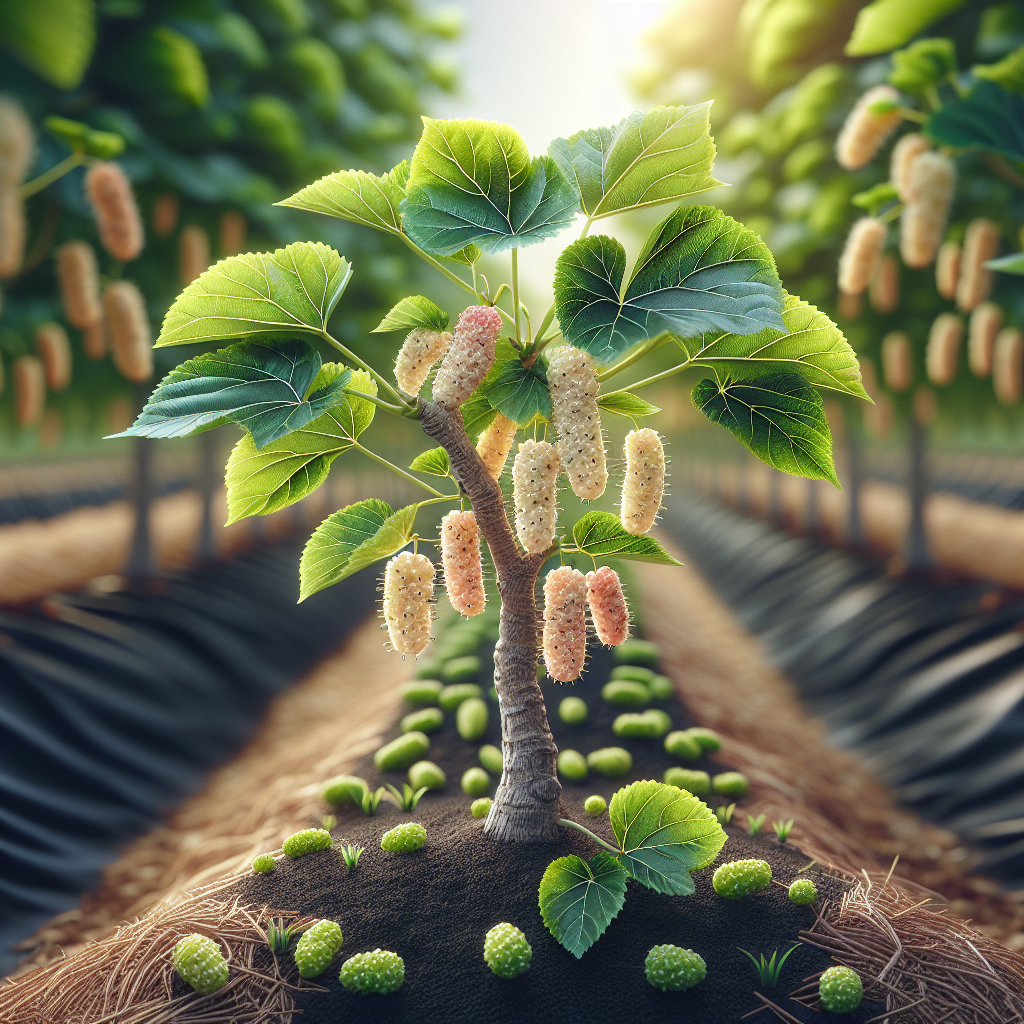
Introduction to Mulberry (White)
Native to China and widely naturalized across Asia, Europe, the Middle East, and North America, white mulberry is one of the most versatile tree crops in cultivation. It has been grown for centuries not only for its fruit but also for its leaves, which are the classical feedstock for silkworm production. In many regions it escaped orchards and became a durable roadside or hedgerow tree because of its tolerance to pruning, drought once established, urban pollution, and variable soils.
Despite the common name, the fruit is not always white. Depending on cultivar, ripened berries may be white, cream, pink, lavender, red, or nearly purple. The species is often confused with red and black mulberries, but white mulberry generally grows faster, tolerates more heat and alkaline soil, and frequently bears sweeter but sometimes milder fruit. If you already grow other tree fruits such as Fig, white mulberry will feel familiar in its forgiving nature, though it tends to establish even more aggressively.
From a production standpoint, this is an excellent low-input tree for mixed orchards, poultry runs, fodder systems, and regenerative plantings. However, its vigor can be a blessing and a management challenge. A definitive growing strategy must balance rapid canopy development with disciplined pruning, careful site placement, and attention to fruit drop, which can stain paths and attract birds.
For broader ecological planning around orchard understories and beneficial plant guilds, see this companion planting article.
Botanical Profile of Mulberry (White)
Morus alba is a deciduous tree in the family Moraceae. Mature height commonly ranges from 20 to 50 feet (6 to 15 m), though unmanaged specimens can grow larger under favorable conditions. Crown shape varies from upright and vase-like to rounded and spreading, depending on cultivar, pruning system, and age. Young shoots are often very vigorous, with long internodes and rapid seasonal extension.
Leaves are alternate, glossy to dull green, and highly variable in shape. On the same tree, especially on vigorous juvenile growth, leaves may be unlobed, mitten-shaped, or deeply lobed. This variability is a useful field characteristic. Leaf margins are serrated, and petioles exude milky latex when damaged. That latex is typical of the mulberry family and can sometimes irritate sensitive skin.
Flowers are usually small and inconspicuous, borne in catkin-like inflorescences. White mulberry can be dioecious, monoecious, or functionally polygamous depending on cultivar and seedling lineage. Many fruiting selections are self-fertile enough for reliable backyard production, but seedling populations can vary widely. For commercial or predictable orchard use, named cultivars are strongly preferable over random seedlings.
The fruit is technically a multiple fruit formed from a cluster of tiny flowers. Ripe berries are typically 1 to 3 cm long, though some improved cultivars bear larger fruit. Flavor ranges from very sweet and honeyed to bland-sweet, with lower acidity than black mulberry. Texture is delicate and shelf life short, making the crop excellent for fresh local use, drying, syrup, jam, and livestock feeding rather than long-distance shipping.
Notable horticultural classes include:
- Fruiting white mulberries selected for sweetness and larger berries.
- Weeping ornamentals, often grafted and grown more for form than crop.
- Leaf-production strains developed for sericulture.
- Dwarf or compact selections for smaller gardens.
The species breaks dormancy early in mild climates and can be susceptible to late spring frost on young shoots, although established trees usually recover quickly. Juvenile trees may fruit within 2 to 5 years from grafted stock, while seedlings often take longer and show greater variation in fruit quality.
Soil, pH, and Climate Requirements for Mulberry (White)
White mulberry is notably tolerant, but maximum fruit quality comes from thoughtful site selection. It performs best in deep, well-drained loam or sandy loam with moderate organic matter and good aeration. Ideal soil pH is roughly 6.2 to 7.5, though the tree tolerates a broader range from about 5.5 to 8.0 better than many fruit crops. It is one of the few fruiting trees that can remain productive in mildly alkaline soils where crops like blueberry would fail.
Drainage is far more important than fertility. The root system dislikes persistent saturation, especially during cool weather. If water remains in the planting hole more than 24 hours after heavy irrigation or rain, root stress becomes likely. Early symptoms of excessive moisture include yellowing lower leaves, soft rank growth, reduced shoot hardening, and eventual dieback of fine feeder roots. In heavy clay, planting on a broad mound 10 to 18 inches high is often better than digging a deep pit that becomes a sump.
For establishment, target evenly moist soil in the top 8 to 12 inches. In practical terms, soil should feel cool and lightly damp when squeezed, forming a weak ball that crumbles with a touch, not a sticky mass that smears. During the first two growing seasons, avoid cycles of bone-dry soil followed by flooding, as this can slow root expansion and increase fruit drop once the tree starts bearing.
Climatically, white mulberry is adaptable from cool temperate to warm subtropical regions. Most selections perform well in USDA zones 4 through 9, with some variation by cultivar. Chilling requirements are generally modest compared with many apples or stone fruits, but some winter rest still benefits regular budbreak and flowering. The tree tolerates summer heat very well and can withstand temperatures above 35°C (95°F) if roots are well established.
Key climate considerations:
- Full sun is best: 6 to 8+ hours daily for dense canopy and sweeter fruit.
- Wind tolerance is moderate to high, but exposed young trees may need staking for one season.
- Drought tolerance increases substantially after year two or three.
- Humid conditions are tolerated better than by black mulberry, though airflow still matters for disease prevention.
- Late frosts may damage new shoots but rarely kill mature trees.
Annual rainfall of 600 to 1200 mm is sufficient with supplemental irrigation in dry spells. In arid regions, deep watering spaced appropriately is more effective than frequent shallow irrigation. In high-rainfall climates, pruning for an open canopy is essential to reduce foliar disease pressure.
Step-by-Step Planting & Propagation
Choose a permanent site carefully. White mulberry can live for decades, develop a broad root zone, and cast dense shade. Keep it at least 20 feet from foundations, septic fields, paved patios prone to fruit staining, and delicate irrigation lines. Standard trees are commonly spaced 20 to 30 feet apart; intensive plantings with annual pruning can be set at 12 to 15 feet.
Planting steps:
- Test drainage by filling a 12- to 18-inch-deep hole with water. If it drains within a day, the site is usually acceptable.
- Remove perennial weeds in a circle at least 3 to 4 feet wide.
- Dig a hole two to three times the width of the root ball but no deeper than the root flare height.
- Set the tree so the root flare sits slightly above finished soil grade, especially in heavier soils.
- Backfill with native soil rather than a highly amended pocket. Over-amending can discourage roots from moving outward.
- Water thoroughly to settle the soil and eliminate air pockets.
- Apply 2 to 4 inches of mulch, keeping it 3 to 6 inches away from the trunk.
For bare-root trees, plant during dormancy in late winter to early spring. Soak roots for 2 to 4 hours before planting, but do not leave them submerged for a full day. Prune broken roots cleanly and head back the top if root loss is significant.
Propagation options:
- Seed: easy but highly variable; not recommended for true-to-type fruit production.
- Hardwood cuttings: feasible in late winter from pencil-thick dormant wood, 8 to 12 inches long, treated with rooting hormone and placed in a well-drained propagation bed.
- Softwood cuttings: often root faster under mist, but require closer humidity control.
- Grafting or budding: best method for preserving named cultivars.
- Layering: useful on low branches or weeping forms.
Seed propagation is mainly useful for rootstocks, shelterbelt plantings, or breeding. For fruit quality consistency, use grafted or cutting-grown material from a proven cultivar.
Training at planting depends on intended use. For orchard fruiting, establish a short trunk and 3 to 5 scaffold limbs beginning 30 to 40 inches above ground. For shade or poultry systems, a higher canopy may be preferable. Mulberries fruit heavily on new season growth arising from older wood, so they respond well to training systems that renew fruiting shoots annually.
Care & Maintenance regimes for Mulberry (White)
The first three years determine long-term structure and productivity. During establishment, provide deep irrigation rather than frequent light watering. A young tree in average loam often needs about 5 to 10 gallons once or twice weekly in mild weather, increasing during heat or sandy conditions. The goal is moisture penetration to 12 to 18 inches deep. If the soil at 4 inches is still wet and cool three days after watering, delay the next irrigation; chronic overwatering suppresses oxygen and promotes root decline.
Once established, mature trees may only need supplemental water every 10 to 21 days in dry weather, depending on soil type and crop load. Drought-stressed trees often show dull, slightly folded leaves and premature fruit shrivel. Overwatered trees more commonly produce excessively lush shoots, pale foliage, and lower sugar concentration in the fruit.
Fertilization should be restrained. White mulberry often grows vigorously without heavy feeding. Excess nitrogen produces long, weak shoots and can reduce fruit quality. In average garden soils, an annual spring top-dressing of compost plus a modest balanced organic fertilizer is sufficient. As a broad guideline, young trees may receive 0.1 to 0.2 lb actual nitrogen per year of age, up to a modest mature maximum, adjusted downward if shoot growth exceeds 18 to 24 inches annually.
Useful fertility cues:
- Pale leaves and weak annual extension may indicate nitrogen deficiency.
- Marginal scorch or poor drought tolerance can indicate potassium shortage in sandy soils.
- Excessively dark, lush growth with little fruiting usually means too much nitrogen.
Pruning is central to professional management. Dormant pruning shapes the framework, while summer pruning controls excessive vigor. Remove crossing limbs, root suckers, inward-growing shoots, and low branches interfering with harvest or mowing. Thin rather than shear whenever possible. Mulberries bleed latex when cut during active growth, but this is usually not harmful.
A practical annual regimen:
- Late winter: structural pruning, deadwood removal, height control.
- Late spring to early summer: light tipping of overly vigorous water sprouts.
- Post-harvest: sanitation pruning if needed.
Because fruit is borne on young shoots, many growers maintain trees at 8 to 12 feet for easy picking. Pollarding or hard annual heading can work where leaf harvest is prioritized, but it may reduce graceful structure and create large pruning wounds if done carelessly.
Mulch management matters. Keep a weed-free circle under the canopy, especially during establishment, because grass competition can reduce growth dramatically. Organic mulches such as wood chips moderate soil temperature and improve moisture retention, but avoid piling them against the trunk to prevent crown rot and rodent damage.
Pests, Diseases & Organic Management
White mulberry is relatively resilient, but no tree is trouble-free. Bird feeding is often the most noticeable "pest" issue as fruit ripens. Netting is difficult on larger trees, so size control through pruning is the main practical defense.
Common insect pests include:
- Scale insects: appear as small bumps on twigs and may cause sticky honeydew.
- Spider mites: more common in hot, dusty conditions; leaves show stippling or bronzing.
- Whiteflies and Aphids: usually minor but can build on lush growth.
- Borers: attack stressed or wounded trees.
- Mealybugs: occasional in sheltered or greenhouse-adjacent environments.
Organic management starts with vigor balance. Avoid excessive nitrogen, reduce dust, and maintain predator habitat. Dormant oil sprays can suppress scale and overwintering pest stages. In active season, insecticidal soap or horticultural oil can help on soft-bodied insects if coverage is thorough and temperatures are not excessively high.
Potential diseases include:
- Powdery mildew in humid, shaded canopies.
- Leaf spot diseases, especially where air circulation is poor.
- Canker on wounded branches.
- Root rot in waterlogged soils.
- Bacterial blight in some climates, usually associated with splash dispersal and stress.
Prevention is more effective than cure:
- Plant in full sun.
- Prune for airflow.
- Irrigate at soil level rather than overhead.
- Remove fallen diseased leaves where pressure is significant.
- Disinfect pruning tools when cutting Cankered tissue.
Fruit rots are usually minor because berries ripen and fall quickly, but prolonged wet weather can reduce marketable quality. Harvest frequently during peak season to avoid buildup of overripe fruit that attracts insects.
Wildlife considerations are important. Raccoons, possums, and rodents may feed on dropped berries. Sanitation, prompt collection, and managed groundcover reduce attraction. Poultry can be integrated under mature trees to consume fallen fruit and insects, though trunk guards may be needed around young trees.
Harvesting, Curing & Optimal Storage
Fruiting time varies by climate and cultivar but usually occurs from late spring into early summer, sometimes over several weeks rather than all at once. Berries are ready when fully colored for the cultivar, soft, sweet, and detach easily with a gentle tug. Immature fruit is firmer, less aromatic, and lower in sugars.
Because mulberries bruise easily, the best harvest method for quantity is often to spread a clean sheet or tarp beneath the canopy and gently shake branches or tap fruiting limbs. For fresh market or premium home use, hand-picking into shallow containers preserves quality better. Harvest in the cool morning once dew has dried.
Expected yields vary widely with age, pruning style, and cultivar, but mature trees can produce heavy crops. Smaller managed trees may yield 10 to 30 kg or more, while large old specimens can far exceed that. Fruit drop is natural at peak ripeness, so daily or near-daily harvest may be needed.
There is no true curing phase as with onions or garlic. Instead, rapid cooling is essential. Mulberries are highly perishable and often keep only 1 to 3 days at room temperature. Under refrigeration at 0 to 2°C (32 to 36°F) and high relative humidity, they may hold 3 to 7 days, though flavor is best when used quickly. Do not wash until just before use unless processing immediately; surface moisture accelerates breakdown.
For longer preservation:
- Freeze berries in a single layer, then bag once solid.
- Dry at low temperatures until leathery for snacks or tea blends.
- Process into jam, syrup, wine, vinegar, or molasses-like reductions.
- Dehydrate leaves separately for herbal or fodder use if appropriate to your production system.
Handle fruit gently and use shallow trays no more than a few berries deep if appearance matters. Berries intended for juice or preserves can be slightly softer, but discard any with sour odor, leakage, or visible mold.
Companion Planting for Mulberry (White)
Because white mulberry forms a substantial canopy and can cast dense shade, companion planting works best as a guild approach rather than crowding annual vegetables right against the trunk. The most effective companions either improve soil, attract beneficial insects, or tolerate dappled light and intermittent root competition.
A strong understory combination includes Clover, Thyme, Yarrow, and Nasturtium. Clover acts as a living mulch and nitrogen-contributing groundcover, especially useful in young orchards with wide spacing. Thyme suppresses weeds near the dripline, tolerates some dryness once established, and attracts pollinators when flowering. Yarrow is excellent for beneficial insects and may improve overall orchard biodiversity. Nasturtium can function as a trap crop for Aphids and also provides edible flowers and foliage.
Best placement strategy:
- Keep a 12- to 18-inch trunk-clear zone free of dense plants and mulch contact.
- Use low-growing companions near the outer half of the young tree's root zone.
- Avoid highly competitive tall grasses directly under the canopy.
- Rotate any annual companions farther from the trunk as the tree matures and shade increases.
Avoid planting heavy feeders or thirsty annuals directly beneath mature mulberries unless irrigation is adjusted accordingly. Also avoid crops that need full, uninterrupted sun close to the canopy edge where shading will intensify over time. In mixed agroforestry, white mulberry works well as an upper-story support tree with managed spacing, especially when summer pruning keeps light penetration adequate.
When designed thoughtfully, companion planting around white mulberry reduces erosion, stabilizes moisture, increases beneficial insect activity, and improves harvest conditions by keeping the orchard floor cleaner and less muddy during fruit drop.