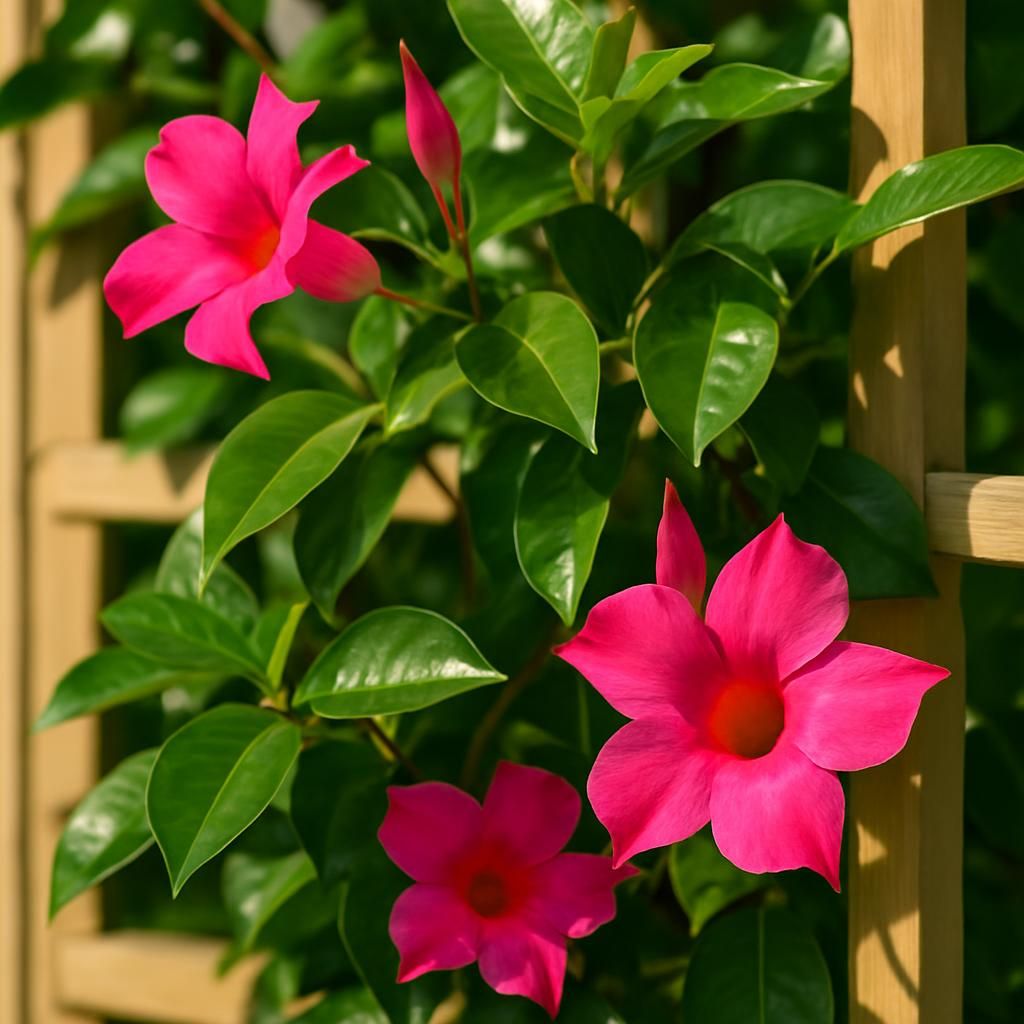
Introduction to Mandevilla
Mandevilla is a vigorous, woody-stemmed tropical vine belonging to the Apocynaceae family. It is widely cultivated for its large, funnel-shaped flowers that appear in shades of pink, red, white, and yellow throughout the warm season. Gardeners value Mandevilla for its ability to cover trellises, arbors, and fences rapidly while attracting pollinators such as hummingbirds and butterflies. In frost-free regions it behaves as a perennial; elsewhere it is grown as a container plant that can be overwintered indoors.
Successful Mandevilla culture depends on providing bright light, consistent warmth, and well-drained yet moisture-retentive soil. The plant rewards attentive care with continuous blooms from late spring until the first cool nights of autumn. Commercial growers and home gardeners alike appreciate its relatively low maintenance once established, provided basic cultural requirements are met.
This guide delivers professional-grade, practical advice drawn from decades of field experience and university research. Whether you are planting your first vine or scaling production, the following sections outline every step from propagation through harvest and storage of cuttings or potted specimens.
Botanical Profile of Mandevilla
Mandevilla comprises approximately 120 species native to Central and South America. Most cultivated forms derive from Mandevilla splendens and Mandevilla boliviensis or their hybrids. The plants produce opposite, leathery leaves that are typically ovate to elliptic and 3–8 cm long. Stems are twining and can reach 3–6 m in a single season when supported.
Flowers are borne in racemes at the terminals of new growth. Each bloom measures 5–10 cm across with five fused petals forming a long corolla tube. The fruit is a slender follicle containing numerous wind-dispersed seeds with silky tufts. Although the plant is evergreen in its native range, cooler temperatures induce leaf drop in temperate climates.
Soil, pH, and Climate Requirements for Mandevilla
Mandevilla thrives in fertile, well-aerated substrates that retain moisture without becoming waterlogged. A slightly acidic to neutral pH supports optimal nutrient uptake. Temperature is the primary limiting factor; the species is frost-tender and performs best when night temperatures remain above 15 °C.
| Parameter | Ideal Range | Notes |
|---|---|---|
| Soil Type | Sandy loam to loam | High organic matter improves drainage |
| Soil pH | 6.0–7.0 | Avoid alkaline conditions causing chlorosis |
| Temperature (Day) | 21–29 °C | Consistent warmth promotes flowering |
| Temperature (Night) | 15–21 °C | Below 10 °C slows growth and may defoliate |
| USDA Zones | 9–11 (or containers) | Protect or overwinter below zone 9 |
| Light | Full sun to partial shade | Minimum 6 hours direct sun for maximum bloom |
| Humidity | 50–70 % | Higher humidity reduces spider mite pressure |
Step-by-Step Planting & Propagation
- Choose healthy 10–15 cm tip cuttings from vigorous, non-flowering shoots in late spring or early summer.
- Remove lower leaves, dip the basal 2 cm in rooting hormone powder, and insert into a sterile mix of 50 % perlite and 50 % peat or coco coir.
- Maintain bottom heat at 24 °C and high humidity under a clear dome or plastic bag; roots form in 3–5 weeks.
- Once roots reach 5 cm, transplant into 15 cm pots using a well-draining potting mix amended with 20 % pine bark.
- Harden off young plants for 7–10 days before moving outdoors or into final containers.
- Provide a sturdy trellis or obelisk at planting; tie stems loosely with soft ties to encourage upward growth.
- Space landscape plantings 45–60 cm apart to allow air circulation and future spread.
Care & Maintenance regimes for Mandevilla
Consistent irrigation, balanced nutrition, and strategic pruning are essential for continuous flowering and plant health. The table below summarizes recommended schedules for container and in-ground specimens.
| Task | Frequency | Details |
|---|---|---|
| Watering | Every 3–4 days in summer; weekly in winter | Keep soil evenly moist; allow top 2 cm to dry between waterings |
| Fertilizer | Every 2 weeks (spring–autumn) | 10-10-10 or 15-15-15 liquid fertilizer at half strength; switch to high-phosphorus bloom formula after first flowers |
| Pruning | Early spring and after each flush | Cut back to 2–3 buds above previous season’s growth; remove dead wood and crossing stems |
Mulch container surfaces with 2 cm of fine bark to moderate soil temperature and reduce evaporation. Repot every 2–3 years or when roots circle the container; use a pot only one size larger to avoid excess moisture.
Pests, Diseases & Organic Management
Common pests include Aphids, Spider Mites, Mealybugs, and Whiteflies. Regular inspection of leaf undersides allows early detection. A strong jet of water dislodges many soft-bodied insects; follow with insecticidal soap or neem oil applied weekly for 3–4 weeks. Scale insects are best removed manually or treated with horticultural oil during dormant periods.
Root rot caused by Pythium or Phytophthora occurs in poorly drained media. Improve drainage, avoid overwatering, and drench with beneficial Trichoderma or Bacillus subtilis products. Powdery mildew may appear in cool, humid conditions; increase spacing and airflow, and apply potassium bicarbonate sprays as needed.
Harvesting, Curing & Optimal Storage
Mandevilla is not harvested for edible fruit; instead, growers harvest cuttings or entire potted plants for sale or overwintering. Take semi-ripe cuttings 10–15 cm long in the morning when turgor is highest. Place immediately in water or moist media; roots develop within three weeks under 24 °C bottom heat. For overwintering, reduce water and fertilizer in autumn, move plants to a bright indoor location at 10–15 °C, and prune to 30–40 cm height. Resume normal care when new growth appears in spring.
Companion Planting for Mandevilla
Mandevilla pairs well with other heat-loving vines and flowering annuals that share similar cultural needs. Nasturtium planted at the base deters aphids while providing edible flowers. Marigold and Thyme repel whiteflies and add pollinator diversity. Avoid planting near heavy feeders such as Corn or Tomato that may compete for nutrients and water. Vertical layering with Clematis or Passionflower creates attractive mixed displays on shared supports.
For further reading on integrated pest management strategies, see My 5 Biggest Failures with Spring Pest Patrol.