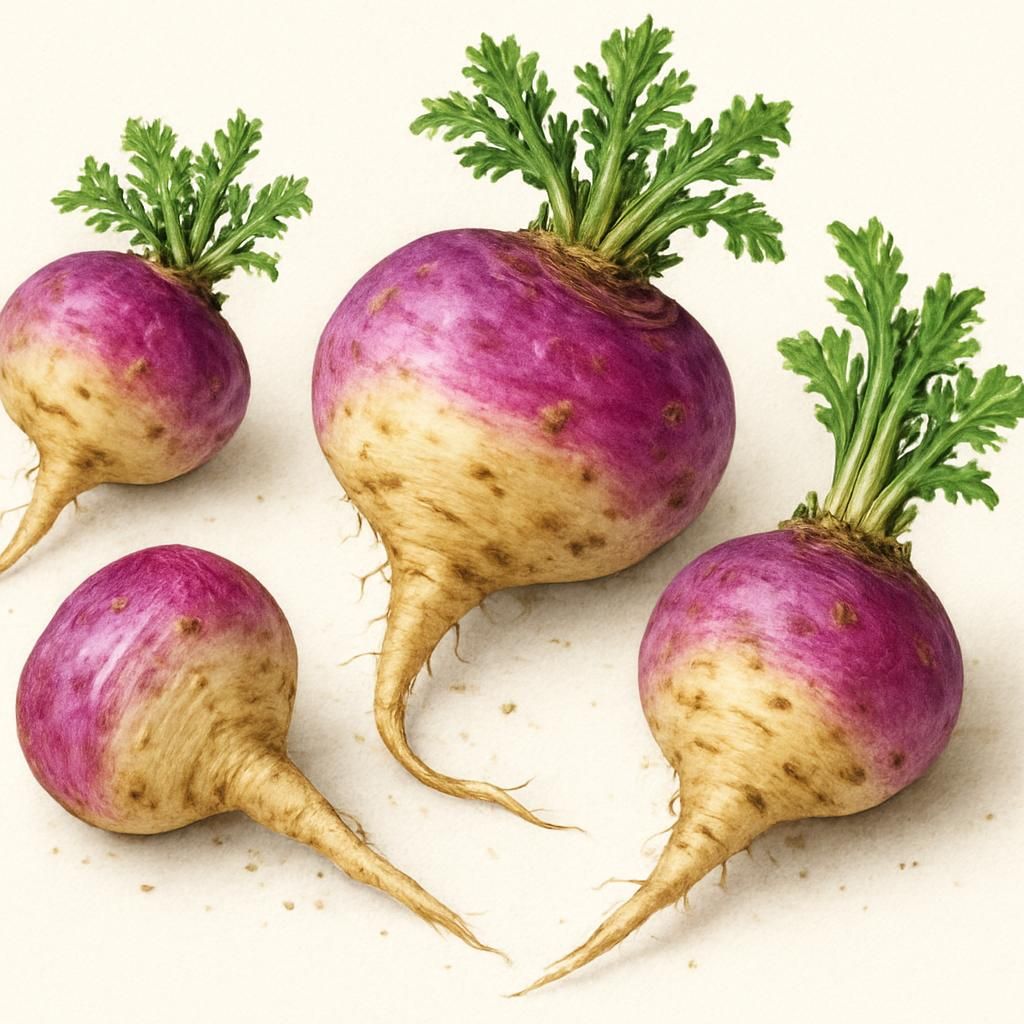
Introduction to Maca
Maca (Lepidium meyenii) is a resilient biennial root vegetable native to the high plateaus of the Peruvian and Bolivian Andes. Grown for its hypocotyl, the plant thrives above 3,800 meters where few other crops survive. Farmers value maca for its dense nutrient profile—rich in carbohydrates, amino acids, and unique macamides—making it a staple in traditional Andean diets and an increasingly important export crop worldwide.
Commercial cultivation remains concentrated in Peru’s Junín and Pasco regions, yet interest is expanding into other high-elevation zones with similar cool climates. Because maca requires a long growing cycle and specific environmental cues, success depends on precise site selection, soil management, and patience through two full seasons.
Botanical Profile of Maca
Maca belongs to the Brassicaceae family, sharing lineage with radish and turnip. Plants form a basal rosette of pinnately lobed leaves 10–20 cm long during the first year. The edible portion is the swollen hypocotyl, which develops underground and ranges in color from cream to purple or black depending on variety. Flowers appear in the second season as small, four-petaled white or cream racemes on stalks reaching 30–50 cm. Seeds are tiny, reddish-brown, and produced in siliques.
Soil, pH, and Climate Requirements for Maca
Maca demands well-drained, sandy-loam soils rich in organic matter yet low in nitrogen. The crop performs best on slopes with good air drainage to prevent frost pockets. High ultraviolet radiation at altitude stimulates secondary metabolite production; growers at lower elevations must replicate these stresses through careful cultivar selection and spacing.
| Parameter | Ideal Range | Notes |
|---|---|---|
| Soil Type | Sandy loam to loamy sand | Avoid heavy clays; incorporate sand if needed |
| Soil pH | 6.0–6.8 | Slightly acidic to neutral |
| Organic Matter | 3–5 % | Well-rotted compost or aged manure |
| Elevation | 3,800–4,500 m | 2,500 m minimum with supplemental cooling |
| Temperature (day) | 12–18 °C | Cooler nights essential |
| Temperature (night) | 0–7 °C | Frost tolerance improves with acclimation |
| Annual Rainfall | 400–700 mm | Supplemental irrigation in dry periods |
| Frost-Free Period | 120–150 days | Full cycle spans 7–9 months |
Step-by-Step Planting & Propagation
- Site Preparation: Till soil to 25 cm depth, remove stones, and incorporate 4–6 kg/m² of well-aged compost. Create raised beds 20 cm high for drainage.
- Seed Treatment: Soak seeds in 1 % hydrogen peroxide solution for 12 hours to improve germination. Stratify at 4 °C for 7–10 days if sowing at lower elevations.
- Sowing Window: Plant in early spring when soil reaches 8 °C. In the Andes this coincides with September–October.
- Seeding Rate & Depth: Broadcast at 8–12 g/m² or drill in rows 30 cm apart, 0.5 cm deep. Lightly cover with fine soil and firm the surface.
- Germination: Expect 60–75 % emergence in 10–18 days under consistent moisture and 10–15 °C soil temperature.
- Thinning: When seedlings reach 5 cm, thin to 10–15 cm in-row spacing, leaving the strongest plants.
Care & Maintenance regimes for Maca
Maca requires minimal intervention once established, but precise timing of water, fertility, and weed control determines root size and quality.
| Task | Schedule | Rate / Method |
|---|---|---|
| Irrigation | Weeks 1–8 after sowing | 10–15 mm every 4–5 days; keep top 5 cm moist |
| Irrigation | Weeks 9–20 | 15–20 mm every 7–10 days; reduce before harvest |
| Fertilizer (N-P-K) | Pre-plant | 40-60-80 kg/ha; 2:3:4 ratio |
| Fertilizer (N-P-K) | Side-dress at 60 days | 20 kg N/ha only if leaf color is pale |
| Weeding | Weeks 3, 6, 10 | Hand or shallow hoe; avoid root disturbance |
| Mulch | After thinning | 5 cm straw or pine needles to moderate temperature |
| Pruning | None required | Remove only diseased leaves |
Pests, Diseases & Organic Management
Maca faces relatively few specialist pests due to its remote native range, yet several cosmopolitan threats can appear.
- Aphids (Aphids): Monitor undersides of leaves; release lady beetles or apply insecticidal soap at first sign.
- Flea beetles (flea beetles): Use floating row covers during early growth; interplant with Thai Basil to deter adults.
- Root-knot nematodes (root-knot nematodes): Rotate with garlic or onion for two seasons; solarize beds between crops.
- Powdery mildew (powdery mildew): Improve airflow; apply potassium bicarbonate sprays at 7–10 day intervals if humidity exceeds 70 %.
- Clubroot (clubroot): Maintain pH above 6.8 and avoid brassica residues for five years.
Harvesting, Curing & Optimal Storage
Harvest occurs 7–9 months after sowing when leaves begin to yellow and day length shortens. Loosen soil carefully with a fork to avoid damaging the hypocotyl. Gently wash roots in cool water, then air-dry in shade for 3–5 days until surface moisture evaporates. Traditional Andean curing involves sun-drying on stone terraces for 10–15 days, concentrating flavor and extending shelf life to 2–3 years. Store cured roots in breathable burlap sacks at 5–10 °C and 60–70 % RH. For fresh market, refrigerate unwashed roots at 2–4 °C for up to 4 weeks.
Companion Planting for Maca
Maca benefits from strategic pairings that improve soil health and deter pests. Interplant with nitrogen-fixing clover to supply modest nitrogen without excess vegetative growth. Aromatic thyme and yarrow mask the scent of maca foliage from flea beetles. Avoid planting near other brassicas to reduce shared disease pressure. After harvest, follow maca with quinoa or amaranth to break pest cycles and restore soil structure.