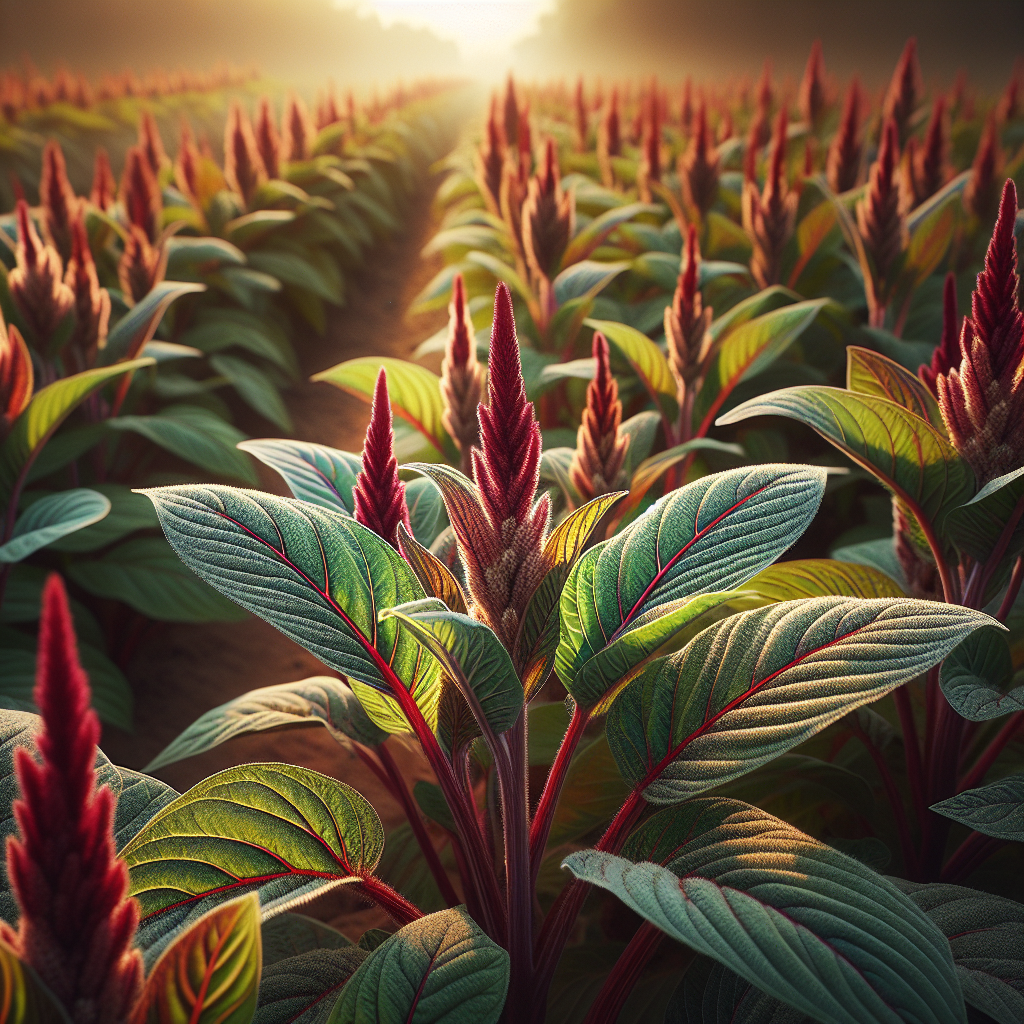
Introduction to Amaranth
Amaranth is one of the most versatile crops a grower can put into a garden or field. Depending on species and management, it can be harvested as a tender leafy green, a high-protein grain, an ornamental with dramatic seed plumes, or a dual-purpose crop that provides both leaves and seed. Its long history stretches from ancient Mesoamerican agriculture to modern regenerative systems, where it is valued for drought tolerance, rapid growth, and dependable production under heat that stresses many common vegetables.
The name “amaranth” covers multiple species within the genus Amaranthus. Some are primarily grain types, especially Amaranthus cruentus, A. hypochondriacus, and A. caudatus, while others are cultivated mainly for leaves, such as A. tricolor and A. dubius. In many regions, edible amaranth greens are harvested continuously as “callaloo,” Chinese spinach, or simply amaranth leaves. Grain amaranth is technically a pseudo-cereal rather than a true cereal grass, more closely comparable in culinary use to quinoa than to wheat or rice.
For production planning, it is essential to decide early whether the crop will be managed for baby greens, mature leaves, seed heads, or a combination. Leaf production favors closer spacing, frequent cutting, and moderate nitrogen. Grain production requires wider spacing, more uniform stands, and avoiding excessive nitrogen late in the season, which can encourage lush foliage at the expense of seed fill. Where mixed goals are pursued, growers should be realistic: heavy leaf harvesting early can reduce eventual grain yield.
Amaranth is especially useful where summers are hot, rainfall is erratic, or soil fertility is moderate rather than ideal. Once established, it tolerates short dry spells better than shallow-rooted leafy crops, yet it performs best with steady moisture during germination and early vegetative growth. It can also fit into small-scale diversified systems; for broader intercropping ideas, see this companion planting guide.
Botanical Profile of Amaranth
The genus Amaranthus belongs to the family Amaranthaceae. Plants are typically annuals with upright stems, alternate leaves, and dense terminal or axillary inflorescences. Growth habit varies widely by species and cultivar. Leaf amaranths may remain compact and bushy at 30 to 90 cm tall, while grain types commonly reach 1.2 to 2.5 m under favorable conditions. Some ornamental-grain dual-purpose forms can exceed that in fertile soils with ample moisture.
Leaves may be green, bronze, burgundy, or variegated with red, purple, and gold. This pigmentation is partly genetic and partly influenced by light intensity and temperature. The edible leaves are rich in vitamins A, C, and K, calcium, iron, and antioxidants, though nutrient levels vary by stage and soil fertility. Tender young leaves are usually preferred because mature leaves can become fibrous, especially in hot, dry conditions.
Flowers are small and inconspicuous individually, but they form dense spikes, tassels, or drooping ropes depending on the cultivar. Most cultivated amaranths are largely self-pollinating, though some cross-pollination can occur via wind and insects, especially when multiple species or cultivars flower together. This matters for seed saving: to maintain a distinct strain, isolate flowering plants if possible.
The seed is tiny, lens-shaped, and usually cream, gold, pink, red, or black depending on type. Pale seed is often associated with grain cultivars selected for food use, while darker seeds are common in wild or ornamental forms. Seed size is small enough that shallow, precise sowing is critical. A common reason for poor emergence is burying seed too deeply or allowing the soil surface to crust after irrigation or rain.
Roots are relatively efficient and can exploit warm soils quickly, but seedlings are delicate in the first two to three weeks. During this stage, amaranth competes poorly with aggressive weeds despite becoming highly competitive once it reaches 15 to 20 cm tall. Growers who mistake mature vigor for seedling vigor often lose stand quality early.
Soil, pH, and Climate Requirements for Amaranth
Amaranth performs best in loose, well-drained, moderately fertile soils with good tilth. Ideal soil textures are sandy loam to silt loam, though the crop can succeed in clay loams if drainage is adequate and the seedbed is carefully prepared. Heavy, compacted soils are risky because the tiny seed requires close contact with fine surface particles but also enough aeration to avoid Damping-off and crusting. A stale seedbed followed by light raking before sowing often improves establishment significantly.
The preferred soil pH is generally 6.0 to 7.5. It tolerates slightly more acidic or alkaline conditions than many leafy crops, but nutrient balance deteriorates outside this range. Below pH 5.8, calcium and magnesium may be less available and root growth can slow. Above pH 7.8, iron and manganese deficiency may appear as interveinal chlorosis on younger leaves, especially in calcareous soils. If soil tests indicate pH problems, correct them before planting rather than trying to force performance with fertilizers alone.
For fertility, target moderate nitrogen with adequate phosphorus and potassium. Excessive nitrogen, especially from fast-release sources, can create succulent growth that is attractive to Aphids, more prone to lodging, and sometimes higher in nitrate accumulation in leaves under low light or drought stress. As a practical field guideline, soils intended for leaf production should contain enough available nitrogen for steady vegetative growth, but not so much that stems become watery and brittle. Compost that is fully matured and incorporated at 2 to 5 kg per square meter, or its field equivalent, often gives excellent structure and slow nutrient release.
Temperature is one of amaranth’s major strengths. Germination is best when soil temperatures are roughly 20 to 30°C. Seed may sprout at slightly lower temperatures, but emergence is slower and less uniform. Frost can kill seedlings outright, and cool spells below about 10 to 12°C can stunt growth and intensify purpling or stress discoloration. Once established, most cultivars thrive in daytime temperatures from 25 to 35°C.
Although considered drought tolerant, amaranth is not drought indifferent. It yields best when moisture is consistent during germination, early leaf expansion, and flowering to seed fill. A useful soil moisture target is to keep the top 5 to 8 cm evenly moist during emergence, then maintain moisture in the active root zone at approximately 60 to 80% of field capacity during vegetative growth. In practical terms, the soil should feel cool and slightly damp below the surface, not sticky, sour-smelling, or waterlogged. If squeezed soil forms a slick ribbon and roots smell anaerobic, watering is excessive. If leaves lose midday turgor and fail to recover by evening, the crop is under significant moisture stress.
Amaranth prefers full sun. Leaf types can tolerate slight afternoon shade in very hot climates, but grain production depends on strong light interception. Shaded stands become lanky, slower to dry after rain, and more vulnerable to foliar disease.
Step-by-Step Planting & Propagation
Propagation is almost always by seed. Direct sowing is the standard method because the seed germinates quickly in warm soils and the plants resent root disturbance when transplanted too late. However, transplants can be useful for early production in cooler temperate climates or for establishing uniform spacing in small plots.
Start with a finely prepared seedbed free of clods, crusting risk, and living weeds. Because the seed is so small, surface roughness that seems minor for beans or corn can be disastrous for amaranth. Remove perennial weed roots, rake level, and lightly firm the bed so seed does not sink unevenly after irrigation.
Sow only after danger of frost has passed and the soil is genuinely warm. For direct seeding, place seed on the surface or cover no more than 3 to 6 mm deep. A very light layer of screened compost, sand, or fine soil is enough. Deeper sowing sharply reduces emergence. Rows for baby greens can be 15 to 25 cm apart; for leaf production, 25 to 45 cm; for grain production, 45 to 75 cm depending on machinery, cultivar height, and rainfall.
Broadcasting is possible for greens, but row sowing is easier for cultivation and airflow. Mix seed with fine sand or dry compost to improve distribution. After sowing, irrigate gently with a fine rose or low-pressure overhead mist so seed is not displaced.
Germination usually occurs in 3 to 10 days under warm conditions. Thin seedlings when they have their first true leaves. Final spacing depends on purpose:
- Baby leaf: 2 to 5 cm apart, often harvested before significant thinning is needed.
- Bunching greens: 10 to 20 cm apart.
- Large leaf plants: 20 to 30 cm apart.
- Grain types: 30 to 45 cm apart in-row for large panicles and reduced lodging.
If transplanting, sow into modules 3 to 4 weeks before field setting. Transplant while plants are still small, ideally with 2 to 4 true leaves. Harden them gradually for 5 to 7 days. Plant at the same depth they grew in trays; burying stems too deeply can encourage rot in cool soils.
Succession sow every 2 to 3 weeks for continuous leaf harvest. In tropical and subtropical areas, multiple plantings across the warm season are possible, provided disease and pest pressure are monitored. For grain, one main sowing timed to avoid harvest during peak rainfall is usually best.
Care & Maintenance regimes for Amaranth
Early weed control is the most important maintenance task in the first month. Seedlings are small and easily overshadowed. Use shallow hoeing or finger weeding when weeds are at thread stage. Cultivate carefully because amaranth roots near the surface are easily damaged. Once plants reach knee height or can shade the row, their weed suppression improves dramatically.
Water management should change with growth stage. During germination and the first 10 to 14 days, irrigate lightly and often enough to prevent the seed zone from drying out. This may mean daily light watering in sandy soils or every 2 to 3 days in loams, depending on weather. After establishment, shift to deeper, less frequent irrigation to encourage root exploration. A typical target is 25 to 40 mm of water per week for leafy production under warm conditions, rising in very sandy soils or extreme heat. Grain crops may tolerate slightly drier intervals after canopy establishment, but moisture stress during flowering and seed fill can reduce yield and seed size.
Look for overwatering symptoms: yellowing lower leaves despite wet soil, slow growth, edema-like blistering on leaves, stem softness near the base, and persistent fungus gnats or algal growth around the plants. In poorly drained beds, plants may wilt even when the soil is wet because roots are oxygen-starved. Underwatering shows as dull leaf color, leaf edge crisping, delayed regrowth after cutting, and early bolting in leaf types.
Feeding depends on harvest goal. For leafy amaranth, a modest side-dressing of nitrogen 2 to 3 weeks after emergence can stimulate vigorous regrowth after the first cut. Organic options include diluted fish emulsion, compost tea from mature compost, or a light band of poultry-manure-based fertilizer used conservatively. For grain amaranth, feed early, then avoid heavy nitrogen once panicle initiation begins. Too much late fertility increases lodging and delays maturity.
Mulching helps stabilize soil moisture, reduce splashing of disease spores, and suppress weeds. Use a thin mulch only after seedlings are established; applying coarse mulch too early can smother tiny plants. In hotter regions, straw or shredded leaf mulch can moderate root-zone temperatures and reduce irrigation frequency.
For leaf harvest systems, pinch or cut plants at 20 to 30 cm to encourage branching. Repeated cutting works best when at least 10 to 15 cm of stem and several healthy leaves remain for regrowth. For grain systems, avoid topping or repeated leaf stripping because the terminal inflorescence drives seed yield.
Tall grain cultivars may require support in windy sites or very fertile soil. Lodging risk increases when plants are crowded, overfertilized, or exposed to storm irrigation. Keep row orientation aligned with prevailing winds when possible and avoid excessive overhead watering late in the day.
Pests, Diseases & Organic Management
Amaranth is relatively resilient, but no crop is immune. The main pest profile varies with whether the crop is grown for leaves or grain. Leaf crops suffer more from chewing and sap-feeding insects because cosmetic damage affects marketability.
Aphids can cluster on tender growth and flower stalks, causing curling, sticky honeydew, and sooty mold. They are often worst in lush, overfertilized stands. Control them by encouraging beneficial insects, avoiding excessive nitrogen, and using insecticidal soap with full coverage on leaf undersides. Spray early in the day and test a small area first, especially on tender red-leaved cultivars.
Flea beetles may perforate seedlings, producing many tiny holes. Damage is most serious during emergence. Floating row cover during the first few weeks is highly effective if edges are sealed well. Once plants are larger, they usually outgrow moderate feeding.
Leaf miners, Beet armyworms, and other Caterpillars can also attack foliage. Hand removal works in small plots. Bacillus thuringiensis products are effective on young Caterpillars when applied at the correct stage and repeated after heavy rain.
In grain systems, Birds can become a major issue as seed heads ripen. Netting, reflective tape, and synchronized planting over a larger block can reduce losses. Small isolated plantings are often the most heavily attacked because panicles stand out as concentrated food sources.
Diseases are commonly linked to excess moisture, poor airflow, and continuous cropping. Damping-off can destroy emerging seedlings in cold, wet, or crusted seedbeds. Prevention is far better than cure: warm soil, shallow sowing, careful irrigation, and clean seed are the essentials.
Leaf spots caused by fungal or bacterial pathogens appear as brown, tan, or dark lesions, sometimes with yellow halos. Remove severely infected leaves, avoid overhead irrigation late in the day, and maintain good spacing. Downy mildew and Stem rots can occur in humid conditions, especially in dense canopies or poorly drained soils. Crop rotation of at least 2 to 3 years away from related hosts and rigorous residue management help reduce inoculum.
Root-knot nematodes may affect amaranth in warm sandy soils. Symptoms include stunting, yellowing, midday wilting despite adequate moisture, and characteristic root galls. Organic management includes rotation, soil solarization in hot climates, resistant rotation crops where available, and adding organic matter to support soil biological balance.
Because some wild amaranths are weedy relatives, volunteer plants can carry pests and diseases between plantings. Rogue out unwanted volunteers before they mature and keep field edges clean.
Harvesting, Curing & Optimal Storage
For baby leaves, begin harvest when plants are 10 to 15 cm tall, usually 20 to 30 days after sowing depending on temperature. Cut with clean shears 2 to 5 cm above the soil surface if a single-cut crop is desired, or snip outer leaves selectively for longer production. For bunching greens, harvest when stems are still tender and before flower initiation causes coarseness.
The best quality leaves are harvested in the cool of morning, after dew has dried but before midday heat. Immediately remove field heat by moving harvested greens to shade. Wash gently in cool, clean water, spin or drain well, and store at 0 to 5°C with high relative humidity around 95%. In these conditions, leaves may keep for 5 to 10 days, though tenderness and color are best when marketed quickly. Avoid storing while wet enough for free water to remain on the leaves, as this encourages decay.
For grain, harvest timing is more nuanced. Seed heads are ready when the panicles become dry to the touch, seeds rub free easily, and the plant begins natural senescence. Seed moisture at harvest is often still too high for safe storage, especially in humid climates. A practical sign of maturity is that lower leaves are drying and many seeds can be dislodged by hand without milky residue. If harvest is delayed too long, shattering and bird loss increase.
Cut seed heads or entire plants on a dry day. In small-scale systems, bundle plants and hang them upside down or place them on clean tarps in a well-ventilated, shaded, rain-protected space. Direct harsh sun can overheat and bleach seed, while damp enclosed spaces promote mold. Cure until the heads are crisp and seeds thresh readily, usually 7 to 14 days depending on humidity.
Thresh by rubbing heads over a clean screen, beating in sacks, or treading gently on tarps. Winnow with fans or natural breeze to remove chaff. Final seed moisture should ideally be around 10 to 12% for short-term storage and closer to 8 to 10% for longer storage. If seed cracks rather than dents under pressure and flows freely without clumping, it is approaching safe dryness. For precision, use a grain moisture meter calibrated as closely as possible.
Store clean dry seed in airtight containers in a cool, dark, low-humidity environment. In warm climates, sealed jars or food-grade buckets with desiccant packs greatly improve shelf life. Watch for condensation inside containers during the first week; if it appears, seed was stored too moist and must be dried again immediately.
Companion Planting for Amaranth
Amaranth fits well into diversified systems when its height, shade pattern, and nutrient use are considered. Because it grows upright and can create light afternoon shade, it can protect some lower-growing plants in hot climates, but it can also outcompete weak neighbors if spacing is careless.
Good companions include low-growing herbs and vegetables that appreciate some shelter from intense sun but do not need heavy root space directly beside the stem. Basil-type herbs, lettuce in hot regions, and certain alliums can fit well nearby when planted with enough airflow. Legumes can also contribute to a balanced polyculture, especially where the aim is overall bed productivity rather than maximum single-crop yield.
Avoid pairing amaranth too densely with sprawling crops that need broad light exposure, or with similarly tall aggressive species competing for the same canopy layer. Since amaranth can self-seed and some relatives are weed problems, keep companion beds managed so volunteers do not become persistent.
In ecological plantings, amaranth’s flowers and structure can support beneficial insects and provide visual diversity. However, if grown for market greens, prioritize companions that do not increase humidity around the leaves. Good airflow remains more valuable than packing every space.
A practical companion strategy is to use amaranth as a summer vertical accent in mixed vegetable rows: sow it at wider intervals, then place shallow-rooted, quick crops between plants early in the season. By the time amaranth enlarges, the intercrop is already harvested. This staged occupancy often gives better results than permanent close intercropping.
For seed-saving or varietal purity, isolate different amaranth cultivars from each other rather than interplanting them closely. Companion planting should support pest balance and space efficiency, but never at the expense of seed integrity if you plan to save seed for future seasons.