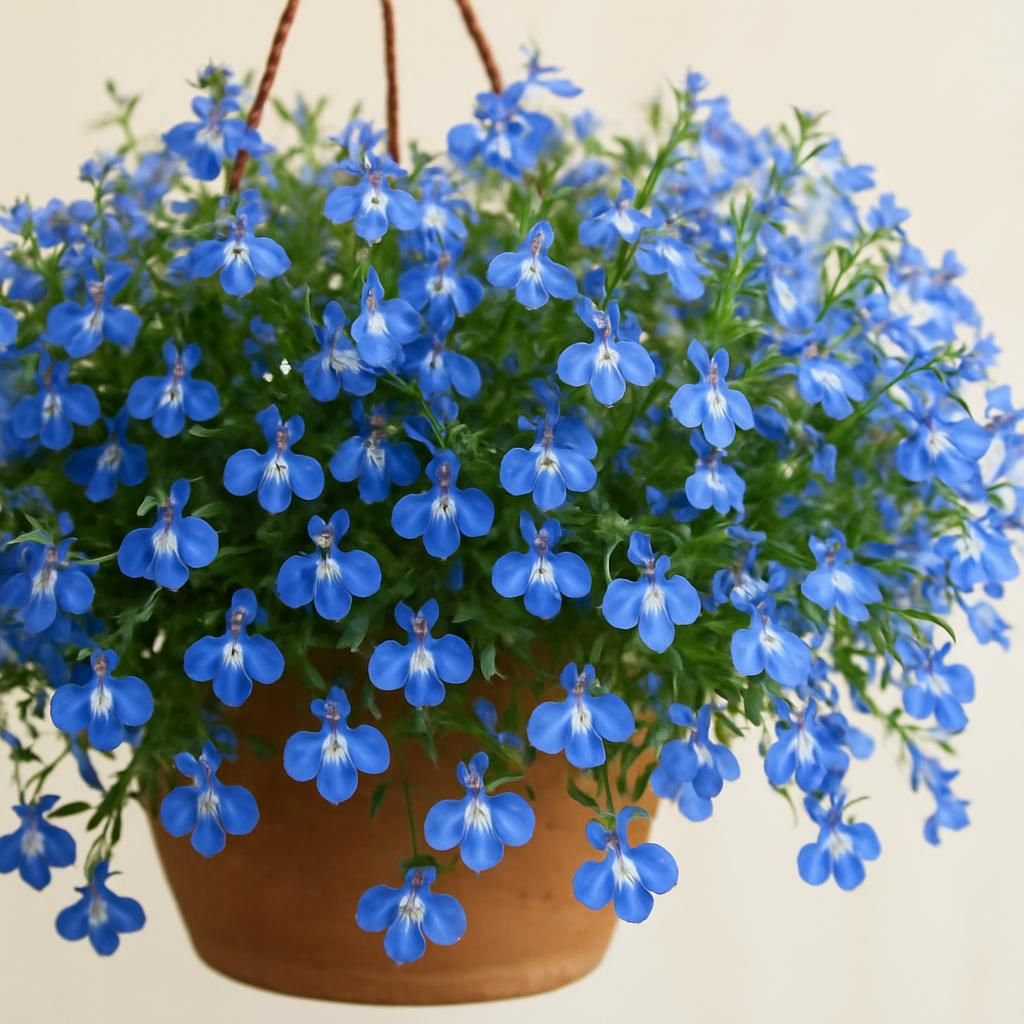
Introduction to Lobelia
Lobelia (Lobelia erinus) is a compact, free-flowering annual widely grown for its intense floral display and trailing habit. Native to southern Africa, it has become a staple in temperate gardens where its vivid blooms provide continuous color from late spring through early autumn. Professional growers and market gardeners appreciate Lobelia for its ability to fill hanging baskets, window boxes, and mixed borders with minimal height while delivering high visual impact. The plant performs best in cool temperatures and requires consistent moisture without waterlogging. When managed correctly, Lobelia produces dense mats or cascades of flowers that attract pollinators and enhance both commercial and home landscapes.
Botanical Profile of Lobelia
Lobelia erinus belongs to the Campanulaceae family and is characterized by slender, branching stems that reach 10–25 cm in height with a spreading or trailing habit. The lanceolate to ovate leaves are typically 1–2 cm long, bright green, and slightly toothed. Small, five-lobed tubular flowers appear in shades of deep blue, violet, purple, pink, and white, each measuring 1–2 cm across. The species produces a fibrous root system that is shallow and benefits from even moisture. Lobelia is frost-tender but can tolerate light frosts once established. Its rapid growth cycle makes it suitable for succession planting in cool-season production systems.
Soil, pH, and Climate Requirements for Lobelia
Successful cultivation of Lobelia begins with selecting a site that provides full sun to partial shade and protection from intense afternoon heat. The plant demands well-drained yet moisture-retentive soil with high organic matter content. Ideal soil pH ranges from 6.0 to 7.0. Lobelia performs best when daytime temperatures remain between 15–24 °C and nighttime temperatures do not drop below 10 °C. In regions with hot summers, afternoon shade or elevated containers improve performance. Heavy clay soils should be amended with coarse sand or perlite to prevent root rot.
| Parameter | Ideal Range/Value | Notes |
|---|---|---|
| Soil Type | Loamy, well-drained | Add compost and perlite for drainage |
| Soil pH | 6.0–7.0 | Slightly acidic to neutral |
| Temperature (Day) | 15–24 °C | Cool-season preference |
| Temperature (Night) | 10–15 °C | Protect below 5 °C |
| Light | Full sun to partial shade | Afternoon shade in hot climates |
| Spacing | 15–20 cm between plants | 20–25 cm in containers |
| Planting Depth | Surface sow or 3 mm deep | Light required for germination |
Step-by-Step Planting & Propagation
Lobelia is most reliably started from seed indoors 8–10 weeks before the last expected frost. Sow seeds on the surface of a sterile seed-starting mix and press lightly; do not cover because light is required for germination. Maintain soil temperature at 18–21 °C and keep the medium consistently moist using a fine mist. Germination occurs in 7–14 days. Once seedlings develop two true leaves, transplant into cell trays and grow on at 15–18 °C. Harden off plants for 7–10 days before setting outdoors after all frost risk has passed. Direct sowing outdoors is possible in cool climates once soil reaches 15 °C. Division of established plants or stem cuttings taken in spring provide clonal propagation options for specialty cultivars.
Care & Maintenance regimes for Lobelia
Consistent moisture is critical; allow the top 1 cm of soil to dry slightly between waterings but never permit complete desiccation. Apply a balanced liquid fertilizer (NPK 10-10-10) diluted to half strength every 2–3 weeks during active growth. Pinch or shear plants lightly after the first flush of bloom to encourage branching and renewed flowering. In hanging baskets, rotate containers weekly for even light exposure. Mulch container surfaces with fine bark to reduce evaporation. Monitor for nutrient deficiencies, particularly nitrogen, which manifests as pale foliage.
| Task | Frequency | Method & Rate | Season Notes |
|---|---|---|---|
| Watering | Every 2–3 days (containers) | Deep soak until drainage occurs | Increase in heat; reduce in cool, wet weather |
| Fertilizer | Every 14–21 days | ½ strength balanced liquid (10-10-10) | Stop or reduce in mid-summer heat |
| Pruning/Deadheading | Weekly | Shear back ⅓ of growth after bloom flush | Repeat to maintain compact habit |
| Mulching | At planting and mid-season | 2 cm fine bark or coco coir | Retains moisture and suppresses weeds |
Pests, Diseases & Organic Management
Common pests of Lobelia include aphids, slugs and snails, and spider mites. Aphids cluster on tender new growth and can be controlled with insecticidal soap or strong water sprays. Slugs are managed by hand-picking at night or applying iron phosphate baits. Spider mites appear during hot, dry spells; increasing humidity and releasing predatory mites provides effective biological control. Diseases include powdery mildew and root rot caused by overwatering or poor drainage. Improve air circulation, avoid overhead irrigation, and remove infected foliage promptly. Pythium and Phytophthora can devastate seedlings; use sterile media and avoid overwatering.
Harvesting, Curing & Optimal Storage
Lobelia is primarily grown as an ornamental rather than a food crop; however, some varieties are harvested for cut-flower use or dried for craft purposes. Cut stems when 50 % of flowers are open, ideally in early morning. Place stems immediately in cool water and hold at 4–7 °C for up to 5 days. For dried arrangements, hang small bunches upside down in a dark, well-ventilated area at 20–25 °C until moisture content drops below 15 %. Store dried material in airtight containers away from light to preserve color. Seed saving involves collecting mature capsules when they turn brown and brittle; clean and store seeds in paper envelopes at 5–10 °C with low humidity.
Companion Planting for Lobelia
Lobelia pairs effectively with cool-season crops and herbs that share similar moisture and light requirements. Plant alongside lettuce, spinach, and thyme to create attractive edible-ornamental combinations. The low-growing habit of Lobelia serves as a living mulch that shades soil and reduces weed pressure around taller vegetables such as tomato or bell pepper. Avoid planting near heavy feeders that compete aggressively for nitrogen. In mixed containers, combine with nasturtium and marigold to enhance pollinator attraction and provide natural pest deterrence. These pairings improve biodiversity and reduce the need for external inputs in small-farm and home-garden systems.
Learn more about Lobelia on Wikipedia
Read: Summer Companion Planting: 10 Organic Pairings to Boost Small Farm Resilience