Introduction to Konjac Glucomannan
Konjac glucomannan, derived from the underground corms of Amorphophallus konjac, is one of the most valuable hydrocolloid crops in modern agriculture. The plant produces a starchy corm containing 30-50% glucomannan on a dry-weight basis, making it a primary source for konjac flour, noodles, and dietary fiber supplements. Commercial growers target high-density glucomannan content through precise agronomic management, achieving yields of 15-30 tons of fresh corms per hectare under optimal conditions. The crop offers strong market demand across Asia, Europe, and North America, with premium pricing for high-glucomannan cultivars.
Cultivation requires patience because the crop has a 3-4 year cycle from planting to commercial harvest. Each successive season increases corm size and glucomannan concentration, rewarding growers who maintain consistent soil health and pest management. The plant's large, umbrella-like leaves also provide seasonal shade that benefits intercropping systems. Because the crop is sensitive to waterlogging and certain soil-borne pathogens, site selection and drainage infrastructure are critical success factors.
Botanical Profile of Konjac Glucomannan
Amorphophallus konjac is a perennial herbaceous plant belonging to the Araceae family. It produces a single, deeply lobed leaf arising from a large underground corm that can reach 15-25 cm in diameter after three seasons. The leaf emerges in spring, supported by a mottled petiole up to 1.5 m tall, and senesces in late autumn, returning nutrients to the corm. The inflorescence is a dramatic, foul-smelling spadix that appears only on mature plants and is rarely used for propagation.
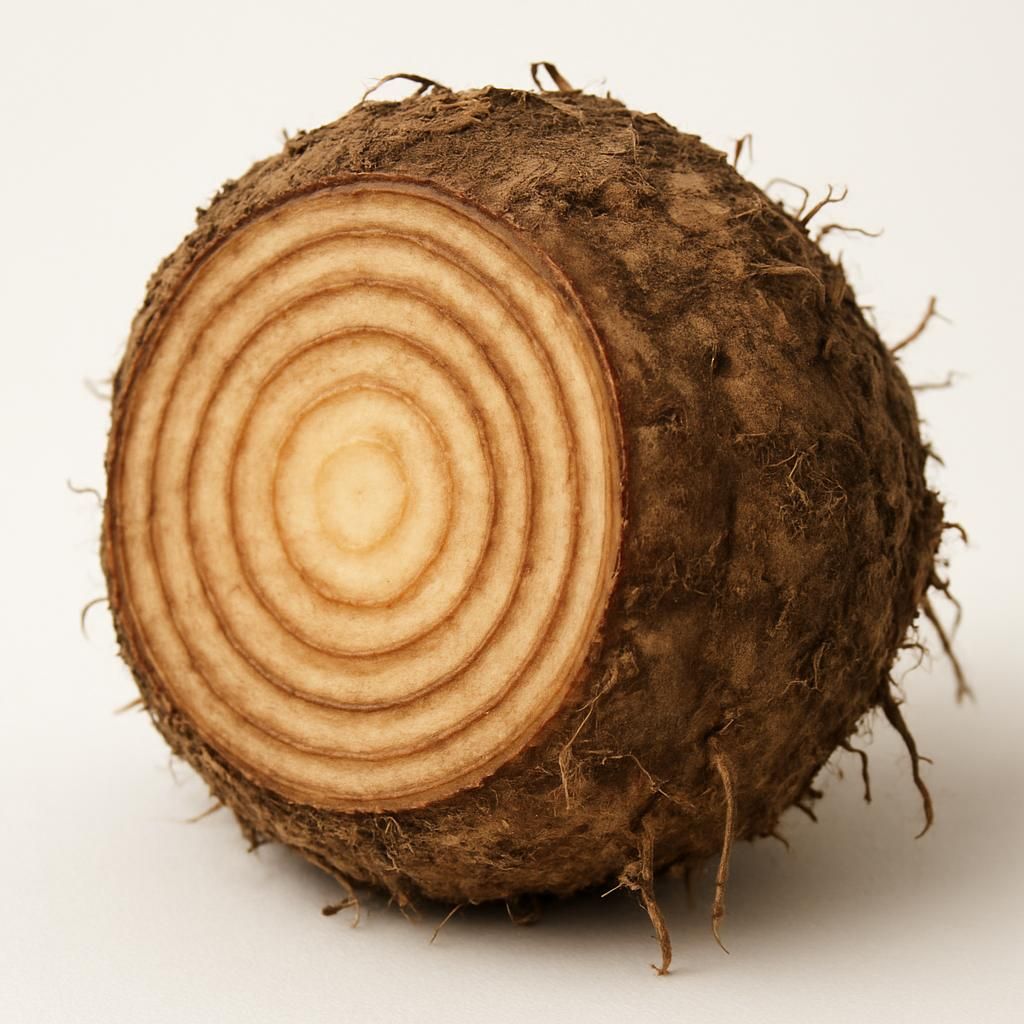
The corm is the primary economic organ, consisting of concentric rings of storage tissue rich in glucomannan, starch, and minerals. Corm dormancy lasts 4-6 months after leaf senescence, during which the plant survives on stored reserves. Propagation is achieved through corm division or small daughter corms (offsets) produced at the base of the parent corm. The plant exhibits strong apical dominance, so growers often remove the central bud to encourage multiple shoots and larger corm development.
Soil, pH, and Climate Requirements for Konjac Glucomannan
Konjac glucomannan thrives in well-drained, fertile soils with high organic matter. The crop is sensitive to waterlogging, which quickly leads to corm rot. Ideal soils are sandy loam to loam with good structure and aeration. Heavy clay soils require raised beds or drainage tiles to prevent saturation during monsoon periods.
| Parameter | Ideal Range | Notes |
|---|---|---|
| Soil Type | Sandy loam to loam | High organic matter improves glucomannan |
| Soil pH | 5.5-7.0 | Slightly acidic to neutral; avoid alkaline |
| Temperature (Growing) | 20-28°C day / 15-20°C night | Optimal for leaf expansion and corm fill |
| Temperature (Dormancy) | 5-12°C | Prevents premature sprouting |
| Annual Rainfall | 1200-2000 mm | Even distribution; supplemental irrigation required in dry spells |
| Altitude | 300-1500 m | Higher elevations reduce disease pressure |
| Frost Tolerance | None | Protect corms below 5°C |
Step-by-Step Planting & Propagation
- Select certified, disease-free corms or offsets weighing 150-300 g for planting stock.
- Prepare raised beds 30-40 cm high with 1.2 m width and incorporate 20-30 tons/ha well-rotted compost.
- Plant corms 8-12 cm deep with the bud facing upward, spaced 40 cm apart in rows 60 cm apart.
- Mulch immediately with 5-8 cm of straw or wood chips to maintain moisture and suppress weeds.
- Irrigate lightly after planting to settle soil without creating waterlogged conditions.
- In subsequent years, divide larger corms in early spring before bud break and replant offsets to expand acreage.
Care & Maintenance regimes for Konjac Glucomannan
Consistent moisture without waterlogging is essential during active growth. Fertilization focuses on potassium and phosphorus to promote glucomannan synthesis, while nitrogen is limited after the first season to avoid excessive foliage at the expense of corm development.
| Growth Stage | Water Schedule | Fertilizer Application | Pruning/Maintenance |
|---|---|---|---|
| Planting to Emergence | Keep top 10 cm moist; 2-3 irrigations/week | 40 kg N, 60 kg P2O5, 80 kg K2O per ha at planting | Remove weeds; maintain mulch layer |
| Leaf Expansion (Spring) | 25-30 mm/week; drip irrigation preferred | Side-dress 30 kg N at 4-6 leaf stage | Remove senescing leaves; scout for pests |
| Corm Bulking (Summer) | Reduce to 15-20 mm/week; avoid saturation | Apply 60 kg K2O and 20 kg P2O5 mid-season | No pruning; monitor leaf health |
| Dormancy (Autumn-Winter) | Withhold irrigation; protect from frost | None | Cut back foliage after full senescence |
Pests, Diseases & Organic Management
Major pests include Aphids, Slugs, and Root-knot nematodes. Organic controls rely on neem oil sprays, diatomaceous earth barriers, and beneficial nematodes. The most serious disease is Pythium and Phytophthora corm rot, favored by poor drainage. Preventive measures include raised beds, crop rotation with Rice or Ginger, and soil solarization between cycles. Regular scouting and removal of infected plants limit spread.
Harvesting, Curing & Optimal Storage
Harvest begins when leaves have fully senesced, typically 8-10 months after emergence. Carefully dig corms to avoid bruising, then wash and air-dry for 48 hours. Curing at 25-28°C and 70-80% RH for 7-10 days reduces field moisture and heals minor wounds. Store cured corms at 8-12°C with 85-90% humidity in well-ventilated crates; glucomannan content remains stable for 4-6 months under these conditions.
Companion Planting for Konjac Glucomannan
Konjac glucomannan benefits from understory companions that improve soil structure and deter pests. Ginger and Turmeric provide complementary root architecture and share similar moisture needs. Thai Basil and Marigold repel aphids and nematodes while attracting beneficial insects. Avoid planting with shallow-rooted Lettuce or Cabbage that compete for surface nutrients. Deep-rooted legumes such as Peas can be rotated in the off-season to fix nitrogen before replanting konjac.
Stop Treating Tomato Blight Like a Spray Problem: Here Is What Works Better