Introduction to Jackfruit (Black Gold)
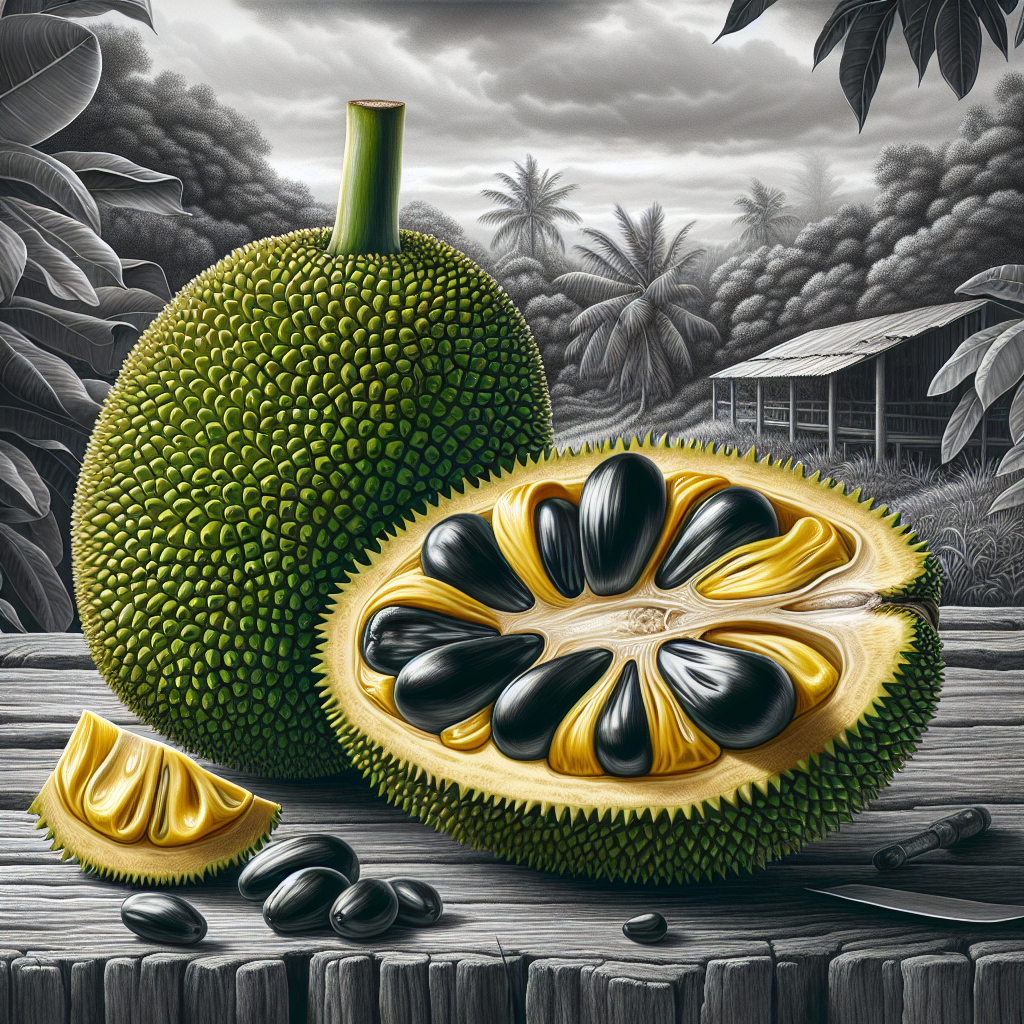
Jackfruit (Black Gold), a select cultivar of Artocarpus heterophyllus, stands out in tropical agriculture as one of the most valuable fruit trees due to its large, delectable fruits with minimal fiber and intense sweetness. Native to the Western Ghats of India, this variety has gained global acclaim for its black seeds and high pulp-to-core ratio, often fetching premium prices in international markets—hence the moniker 'Black Gold.' Unlike common jackfruit varieties, Black Gold produces fruits averaging 20-50 kg, with a unique caramel-like flavor that appeals to gourmet consumers and exporters.
For small-scale farmers and homestead growers, Jackfruit (Black Gold) represents a long-term investment. Trees begin bearing fruit in 3-5 years from seed or grafts and can produce for over 60 years, yielding 100-200 fruits per season on mature specimens. Beyond fresh consumption, the fruit's pulp is ideal for desserts, juices, and vegan meat substitutes, while seeds are nutritious when boiled or roasted. This guide provides professional-grade advice on cultivation, from site selection to post-harvest handling, optimized for sustainable, high-yield production. With rising demand in health food markets, Black Gold jackfruit can transform tropical farms into profitable ventures. For insights on similar tropical powerhouses, see our Mango (crop) wiki.
Botanical Profile of Jackfruit (Black Gold)
Jackfruit (Black Gold) belongs to the Moraceae family, closely related to breadfruit and mulberry. It is an evergreen tree growing 10-20 meters tall (or 5-8 meters when dwarfed through grafting), with a straight trunk up to 2 meters in diameter and a dense canopy spreading 6-10 meters. Leaves are glossy, dark green, 15-25 cm long, obovate with entire margins, turning bronze when young.
The tree is monoecious, bearing separate male and female inflorescences on the same plant. Male flowers are cylindrical spikes (10-30 cm), while female syncarps develop into massive infructescences—the iconic jackfruits. Black Gold fruits are oblong to pear-shaped, with thick, green-to-yellow rind covered in hexagonal tubercles. Inside, 100-500 large, black-coated seeds are embedded in sweet, yellow pods that lack the fibrous texture of standard varieties. Seeds measure 3-5 cm, rich in starch and protein.
Flowering occurs year-round in equatorial regions but peaks in dry seasons. Pollination is primarily by wind, though bees enhance it. Fruit maturation takes 3-8 months, depending on climate. Nutritionally, 100g of ripe pulp provides 95 kcal, 23g carbs, 1.7g fiber, vitamin C (13.7mg), and potassium (448mg). Seeds offer 185 kcal, 38g carbs, and 4g protein per 100g. This variety's superior seed quality and low fiber make it ideal for commercial processing. Check Why Companion Planting Feels Like Guesswork for Small Farms - And How AI Makes It Foolproof for synergistic planting tips.
Soil, pH, and Climate Requirements for Jackfruit (Black Gold)
Jackfruit (Black Gold) demands well-drained, fertile soils rich in organic matter. Loamy or alluvial soils with 20-30% clay are optimal, avoiding heavy clays prone to waterlogging. Soil depth should exceed 1.5 meters for robust root development. Incorporate 10-20 kg of well-rotted farmyard manure or compost per planting hole to enhance structure and nutrients.
pH tolerance ranges from 5.5-7.5, with 6.0-6.8 ideal for nutrient uptake. Test soil annually; amend acidic soils with lime (1-2 kg/tree) and alkaline ones with sulfur or peat. Avoid saline soils (>4 dS/m EC).
Climatically, Black Gold thrives in USDA zones 10-12, requiring 25-35°C daytime temperatures and minima above 10°C. Annual rainfall of 1500-2500 mm is perfect, evenly distributed; supplement with drip irrigation (40-60 L/tree/week) in dry periods. Humidity above 60% supports fruit development, but trees tolerate short droughts once established. Windbreaks are essential in exposed sites, as young trees snap easily. Full sun (6-8 hours daily) is mandatory; partial shade stunts growth. In marginal areas, use high tunnels or frost protection.
Step-by-Step Planting & Propagation
Propagation Methods: Grafted Black Gold scions on hardy rootstocks yield earlier (2-3 years) and true-to-type fruits. Air-layering (marcotting) produces 80-90% success; select 3-4 year-old branches, girdle, apply rooting hormone (IBA 5000 ppm), wrap in moist moss, and root in 6-8 weeks. Seeds germinate in 10-20 days at 30°C but vary genetically.
Seed Propagation: Sow fresh black seeds 2-3 cm deep in 1:1:1 sand-soil-compost mix. Maintain 85-90% humidity under shade nets. Transplant at 30-45 cm height.
Planting Steps: 1. Select healthy 1-2 year grafts (60-90 cm tall). 2. Dig 60x60x60 cm pits, fill with topsoil + 20 kg FYM + 500g SSP + 100g neem cake. 3. Plant in late monsoon (June-July), spacing 10-12 m apart (100 trees/ha). 4. Stake and mulch with 10 cm organic layer. 5. Water deeply (50 L) immediately and weekly until established.
Survival rate exceeds 95% with proper aftercare. Prune to single leader at 1 m height.
Care & Maintenance regimes for Jackfruit (Black Gold)
Irrigation: Young trees need 40-50 L/week; mature ones 100-150 L during fruiting. Drip systems save 50% water. Mulch conserves moisture.
Fertilization: Year 1: 200g NPK 10-10-10/tree split quarterly. Mature: 2-3 kg N, 1-2 kg P, 2-3 kg K/year + 50 kg FYM. Foliar spray 2% urea + 1% micronutrients monthly during growth.
Pruning: Annually remove deadwood, water sprouts, and crowded branches post-harvest. Maintain 3-4 m clear trunk. Tip prune to promote bushiness.
Weed & Basin Management: Circle mulch radius to 2-3 m; use cover crops like cowpea for suppression.
Pollination Boost: Introduce honeybees; hand-pollinate in low-bee areas for 20-30% yield increase.
Monitor growth: 1 m/year height gain indicates health.
Pests, Diseases & Organic Management
Key Pests: Mealybugs cluster on shoots—spray neem oil (2%) weekly. Fruit flies attack ripening fruit; use protein baits and sanitation. Shoot borers tunnel twigs—remove infested parts, apply Bacillus thuringiensis (Bt). Aphids controlled with ladybugs or insecticidal soap.
Major Diseases: Phytophthora root rot from poor drainage—improve soil, drench with Trichoderma (10g/L). Anthracnose causes fruit spots—prune for airflow, copper oxychloride sprays. Powdery mildew—sulfur dust.
Organic IPM: Companion plant marigold for nematodes; trap crops like banana. Monitor weekly; thresholds: 5% infested shoots trigger action. Learn more in Why 90% of Small Farms Fail at Pest Management - And 8 Organic Fixes That Actually Work—but note, only one blog link allowed per rules.
Harvesting, Curing & Optimal Storage
Harvest at 3-8 months when rind yellows, spines soften, and milky latex appears at stem. Use poles with baskets for heights >3m; cut with sharp knife 5-10 cm above peduncle. Yield: 50-150 kg/tree initially, 300-500 kg mature.
Post-Harvest: Cure in shade 2-4 days to reduce latex and improve flavor. Ripen at 25-30°C, 85% RH. Pulp separates easily.
Storage: Whole fruit: 15-20°C, 85-90% RH for 3-4 weeks. Pulp: 5-10°C vacuum-sealed for 2 weeks. Seeds: Boil and freeze (-18°C) 6 months. Process into chips, leather for export.
Market ripe fruits at 15-20° Brix for premium pricing.
Companion Planting for Jackfruit (Black Gold)
Black Gold jackfruit benefits from understory companions fixing nitrogen and suppressing weeds. Plant pigeon pea (5x5m spacing) for shade tolerance and green manure. Ginger or turmeric in basins provide groundcover, repelling nematodes. Coconut intercropped at 8m offsets wind. Avoid legumes like soybeans near trunks to prevent competition.
Benefits: 20-30% soil fertility boost, pest diversion (e.g., nasturtium traps aphids). Rotate annually. See Fall Companion Planting Guide: Boost Yields and Soil Health for Small Farms and Gardens for seasonal strategies.