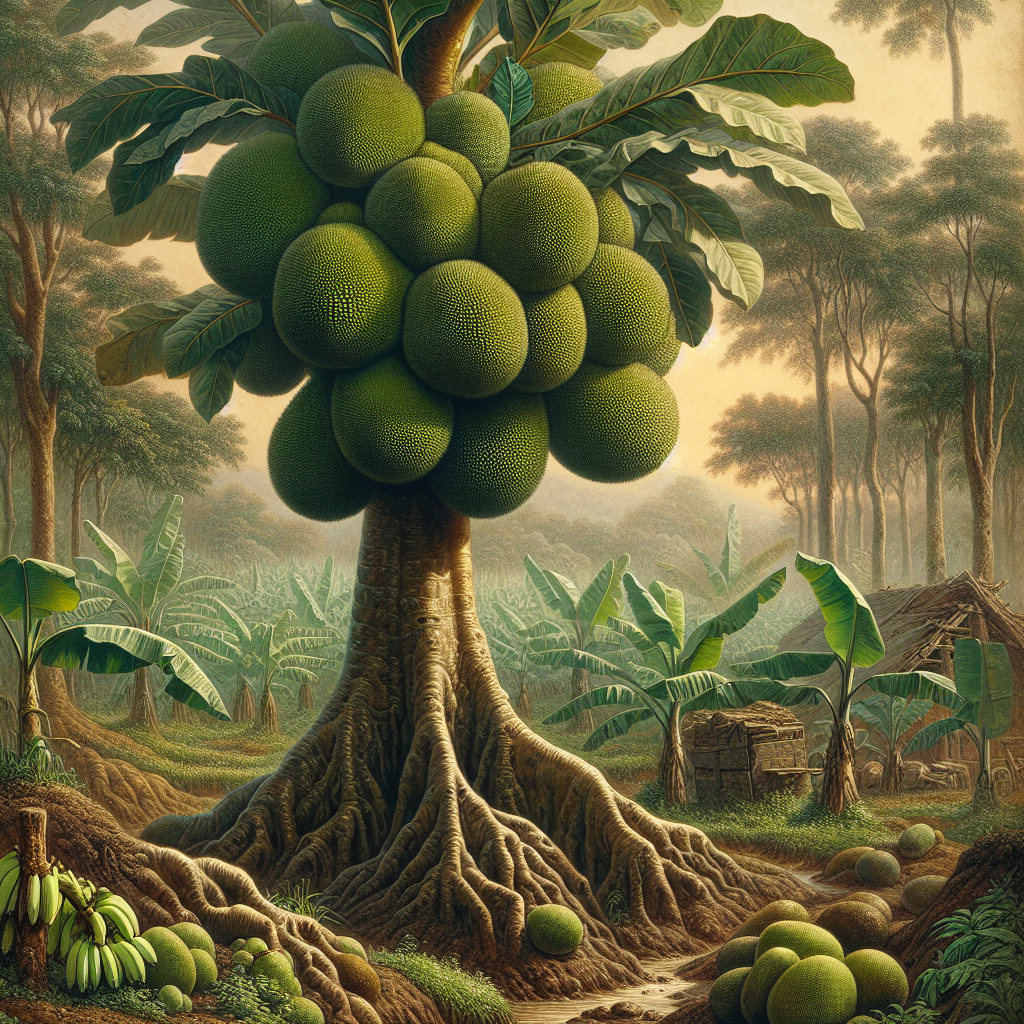
Introduction to Jackfruit
Jackfruit (Artocarpus heterophyllus), often celebrated as the 'king of tropical fruits,' poses significant challenges as an invasive pest in agricultural settings outside its native range in South and Southeast Asia. This fast-growing evergreen tree can reach heights of 50-80 feet (15-25 meters) with a broad canopy spanning 20-40 feet, producing massive fruits weighing up to 100 pounds (45 kg). While valued for its nutritious, versatile fruit in home gardens and orchards, unchecked jackfruit proliferation in tropical and subtropical farms leads to severe competition for light, water, and nutrients, smothering understory crops and native vegetation.
Farmers in regions like Florida, Hawaii, Australia, and parts of Africa report jackfruit invading farmlands, where its deep taproots and lateral spread deplete soil resources. A single mature tree can drop thousands of seeds annually via fruit dispersal by animals or gravity, germinating rapidly in humid conditions. Early detection and management are crucial, as mature specimens become nearly impossible to eradicate without heavy machinery. This guide equips agricultural professionals with diagnostic tools, lifecycle insights, and organic control methods to mitigate jackfruit's impact, ensuring sustainable crop yields. For more on invasive tropical challenges, see Why 90% of Small Farms Fail at Pest Management - And 8 Organic Fixes That Actually Work.
Identifying Symptoms & Damage
Diagnosing jackfruit invasion requires vigilance for both above- and below-ground indicators. Visual foliage signs include large, glossy, deeply lobed leaves (up to 12 inches long) emerging in dense clusters that rapidly canopy over smaller plants, blocking 70-90% of sunlight within 2-3 years of establishment. Look for thick, milky sap exuding from cut stems—a hallmark trait—and bumpy, green-to-yellow fruits developing high in the trunk or branches.
Root damage manifests as stunted growth in nearby crops due to competition; mango trees within 20 feet may show yellowing leaves and reduced fruiting, while banana plantations exhibit pseudostem buckling from water theft. Soil probes reveal extensive fibrous roots extending 50+ feet laterally, often girdling young trees. Fruit drop impacts include mashed, fermenting fruits attracting rodents, fruit flies, and ants, creating hygiene issues and secondary pest hotspots.
Quantitative assessment: Measure canopy overlap using drone imagery or quadrant sampling—jackfruit dominance exceeds 30% cover signals infestation. Differentiate from similar invasives like breadfruit (Artocarpus altilis) by jackfruit's larger fruit size and more pungent odor. Early symptoms in affected crops include 20-40% yield loss in the first year, escalating to total understory suppression. Regular scouting every 2 weeks during rainy seasons is essential.
Lifecycle and Progression of Jackfruit
Jackfruit's lifecycle spans 3-5 years to maturity, with peak invasiveness from years 10-30. Seed germination occurs within 2-10 days in warm (77-95°F/25-35°C), moist soils, producing cotyledons that photosynthesize immediately. Seedlings grow 3-6 feet in the first year, developing a taproot up to 10 feet deep.
Vegetative growth accelerates in years 2-5, with annual height gains of 3-5 feet and lateral branches forming a dense umbrella. Flowering begins at 3-7 years, with female flowers on main stems producing syncarps (compound fruits) after 3-4 months. Pollination is anemophilous (wind-borne), yielding 100-500 fruits per tree annually by maturity.
Seed dispersal and propagation peaks in wet seasons; viable seeds persist 1-2 months in fallen fruit, spread by gravity, mammals, or floods up to 100 meters. Vegetative reproduction via root suckers occurs post-disturbance, forming clonal thickets. Progression stages: Year 1 (seedling establishment), Years 2-4 (juvenile canopy formation), Years 5+ (reproductive invasion). Lifespan exceeds 100 years, with peak seed production at 20-40 years. Monitor progression with growth rings or annual fruit counts to time interventions.
Environmental Triggers & Risk Factors
Jackfruit thrives in USDA zones 9b-11, requiring full sun, well-drained loamy soils (pH 6.0-7.5), and 40-80 inches annual rainfall. Key triggers include prolonged monsoons or irrigation overflow, boosting germination rates by 80%; temperatures above 86°F (30°C) enhance growth, while frost below 32°F (-0°C) halts expansion.
Risk factors encompass disturbed sites like cleared pastures or abandoned orchards, where soil exposure favors seedlings over competitors. Proximity to papaya or guava groves heightens spread via shared pollinators and dispersers. Poor farm hygiene—uncollected fallen fruits—amplifies infestation 5-fold. Climate change exacerbates risks through extended wet seasons and hurricane debris dispersal. High-risk farms: Those with >20% canopy gaps or histories of tropical fruit cultivation. Mitigation starts with soil moisture monitoring to preempt triggers.
Organic Control & Treatment Plans
Organic management prioritizes prevention over eradication, combining mechanical, biological, and cultural tactics. Seedling stage (0-2 years): Hand-pull or hoe seedlings weekly, targeting taproots; mulch heavily (6-8 inches organic matter) to suppress germination by 70%. Juvenile trees (2-10 years): Girdle trunks with pruning saw (remove 2-inch bark ring), apply organic herbicides like vinegar (20% acetic acid) or citrus oil sprays repeatedly.
Mature trees: Cut and cover with heavy tarps (solarization) for 6-12 months to kill roots via deprivation; introduce competing groundcovers like marigold or vetiver. Biological controls include goats for browse and biofumigants (mustard cover crops) to deter roots. Integrated plan: 1) Scout biweekly; 2) Remove fruits promptly; 3) Plant dense barriers (e.g., lemongrass); 4) Monitor soil nematodes as allies against roots. Success rates: 85% for seedlings, 60% for matures with persistence. Avoid synthetic chemicals to preserve biodiversity. For companion strategies, explore Why Companion Planting Feels Like Guesswork for Small Farms - And How AI Makes It Foolproof. Track progress with yield mapping.
Preventing Jackfruit in the Future
Long-term prevention hinges on cultural vigilance and landscape design. Site selection: Avoid planting in open fields; use windbreaks of thorny species like bamboo. Sanitation protocols: Collect and compost (hot pile >140°F/60°C) all fruits/seeds off-site; prohibit fruit drop in buffers. Crop rotation and diversity: Interplant with aggressive competitors like pigeon pea or cassava to shade out seedlings.
Monitoring tech: Employ trail cams for animal dispersal tracking and soil sensors for moisture alerts. Community efforts: Coordinate with neighbors for perimeter control. Resistant rootstocks or sterile cultivars (if available) reduce risks. Annual audits: Map jackfruit density; maintain <5% cover. Educate on dispersal vectors like birds. Sustainable prevention yields 90% efficacy, transforming vulnerable farms into resilient systems.
Crops Most Affected by Jackfruit
Jackfruit's shade and resource competition devastates low-growing tropicals. Primary victims: Banana (50-70% yield drop from light/water theft), mango (root girdling causes dieback), papaya (overshading halts fruiting). Secondary impacts: Pineapple and coconut suffer suppressed growth; understory like ginger and turmeric face total exclusion. In mixed orchards, avocado and durian show 30% vigor loss. Native forests lose biodiversity, favoring jackfruit monocultures. Prioritize buffers around these high-value crops.