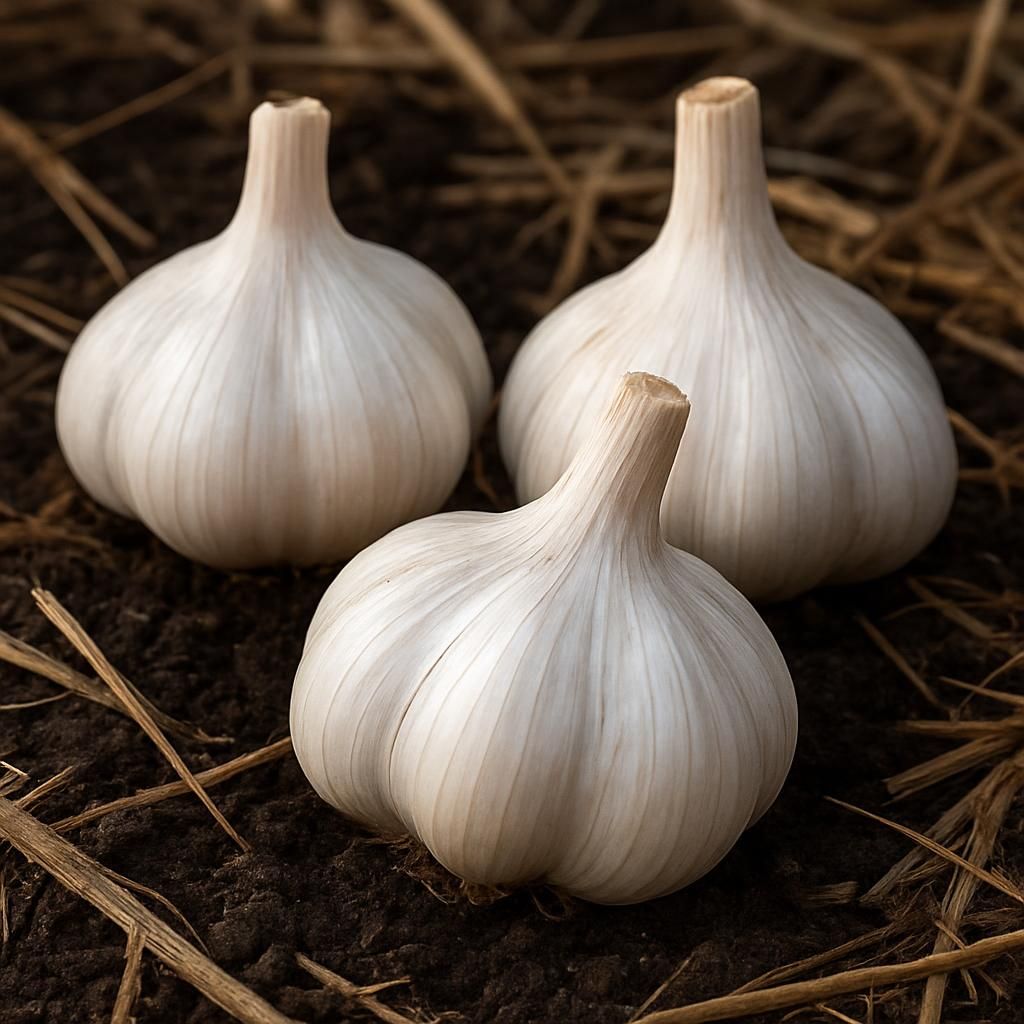
Introduction to Garlic (Music)
Music garlic (Allium sativum 'Music') is a hardneck variety originating from Canada, renowned among growers for its vigorous growth, cold tolerance, and exceptional flavor profile. It produces large, easy-to-peel cloves with a strong, spicy taste that mellows when cooked. Farmers and home gardeners value Music garlic for its consistent performance in northern climates and its ability to store well into the following spring. This comprehensive guide covers every stage of cultivation with data-driven recommendations suitable for both commercial and small-scale production.
Botanical Profile of Garlic (Music)
Music garlic belongs to the Amaryllidaceae family and is classified as a hardneck type due to its stiff central scape. The plant develops long, flat, blue-green leaves and sends up a flower stalk (scape) that typically coils before straightening. Each bulb contains 4–6 large cloves arranged around the central stem. Unlike softneck varieties, hardneck garlic such as Music produces fewer but larger cloves and is generally more cold-hardy. The variety is well adapted to USDA zones 3–8 and performs best when exposed to a period of winter vernalization.
Soil, pH, and Climate Requirements for Garlic (Music)
Music garlic thrives in well-drained, fertile soils with high organic matter. Heavy clay soils should be amended with compost or raised beds to prevent waterlogging. Ideal planting occurs in fall when soil temperatures drop below 60°F (15.5°C), allowing roots to establish before winter dormancy.
| Parameter | Ideal Range/Value | Notes |
|---|---|---|
| Soil Type | Loamy or sandy loam | Well-drained; avoid compacted clays |
| Soil pH | 6.0–7.0 | Slightly acidic to neutral |
| Organic Matter | 3–5% | Incorporate 2–4 inches of compost |
| Planting Depth | 2–3 inches (5–7.5 cm) | Pointy end up; cover with 4–6 inches mulch |
| Row Spacing | 12–18 inches (30–45 cm) | Allows airflow and mechanical weeding |
| In-Row Spacing | 4–6 inches (10–15 cm) | Larger cloves benefit from wider spacing |
| Soil Temperature | 50–60°F (10–15.5°C) at planting | Optimal for rapid root development |
| Winter Hardiness | Zones 3–8 | Requires 6–8 weeks below 40°F (4°C) |
| Full Sun Exposure | Minimum 6–8 hours daily | Essential for bulb size and flavor |
Step-by-Step Planting & Propagation
- Select healthy, disease-free seed garlic from a reputable source; avoid supermarket bulbs treated with sprout inhibitors.
- Separate bulbs into individual cloves 1–2 days before planting; discard any damaged or soft cloves.
- Prepare beds by incorporating aged compost and a balanced organic fertilizer (e.g., 5-5-5) at 2–3 lbs per 100 sq ft.
- Plant cloves 2–3 inches deep with the pointed end facing upward in rows spaced 12–18 inches apart.
- Space cloves 4–6 inches within the row to allow for large bulb development.
- Mulch immediately after planting with 4–6 inches of straw or shredded leaves to moderate soil temperature and suppress weeds.
- Water thoroughly after planting to settle soil around cloves; maintain even moisture until ground freezes.
Care & Maintenance regimes for Garlic (Music)
Consistent moisture and nutrient management are critical during the active growth period in spring. Avoid over-fertilization after scapes emerge to prevent soft bulbs. Scapes should be removed when they begin to coil to redirect energy into bulb enlargement.
| Growth Stage | Watering Schedule | Fertilizer Application | Pruning/Scape Removal |
|---|---|---|---|
| Fall Establishment | 1 inch per week until freeze | None (rely on pre-plant amendment) | None |
| Early Spring | 1–1.5 inches per week | Side-dress with compost tea or fish emulsion (N-rich) at 2–3 weeks after emergence | Remove any weeds; do not remove scapes yet |
| Mid-Spring | Maintain even moisture; reduce if rainfall is adequate | Second feeding with balanced organic fertilizer 4–5 weeks after first | Cut scapes when they form 1–2 loops (around May in northern zones) |
| Bulb Swelling | 0.75–1 inch per week; taper off 2–3 weeks before harvest | No additional fertilizer | Continue weed control; avoid damaging leaves |
Pests, Diseases & Organic Management
Music garlic is generally resistant to many common allium pests but can be affected by onion thrips, aphids, and onion maggot in some regions. Fungal issues such as white rot and botrytis neck rot may occur in poorly drained soils. Implement a 3–4 year rotation away from alliums and use floating row covers during early spring to exclude onion maggot flies. Neem oil or insecticidal soap can manage aphids and thrips when populations exceed economic thresholds. Remove and destroy infected plants promptly to limit spread of fungal pathogens.
Harvesting, Curing & Optimal Storage
Harvest when lower leaves begin to yellow and dry while upper leaves remain green, typically 90–120 days after spring growth resumes. Gently lift bulbs with a garden fork to avoid bruising. Cure in a shaded, well-ventilated area at 60–70°F (15–21°C) with 60–70% humidity for 2–3 weeks. Once necks are dry and papery, trim roots and tops to 1 inch and store at 32–40°F (0–4°C) with 60–70% relative humidity. Properly cured Music garlic can store 6–9 months.
Companion Planting for Garlic (Music)
Garlic is an excellent companion crop due to its natural pest-repellent properties from sulfur compounds. Plant Music garlic near tomato, carrot, beet, and lettuce to deter aphids, carrot rust flies, and other insects. Avoid planting near peas or beans as alliums can inhibit legume growth. Interplanting with marigold or nasturtium further enhances pest management through trap cropping and beneficial insect attraction. Rotate garlic with non-allium crops such as cucumber or squash in subsequent seasons to break pest and disease cycles.
For additional organic soil-building strategies, see The Hidden Power of Mulching: 8 Organic Strategies to Transform Small Farm Soil.