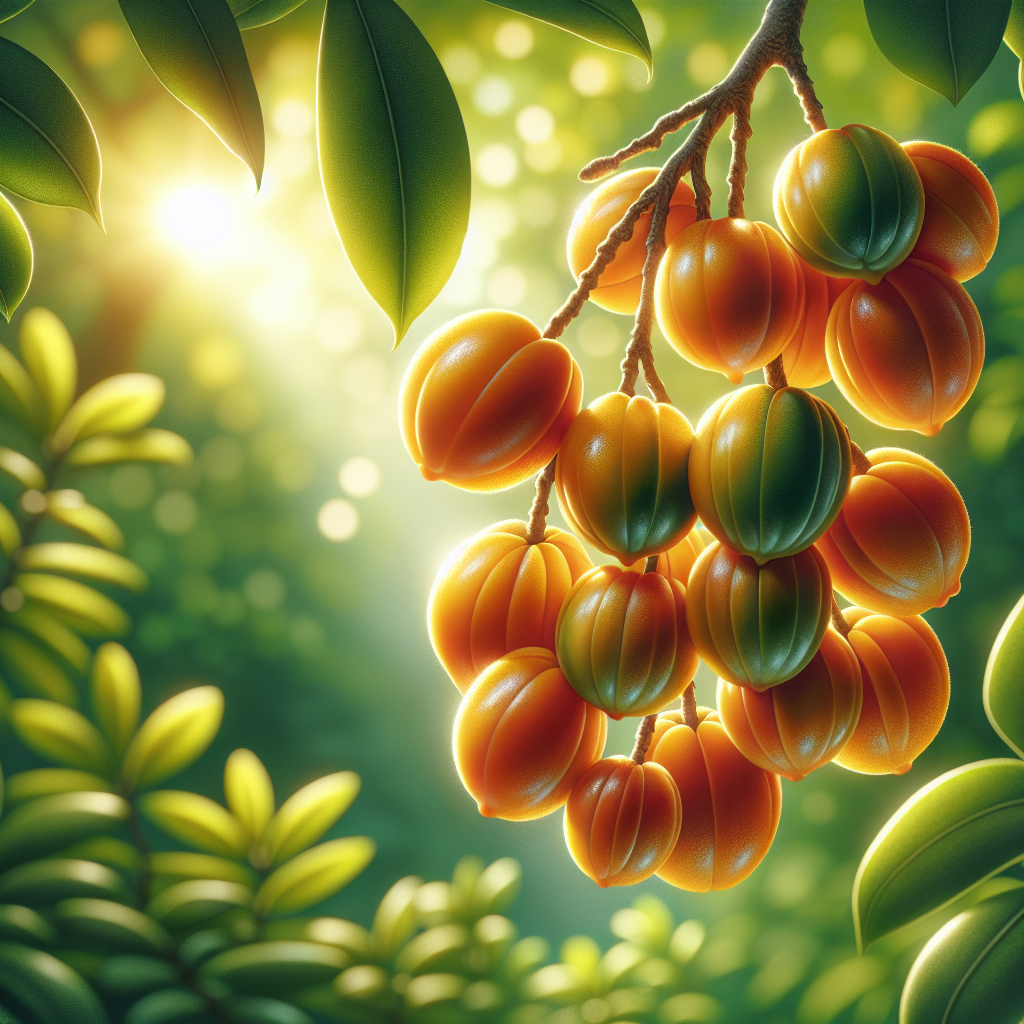
Introduction to Gamboge (Garcinia xanthochymus)
Gamboge, scientifically known as Garcinia xanthochymus, is a lesser-known but highly valuable tropical tree belonging to the Clusiaceae family. Native to the rainforests of India, Myanmar, Thailand, and other parts of Southeast Asia, this evergreen species has been utilized for centuries in traditional Ayurvedic and Chinese medicine for its bright yellow latex resin, known as gamboge gum. The resin, harvested by slashing the bark, serves as a powerful purgative, laxative, and anti-inflammatory agent, while also finding applications in art as a vibrant yellow pigment for paints and varnishes.
Beyond its resin, G. xanthochymus produces small, yellowish-orange fruits that are edible with a sweet-tart flavor reminiscent of mango crossed with citrus notes. The fruits, though not commercially dominant like its relative Garcinia mangostana, offer potential for niche markets in fresh consumption, juices, and preserves. Trees can reach 20-30 meters in height in natural settings but are manageable at 10-15 meters in cultivation through pruning. With growing interest in ethnobotanicals and sustainable agroforestry, cultivating gamboge presents opportunities for small farms seeking high-value, low-maintenance crops. Its resilience to tropical conditions and multiple harvestable products make it ideal for diversified farming systems. Successful growers report yields of 20-50 kg of resin per mature tree annually, plus fruit crops, providing dual income streams.
Botanical Profile of Gamboge (Garcinia xanthochymus)
Garcinia xanthochymus is a dioecious (separate male and female trees) evergreen tree with a straight bole, buttressed at maturity, and a dense, pyramidal crown. Leaves are opposite, lanceolate, glossy dark green, measuring 10-20 cm long, with prominent midribs. New flushes emerge reddish, turning green. Flowers are small (1-2 cm), borne in axillary clusters; male flowers have stamens in four bundles, while female flowers feature a superior ovary with 8-12 stigma lobes. Pollination occurs via insects, primarily bees and flies.
Fruits are subglobose to ovoid berries, 2-4 cm in diameter, with thick, leathery, yellow-orange rind containing latex channels. Inside, 6-12 seeds are embedded in edible, juicy, acidic pulp. Seeds are ellipsoid, with thin, hard coats. The tree's latex is a hallmark feature: bright yellow sap exudes from wounds, hardening into gamboge resin upon exposure to air. Root system is deep taproot with lateral spread, aiding drought tolerance once established.
Growth is slow initially (30-50 cm/year) but accelerates after 3-5 years, reaching fruiting maturity at 7-10 years. Lifespan exceeds 50 years, with peak productivity from 15-30 years. Similar to other Garcinia species, it exhibits cauliflory—flowers and fruits on older wood—facilitating high yields without excessive height. For more on companion tropical fruits, see Why Companion Planting Feels Like Guesswork for Small Farms - And How AI Makes It Foolproof.
Soil, pH, and Climate Requirements for Gamboge (Garcinia xanthochymus)
Gamboge thrives in fertile, well-drained loamy soils rich in organic matter, mimicking its rainforest habitat. Avoid heavy clays or waterlogged sites to prevent root rot. Ideal soil texture is sandy loam or lateritic soil with 20-30% organic content. pH range is acidic, 5.0-6.5; test and amend with peat moss, pine bark, or sulfur if necessary. High aluminum tolerance suits acidic tropical soils.
Climate demands are tropical humid: average temperatures 24-32°C (75-90°F), with minima above 15°C to avoid chilling injury. Annual rainfall of 2000-4000 mm, evenly distributed, is optimal; supplement with irrigation in dry spells. Relative humidity >70% prevents leaf scorch. USDA zones 10b-12; frost-intolerant. Elevation up to 1000m suits hill cultivation. Full sun to partial shade (50% light); young plants benefit from 30-50% shade cloth. Wind protection essential for fruit set. Mulch heavily (10-15 cm) with leaf litter or coconut husk to retain moisture and suppress weeds.
Soil preparation: deep till to 60 cm, incorporate 20-30 kg/m² compost, plus rock phosphate (200 g/m²) and greensand (100 g/m²) for micronutrients. Maintain 2-3% organic matter via annual top-dressing.
Step-by-Step Planting & Propagation
Propagation primarily via seeds, as cuttings root poorly. Collect ripe fruits, extract seeds, wash off pulp, and sow fresh (viability drops after 2 weeks). Soak in water 24 hours, treat with 0.1% GA3 for 12 hours to boost germination (70-85% rate).
- Seed Sowing: Use 30x30 cm polybags with 1:1:1 topsoil:sand:compost. Sow 2-3 seeds 2 cm deep, 25-30°C under mist or shade net. Germinate in 20-40 days.
- Seedling Care: Water daily, fertilize with half-strength NPK 19-19-19 weekly after true leaves. Cull males at 6-12 months via flower observation (plant 1:4 female:male ratio).
- Transplanting: At 30-50 cm height (6-12 months), plant 8x8x8m spacing (156 trees/ha). Dig 60x60x60 cm pits, fill with 20 kg FYM + 500g SSP + 200g MOP. Plant at soil mark, stake, mulch.
Grafting (veneer or cleft) onto rootstock improves vigor; success 40-60%. Air-layering for females yields 70% roots in 2-3 months. Plant during monsoon onset for establishment. Survival >90% with proper aftercare.
Care & Maintenance regimes for Gamboge (Garcinia xanthochymus)
Irrigation: Young trees: 40-50 L/week; mature: 100-150 L/week in dry periods. Drip irrigation ideal (4-6 L/hour/tree). Avoid overhead to prevent fungal issues.
Fertilization: Year 1-3: 100g NPK 10-30-20/tree/year, split 4x. Mature: 1-2 kg N, 1.5 kg P, 1.5 kg K/tree/year via splits. Foliar: 2% urea + micronutrients (Zn, B, Mn) 3x/year. Organic: 20-30 kg compost/tree annually.
Pruning: Annual formative prune to single leader, remove deadwood. Maintain 4-6 m height for resin tapping; cauliflorous branches untouched. Thin crowded fruits for size.
Weeding/Mulching: Slash weeding first 2 years; perennial mulch thereafter. Intercrop with ginger or legumes years 1-4.
Training: Stake to 1.5 m; pyramid shape for light penetration.
Monitor growth: 1 m/year target. Basin irrigation (2x2 m) around trunk conserves water.
Pests, Diseases & Organic Management
Pests: Scale insects and mealybugs suck sap—neem oil 2% sprays (3x, 10-day intervals). Fruit flies on ripening fruits: bait traps with methyl eugenol. Aphids—ladybugs release + insecticidal soap. Shoot borers: remove infested tips, Bacillus thuringiensis (Bt) sprays.
Diseases: Phytophthora root rot—improve drainage, Trichoderma drench (5 g/L). Powdery mildew—sulfur sprays, potassium bicarbonate. Leaf spots (Alternaria)—copper oxychloride + neem.
Integrated management: yellow sticky traps, neem cake soil amendment (2 kg/tree), beneficial insects. For deeper strategies, explore Why 90% of Small Farms Fail at Pest Management - And 8 Organic Fixes That Actually Work. Scout weekly; thresholds: 5% leaf infestation.
Harvesting, Curing & Optimal Storage
Fruit Harvest: 7-10 years onset; July-September peak. Pick when rind yellows, detaches easily (Brix 12-15%). Yield 20-50 fruits/tree initially, up to 200 mature. Hand-pick with clippers; yield 50-100 kg/tree.
Resin Tapping: 5+ years; slash bark 45° V-cuts (5 cm long, 1-2 cm deep) on main branches, 20-30/tree, spaced 15 cm. Collect exudate in pots 2-3x/week. Tap April-June (dry season). Sustainable: rotate panels, heal 6 months.
Curing: Resin—sun-dry 3-5 days into brittle lumps, grade by color/purity. Fruits—shade-dry 2 days or process fresh into pulp/juice.
Storage: Fruits: 10-15°C, 85-90% RH, 2-4 weeks. Resin: cool, dry, airtight (lasts years). Market fresh fruits locally; resin to pharma/art suppliers.
Companion Planting for Gamboge (Garcinia xanthochymus)
Pair with shade-tolerant undercrops: turmeric, cardamom, or black pepper vines on trunks for nitrogen fixation and income. Nitrogen-fixers like pigeon pea or gliricidia improve soil. Repel pests with marigold borders, thyme interrows. Avoid water-hoggers like banana initially. Multi-tier system: canopy gamboge, mid coconut, ground legumes. Enhances biodiversity, suppresses weeds, boosts yields 20-30%.