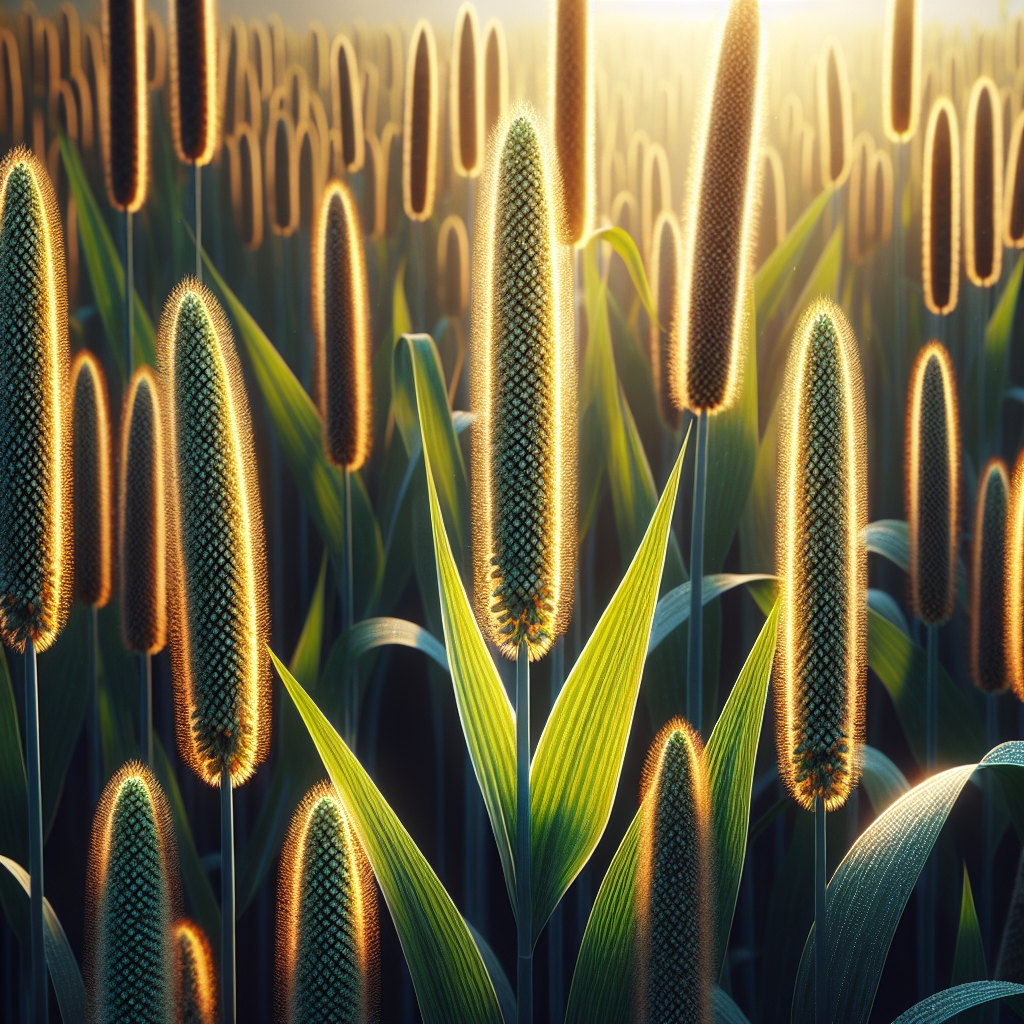
Introduction to Foxtail Millet
An ancient cereal with roots in East Asia and a long history across India, Central Asia, and parts of Europe, this crop remains highly relevant in modern agriculture because it combines resilience with efficiency. It is often chosen where rainfall is unreliable, soils are light to medium textured, and growers need a short-duration grain that can fit into tight rotations.
Compared with larger cereals, foxtail millet matures quickly, usually in about 75 to 120 days depending on cultivar, temperature, and moisture. Its compact, bottlebrush-like seed head gives the crop its common name. The grain is small, typically cream, yellow, golden, red, or brown depending on variety, and is used in porridges, flatbreads, fermented foods, bird feed, and livestock rations.
From a production standpoint, its major strengths are early vigor under warm conditions, relatively low water demand compared with many staples, and adaptability to low-input systems. However, growers should not mistake drought tolerance for neglect tolerance. Good seedbed preparation, early weed suppression, and moisture during germination and heading are still essential for profitable yields. In dryland systems, it often performs well where Sorghum and other hardy cereals are also used, though its season is generally shorter and its seed is much smaller.
For growers interested in building robust grain systems, especially in mixed farms, the crop works well as a catch crop, contingency crop after failed rains, or a rotation grain after legumes. For broader fertility strategy, the principles in soil health planning are particularly relevant because millet responds strongly to improved soil structure and balanced nutrition even when grown on relatively poor land.
Botanical Profile of Foxtail Millet
This species belongs to the grass family, Poaceae, and is a domesticated relative of green foxtail, Setaria viridis. It is a tufted, erect annual grass with fibrous roots, narrow linear leaves, and dense cylindrical panicles that may be erect, nodding, compact, or slightly bristled depending on genotype.
Typical plant height ranges from 60 to 150 cm, though fertile soils and higher rainfall can push some cultivars taller. The root system is relatively shallow to moderate in depth compared with deep-rooted sorghums, but it is efficient enough to exploit brief moisture pulses in warm soils. Leaves are usually glabrous to slightly hairy, with a distinct ligule region and flat blades that can show rolling under drought stress.
The inflorescence is technically a dense panicle. Bristles surrounding the spikelets can vary in color from green to purplish or straw-colored as the crop matures. Each small spikelet produces one seed, enclosed in a husk that is removed during processing. Thousand-seed weight is low, so precision during sowing is important; planting too deep or into cloddy soil often causes weak emergence.
Foxtail millet is predominantly self-pollinated, which helps preserve varietal purity better than many cross-pollinated crops. Flowering proceeds over several days on a panicle, so maturity within a field can be slightly uneven, especially where fertility or moisture is patchy. This matters at harvest: waiting for absolute uniformity may increase shattering losses in the earliest panicles.
Cultivars differ by maturity length, panicle compactness, lodging resistance, grain color, and adaptation to rainfall zones. Short-duration lines are preferred in drought-prone or double-cropping systems; medium-duration lines may yield better where moisture is more reliable. Some fodder-oriented types produce more biomass but slightly lower grain harvest index.
Soil, pH, and Climate Requirements for Foxtail Millet
This crop performs best in well-drained loam, sandy loam, or light clay loam soils, but it is notably adaptable and can still produce in poorer soils where other grains fail. The critical limitation is not low fertility alone but poor drainage. Waterlogged soils sharply reduce root respiration, weaken stands, and increase seedling disease pressure.
Ideal soil pH is about 5.5 to 7.5, with optimum performance often seen around 6.0 to 7.0. It tolerates mild acidity better than some cereals, but strongly acidic soils below pH 5.2 may limit phosphorus availability and root development. On alkaline soils above pH 8.0, micronutrient deficiencies, especially zinc and iron, can appear as pale striping and reduced tillering.
A friable seedbed is especially important because the seed is small. Surface crusting after rain can seriously impair emergence. If your soil tends to seal, incorporate organic matter ahead of the season and avoid over-pulverizing the top layer. Fine tilth is desirable, but powdery soil that slakes into a crust is not.
Temperature strongly influences success. The crop is distinctly warm-season and should be planted only when soil temperatures at 5 cm depth are consistently above 18°C, with faster and more uniform emergence closer to 20 to 25°C. It does not tolerate frost, and young seedlings are particularly vulnerable to chilling. Optimal vegetative growth generally occurs between 24 and 32°C.
Rainfall requirements vary by season length, soil type, and management, but a rough seasonal range of 300 to 600 mm is often adequate. It can survive with less under dryland conditions, but yield falls sharply if moisture stress coincides with establishment, panicle initiation, flowering, or grain fill. The most critical moisture windows are:
- Germination to 2-leaf stage
- Tillering to panicle initiation
- Flowering and early grain fill
In practical terms, the soil should remain evenly moist, not saturated, in the top 3 to 5 cm during emergence. Later, allow the upper surface to dry slightly between irrigations, but avoid prolonged dryness below the root zone. If you squeeze soil from 10 cm depth and it barely holds together then breaks apart with light pressure, moisture is usually acceptable. If it forms a slick, sticky mass or smells sour, it is too wet.
Signs of overwatering include yellowing lower leaves, stalled growth despite warm weather, shallow rooting, and lodging-prone stems. Signs of underwatering include delayed emergence, leaf rolling by mid-morning, reduced tiller formation, shortened panicles, and pinched grain.
Step-by-Step Planting & Propagation
Propagation is by seed. Direct sowing is strongly preferred because transplanting is rarely economical and can set back early growth.
Select adapted seed. Choose certified or clean, high-germination seed of a cultivar suited to your rainfall window and intended use. Grain types should have uniform maturity and good panicle retention. If seed is farm-saved, clean out shriveled grains and test germination before planting.
Prepare the land. Create a weed-free, firm, level seedbed. One deep primary tillage pass may be useful where compaction exists, followed by shallow secondary cultivation to break clods. In conservation systems, stale seedbed techniques can reduce the early weed flush, which is crucial because millet seedlings compete poorly for the first 3 to 4 weeks.
Apply basal fertility. In low-input systems, incorporate composted manure well before sowing, not fresh material at planting. A moderate basal nutrient program usually works best. Excess nitrogen can cause lush growth, delayed maturity, and lodging, especially in high-rainfall fields.
Time sowing carefully. Plant after the danger of frost has passed and once the soil is warm. In monsoonal climates, sow at the onset of dependable rains rather than after one isolated storm. In irrigated systems, pre-irrigate if needed and sow into moist soil.
Sow shallowly. Recommended sowing depth is generally 1 to 2 cm in heavier soils and up to 3 cm in light sandy soils if moisture is deeper. Planting deeper than 3 cm often causes uneven emergence because the seed has limited energy reserves.
Set spacing based on system. For grain production, row spacing of 20 to 30 cm is common in intensive systems, while 30 to 45 cm may be used where inter-row weeding is planned. In broadcasting systems, seed rate must be increased to compensate for uneven distribution and later thinning may be needed.
Typical seed rates:
- Line sowing: about 8 to 12 kg/ha
- Broadcasting: about 12 to 15 kg/ha
Firm the soil after sowing. Light rolling or gentle firming improves seed-soil contact and moisture uptake, especially in dry seedbeds.
Thin if necessary. Where dense patches occur, thin early to avoid weak, spindly plants. Crowded stands increase disease humidity and reduce panicle size.
Protect emergence. Birds can pull seedlings in small plots, and crusting after heavy rain may need shallow mechanical breaking between rows if emergence is trapped below the surface.
Under ideal warmth, seedlings may emerge in 4 to 7 days; in cooler soils, 10 days or more is possible.
Care & Maintenance regimes for Foxtail Millet
The most important management window is the first 30 days after sowing. During this period, aim for rapid canopy establishment without waterlogging or nutrient excess.
Water management should be strategic. In rainfed fields, conserve every millimeter through early weed removal, residue management where practical, and avoiding unnecessary soil disturbance after crop establishment. In irrigated production, the crop usually benefits from light to moderate irrigation rather than frequent shallow watering.
A practical irrigation schedule on medium soils may be:
- One light irrigation immediately after sowing if surface moisture is inadequate
- One irrigation at active tillering
- One at panicle initiation
- One at flowering to early grain fill if rainfall is absent
Do not irrigate heavily late in maturity. Wet conditions as the panicles dry increase lodging, delayed harvest, seed discoloration, and fungal contamination.
Nutrient management should be balanced, not aggressive. Foxtail millet often responds to nitrogen, but overapplication leads to soft stems and reduced harvest quality. A moderate program might include a basal phosphorus dose where soils test low, along with split nitrogen: part at sowing and part at early tillering. Potassium is especially valuable on sandy or low-reserve soils because it improves water-use efficiency and stem strength.
Micronutrients matter more than many growers expect. Zinc deficiency is common in calcareous or high-pH soils and appears as pale interveinal striping on young leaves with stunted plants. Sulfur deficiency can mimic nitrogen deficiency but often shows first on younger leaves. Correct based on soil or tissue tests whenever possible.
Weed control is essential early, less critical later. The crop becomes a fair competitor once tillering and canopy closure begin, but before that it can be overwhelmed by fast-growing annual grasses and broadleaf weeds. The critical weed-free period is roughly the first 20 to 35 days after emergence. Effective approaches include:
- Stale seedbed before sowing
- Line sowing to enable hoeing
- One hand weeding or mechanical weeding at 15 to 20 days
- A second pass at 30 to 35 days if pressure remains high
- Mulching in small-scale production systems
Lodging risk increases with high nitrogen, dense stands, tall varieties, late storms, and overirrigation. To reduce it, avoid excessive fertility, maintain moderate plant population, and choose lodging-resistant cultivars in fertile areas.
In mixed systems, intercropping with short legumes can improve land use efficiency and weed suppression. Good companions include Cowpea, Mung Bean, and Sunflower when spacing and competition are managed properly.
Pests, Diseases & Organic Management
Foxtail millet is often less pest-ridden than many cereals, but losses can still be significant if scouting is neglected.
Among insect pests, shoot fly and stem borers can damage seedlings and developing stems, causing deadhearts, weak tillers, or poor panicle formation. aphids may colonize leaves and panicles during dry spells, extracting sap and sometimes encouraging sooty mold. armyworms and grasshoppers can defoliate young stands. In storage, grain moths and weevils are major threats if the seed is not dried properly.
Bird damage is one of the most serious practical problems, especially from soft dough stage until harvest. Dense panicles attract grain-feeding birds, and smallholder plots near hedges or roosting sites are especially vulnerable. Use reflective tape, synchronized community planting, netting in small plots, or patrol-based scaring where feasible.
Important diseases include blast, smut, downy mildew, rust, and seedling blights caused by seed- or soil-borne fungi. Disease severity tends to rise under three conditions: infected seed, prolonged leaf wetness, and overly dense or lush canopies.
Organic and low-input disease management should focus on prevention:
- Use clean, disease-free seed
- Rotate with non-grass crops for at least one season where disease pressure is persistent
- Avoid repeated millet-on-millet or millet-after-sorghum sequences in diseased fields
- Improve airflow by avoiding excessive density
- Irrigate early in the day rather than late evening when possible
- Remove heavily infected volunteer grasses nearby
Seed treatment with approved biological agents such as Trichoderma-based products can help suppress seedling diseases. Botanicals like neem are sometimes useful against soft-bodied insects, though timing matters: apply when populations are building, not after major panicle injury has occurred. Encourage natural predators by maintaining flowering borders and limiting broad-spectrum interventions.
Field scouting should begin from emergence and continue weekly. Inspect 20 to 30 plants in multiple spots. Look for deadheart symptoms, leaf lesions with gray or brown centers, sticky aphid colonies, and malformed or partially filled panicles. Early intervention is always more effective than rescue treatment.
Harvesting, Curing & Optimal Storage
Harvest timing determines grain quality as much as yield. The crop is usually ready when panicles turn straw-yellow to golden-brown, grains become hard, and seed moisture drops to roughly 18 to 20% in the field. Leaves and stems may still retain some green color, especially in uneven fields, but waiting for total plant dryness can increase shattering and bird losses.
A practical field check is to rub grains from several panicles across the field. Mature grain should be firm, not milky or easily dented with a fingernail. If panicles mature unevenly, prioritize harvest when the majority of heads are hard and the earliest heads are not yet shedding significantly.
Harvest can be done by cutting whole plants, cutting only panicles, or direct combining in large mechanized systems. In small-scale production, cut in the morning after dew lifts but before the hottest, driest part of the day if shattering is a concern.
After cutting, cure in small bundles or thin layers on clean tarpaulins, mats, or raised platforms. Avoid direct contact with damp soil. Good airflow is essential. If rain threatens, move harvested material under cover immediately because partially dried panicles can reabsorb moisture and develop mold.
Thresh gently once the material is dry enough. Because the seed is small, excessive beating can cause grain loss and contamination with fine chaff. After threshing, winnow thoroughly and dry the grain further to safe storage moisture.
Target moisture levels:
- Short-term storage: 12% or lower
- Long-term storage: 10% or lower
- Seed storage for planting: ideally 8 to 10%, cool and dry
If you do not have a moisture meter, a traditional indicator is that thoroughly dried grain is hard, brittle under tooth pressure, and does not feel cool or slightly rubbery in the hand. However, meter verification is far more reliable.
Store in airtight bins, food-grade drums, sealed bags, or insect-resistant containers in a cool, dry, rodent-proof space. Clean storage rooms before loading new grain. Never mix new harvest with old grain residues. For organic storage protection, dried neem leaf, inert dusts approved for grain storage, or hermetic bags can reduce insect buildup. Check grain every 2 to 4 weeks for condensation, off-odors, clumping, insect frass, or live weevils.
Companion Planting for Foxtail Millet
Best companion choices are plants that either improve nitrogen availability, attract beneficial insects, or occupy a different canopy niche without strongly outcompeting the millet during establishment. In mixed fields and small farms, the most practical companions are legumes and beneficial border species.
Mung Bean is one of the best partners because it is relatively quick, fixes nitrogen, shades the soil lightly, and can help diversify harvests. Black Eyed Peas also pair well in warm climates, especially in wider-row millet systems where the legume can run between rows without overwhelming the cereal. Sunflower can function as a border plant to support pollinators and beneficial insects, though it should usually be kept on field edges so it does not shade millet excessively.
Companion strategies work best when competition is controlled. Keep millet as the structural crop and reduce the density of companion plants compared with their sole-crop rate. Legumes should be sown so that they do not smother seedlings during the first three weeks. Border or strip arrangements are usually more reliable than intimate mixed sowing for commercial grain fields.
Avoid pairing with highly aggressive tall cereals in the same row zone, and avoid dense sprawling vines that can interfere with airflow and harvest. The goal is complementary use of light, nutrients, and rooting depth, not simple plant diversity for its own sake.
In professional systems, foxtail millet also fits well into rotational companionship: a legume before millet to raise available nitrogen, then a broadleaf crop afterward to break pest and disease cycles associated with grasses.