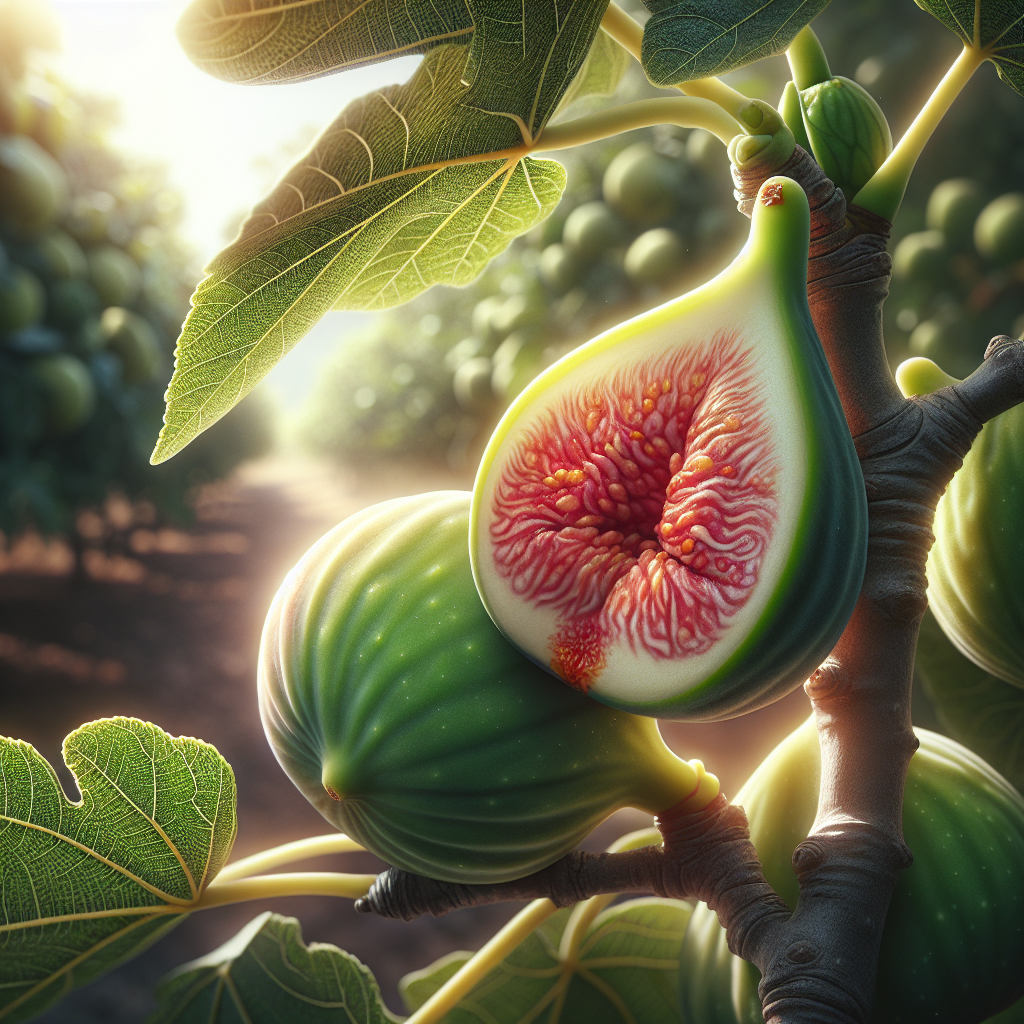
Introduction to Fig (Adriatic)
A long-established cultivar in the common fig group, Adriatic is best known for its pale green to yellow-green skin and deep pink to strawberry-red interior. It is widely regarded as one of the finest dessert and drying figs because the flesh develops a concentrated berry-like sweetness with low acidity when fully mature. In Mediterranean-style climates, the fruit can be outstanding, with syrupy pulp, thin skin, and excellent sugar accumulation.
This cultivar is generally grown for the main crop rather than for a strong breba crop, so annual productivity depends heavily on preserving healthy current-season shoots and maintaining balanced vigor. Adriatic is often associated with premium dried fig production, especially in regions with hot summers and dry ripening weather. Compared with darker-skinned types such as Mission Fig, Adriatic is usually more visually subtle on the tree, so careful harvest timing matters.
Botanically, fig fruit is a syconium, an enclosed inflorescence containing many tiny flowers internally. What growers call the "fruit" is actually a fleshy receptacle lined with seed-like achenes. This explains why texture, sweetness, and cavity formation differ so much among cultivars. Adriatic tends toward soft, richly filled interiors when well watered early in fruit development and then allowed to ripen under drier, sunny conditions.
For commercial and serious home production, this is a cultivar that benefits from site precision. It is forgiving once established, but exceptional quality comes from managing three things very well: drainage, sunlight, and irrigation consistency before ripening. A useful broader reference for species-level habits is our Fig guide.
Botanical Profile of Fig (Adriatic)
Adriatic belongs to the species Ficus carica, family Moraceae. It is a deciduous subtropical fruit tree with a spreading to rounded habit, large lobed leaves, milky latex in stems and immature fruit, and a strong tendency to produce vigorous shoots from older wood and the root crown. Mature trees commonly reach 10-20 feet tall in managed plantings, though unpruned specimens can grow larger and broader than tall.
Leaves are rough-textured, aromatic when crushed, and usually three- to five-lobed. The tree enters winter dormancy in cooler climates, shedding leaves after autumn cooling or frost. Fruiting wood for the main crop forms largely on new shoots arising from one-year-old wood or older framework, depending on pruning style and local climate. That means excessively hard winter pruning can reduce the upcoming crop by stimulating too much vegetative growth at the expense of fruiting nodes.
Adriatic fruit is medium to medium-large, turbinate to rounded, with green skin that may remain relatively pale even at maturity. Unlike dark figs, color change is not the best harvest indicator. Instead, watch for neck softening, slight droop, skin dulling, fine surface cracking near full ripeness, and a slight opening of the eye without signs of souring. The pulp should be dense, jammy, and richly colored.
This cultivar is usually considered common-type fig, meaning it sets fruit parthenocarpically in many growing regions without pollination. In practical terms, most growers can produce a crop without caprification. However, local strain behavior can vary, and performance depends more on climate and crop load than on pollination needs in most gardens and orchards.
Adriatic is valued for high soluble solids when mature. In hot, dry finish conditions, fruit sugar concentration rises markedly, making it ideal for fresh eating, preserves, paste, and drying. The thin skin is excellent for flavor but means the fruit bruises easily and has a short postharvest window.
Soil, pH, and Climate Requirements for Fig (Adriatic)
This cultivar thrives in deep, moderately fertile, well-drained soil with strong aeration in the upper root zone. Sandy loam, loam, and gravelly loam are excellent. Heavier clay can work if planted on a berm or raised mound and improved with coarse organic matter, but prolonged saturation is a major risk. Figs tolerate poorer soils better than many fruit trees, yet fruit size and consistency improve significantly when root conditions are balanced rather than harsh.
Ideal soil pH is about 6.0-7.5, with best nutrient availability often seen around 6.2-6.8. It can tolerate slightly alkaline conditions better than blueberries or many soft fruits, but when pH rises above 7.8, iron chlorosis may appear, especially in calcareous soils. Symptoms include yellowing young leaves with green veins, reduced shoot growth, and smaller fruit. If this occurs, incorporate compost regularly, improve drainage, and consider chelated iron appropriate for high-pH soils.
Drainage matters more than richness. Roots need oxygen. If water stands in the planting hole longer than 24 hours after heavy irrigation or rain, the site is unsuitable without modification. Chronic saturation leads to root decline, weak canopy growth, fruit drop, and increased vulnerability to fungal pathogens. In practical field terms, aim for soil that can be squeezed into a ball when moist but crumbles with light pressure rather than forming a sticky ribbon.
Climatically, Adriatic performs best in warm temperate to Mediterranean zones with hot summers, low summer rainfall, and mild winters. Full sun is essential; a minimum of 8 hours direct sun is preferred, and 10 or more hours in summer improves sugar loading and reduces disease pressure. Humid climates can still produce the tree well, but fruit quality may be lower and spoilage higher, especially near maturity.
Winter cold tolerance is respectable for a fig, but young wood can be damaged below about 15-20°F (-9 to -6°C), and severe trunk injury may occur lower than that depending on tree hardiness, acclimation, and site exposure. Dormant mature trees often recover from moderate freeze damage, yet repeated winter injury reduces structure and delays cropping. In marginal climates, plant against a south- or west-facing masonry wall, avoid frost pockets, and mulch the root zone without burying the trunk.
Heat tolerance is strong, but fruit can sunburn during sudden heat spikes above 100°F (38°C), especially after canopy thinning. Moderate leaf cover over the crop is beneficial. Wind protection is also valuable because softening fruit rubs and splits easily under hot dry wind.
Step-by-Step Planting & Propagation
Plant dormant bare-root or container-grown trees in early spring after severe frost danger has passed, or in mild-winter climates during late fall through winter so roots establish before summer heat. Choose a site with excellent air drainage, open sun, and at least 12-16 feet spacing from other trees if you want a broad, accessible canopy. High-density plantings can be closer, but only with disciplined annual pruning.
For planting, first prepare an area rather than a narrow hole. Loosen soil in a circle 3-4 feet wide. Do not create a compost pocket in heavy soil, as roots may circle in the amended zone and water can collect there. Dig a hole only as deep as the root system and two to three times as wide. Set the tree so the original nursery soil line sits at or slightly above the surrounding grade. In heavy soils, 2-4 inches above grade on a gentle mound is safer.
Backfill with native soil. Water thoroughly to settle air pockets, then apply 2-4 inches of mulch such as wood chips, shredded leaves, or composted bark, keeping mulch 4-6 inches away from the trunk. Initial staking is usually unnecessary unless the site is windy or the nursery whip is top-heavy.
In the first year, remove damaged shoots and decide on form. A multi-trunk bush form is common in colder regions because it resprouts well after freeze damage. A low open-center tree with 3-5 main scaffolds is often better for warm climates and easier harvest. Head back the planting whip to encourage lateral branching if needed.
Propagation is straightforward from hardwood cuttings. During dormancy, select pencil-thick to thumb-thick one-year wood 8-12 inches long with several nodes. Make a flat cut at the top and an angled cut at the base for orientation. Insert the lower half to two-thirds of the cutting into a sterile, well-drained medium such as coarse perlite mixed with peat or coco coir. Bottom heat around 70-75°F (21-24°C) speeds rooting, while top growth prefers slightly cooler air. Keep the medium evenly moist, not saturated. Rooted cuttings can be potted once white roots are 1-2 inches long and the cutting resists a gentle tug.
Air layering is also possible for preserving true-to-type material from superior trees. Bendable, one-year shoots can be girdled lightly, wrapped with moist medium, and enclosed until roots form. This method yields larger transplAnts faster but is more labor-intensive.
If you're improving the orchard floor before planting, the principles in soil health strategies are especially useful for building water infiltration and long-term tilth.
Care & Maintenance regimes for Fig (Adriatic)
Irrigation should be adjusted by tree age and fruit stage. Newly planted trees need frequent but not constant moisture. For the first 6-10 weeks after planting, keep the root zone uniformly moist to roughly the top 8-12 inches. In practical terms, irrigate when the top 2-3 inches begin to dry, but before the root ball becomes dusty or hydrophobic. A newly planted tree may need 2-5 gallons every 2-4 days in warm weather, depending on soil texture.
Established trees are moderately drought tolerant, but tolerance is not the same as optimal production. Deep irrigation is preferred over shallow sprinkling. On loam soils, mature trees often perform well with watering that wets soil 18-24 inches deep, followed by a partial dry-down before the next cycle. During active shoot growth and early fruit sizing, maintain moderate moisture. A good target is soil that feels cool and faintly moist at 6 inches depth, never swampy and never powder-dry for extended periods.
Overwatering signs include limp yellowing leaves, low vigor despite abundant water, small fruit that drops prematurely, sour-smelling soil, algae or moss near emitters, and persistent wetness beyond 24-48 hours after irrigation. Underwatering signs include dull leaves folding inward in afternoon heat that do not recover by morning, hard undersized fruit, early leaf yellowing on interior shoots, and fruit splitting after a dry spell followed by heavy watering.
The most important irrigation nuance for Adriatic is consistency before ripening and restraint during final maturation. Irregular moisture during fruit swell can cause splitting or watery flavor. Once fruit begins softening, slightly reducing irrigation can improve sweetness, but do not impose severe drought or the tree may abort fruit and weaken next year's wood.
Fertilization should be conservative. Excess nitrogen creates rampant vegetative growth, large coarse leaves, delayed ripening, and lower flavor concentration. Young trees may benefit from light feeding in spring, such as 0.25-0.5 pound of actual nitrogen split over two or three applications, depending on soil fertility and tree size. Mature trees often need little fertilizer if annual shoot growth is 8-12 inches on bearing wood. If growth exceeds 18-24 inches broadly across the canopy, reduce nitrogen.
Compost as a surface dressing is often enough in home orchards. In commercial settings, leaf analysis and soil testing are preferable. Potassium is important for fruit quality, sugar movement, and drought resilience. Where fruit quality is poor despite healthy canopy color, low potassium is worth checking. Avoid high late-summer nitrogen, which pushes tender growth before winter.
Pruning is best done during dormancy or very early spring. Remove dead, crossing, weak, and inward-growing shoots. Preserve a framework that allows light penetration without exposing all fruit to harsh afternoon sun. Since Adriatic's main crop is important, avoid severe heading cuts across all fruiting wood every year. Instead, thin selectively and renew gradually. Summer pinching of overly vigorous water sprouts can redirect energy toward fruit maturation.
Mulch helps moderate soil temperature and moisture. Maintain a 3-5 foot weed-free ring around young trees because figs dislike root competition during establishment. Keep grass and aggressive perennial weeds away from the drip line.
Container culture is possible, but Adriatic is more demanding in pots because moisture swings are sharper. Use a large container, at least 20-30 gallons, with a mineral-rich, sharply drained mix. Root pruning and canopy pruning must be balanced every few years.
Pests, Diseases & Organic Management
Birds are often the most serious preharvest pest because pale fruit can be ignored until peak sweetness, then stripped quickly. Use netting before fruit softens. Lightweight drape netting works for home trees; commercial systems may require framed exclusion. Harvesting daily at full maturity also reduces losses.
Fig beetles, Ants, Wasps, and Fruit flies may enter soft fruit through the eye or through splits. Sanitation is crucial: remove fallen fruit every day during peak season, harvest promptly, and avoid overripe fruit hanging on the tree. Ant barriers on trunks can reduce secondary pest activity where Ants farm sap-feeding insects.
Nematodes can be a significant issue in sandy soils, especially in warm regions. Symptoms include poor vigor, sparse leaves, and weak response to irrigation despite no visible trunk disease. Heavy mulching, compost additions, and maintaining biologically active soil can help suppress damage, though heavily infested sites may remain problematic.
Rust can appear as yellow spots on upper leaf surfaces with Rusty pustules beneath, leading to premature defoliation in humid conditions. Improve air circulation, avoid overhead irrigation, and remove heavily infected fallen leaves. A copper-based organic spray may help in severe recurrent cases if applied preventively according to local regulations.
Anthracnose, Fruit souring, and Soft rots increase with rain or overhead irrigation near harvest. Because Adriatic has tender, sweet fruit, it is more vulnerable to spoilage during humid ripening periods than firmer, thicker-skinned cultivars. The best organic control is cultural: dry canopy, open airflow, clean orchard floor, and rapid harvest at maturity.
Mosaic virus-like symptoms occur in some figs, showing mottled leaves, distortion, and reduced vigor. Since figs are commonly propagated vegetatively, starting with clean planting stock is important. Trees with mild symptoms may still crop acceptably, but severe cases should not be used for propagation.
Scale insects, Mealybugs, and Aphids can colonize shoots and leaf undersides. Dormant horticultural oil, applied correctly in the dormant season, is often effective for suppressing overwintering populations. During the growing season, encourage beneficial insects and avoid broad-spectrum insecticides that disrupt predator balance.
Root rot is the most dangerous chronic problem in poorly drained soils. No spray fixes bad drainage. If a tree declines from waterlogging, correction means redirecting water, improving grade, or replanting on a mound in a better site.
Harvesting, Curing & Optimal Storage
Harvest only when fruit is fully mature. Adriatic does not always signal readiness strongly by color, so rely on texture and posture. Ripe fruit softens at the neck, hangs downward, and feels heavy and yielding but not collapsed. The skin may show slight wrinkling and small sugar cracks. The eye should remain relatively sound; if it is wide open with fermentation odor, harvest is late.
Pick by lifting and twisting gently, or clip with short stem if you want cleaner presentation. Wear gloves if latex irritates your skin, especially when harvesting fruit that is not completely ripe. Morning harvest after dew dries but before midday heat helps preserve quality.
For fresh market use, sort immediately. Separate split, pecked, or overripe fruit from sound fruit. Because the skin is delicate, stack only shallowly. Refrigerate at about 32-36°F (0-2°C) with high relative humidity around 85-90%. Even under good conditions, fresh Adriatic figs are best within 3-5 days. Longer storage usually causes flavor decline and skin breakdown.
For drying, select fully ripe but still intact fruit with high sugar content. Drying can be done on screens in hot, arid climates with insect protection, or in a dehydrator at low temperature, typically around 135°F (57°C), until leathery and pliable. Properly dried figs should have reduced moisture enough to prevent free water but remain supple rather than brittle. Conditioning dried fruit in loosely filled jars for several days, shaking daily, helps equalize moisture. If condensation appears, dry further.
Store dried figs in airtight containers in a cool, dark place. For long keeping, refrigeration or freezing is excellent. Watch for mold if fruit was under-dried. High-quality Adriatic is particularly prized when dried because the internal flesh becomes dense, amber-red, and confection-like.
Companion Planting for Fig (Adriatic)
Companion planting around figs works best when it supports pollinators, beneficial insects, mulch production, and shallow soil improvement without creating dense root competition right at the trunk. Keep the inner 2-3 feet around young trees relatively clear, then establish companions beyond that ring.
Thyme is an excellent low-growing companion because it tolerates sunny, dry conditions and does not aggressively overtop the root zone. It can reduce bare soil, attract beneficial insects when flowering, and make harvest areas cleaner.
Clover is useful in wider orchard alleys or beyond the immediate trunk zone. As a living mulch, it helps moderate erosion, supports beneficial insects, and contributes biologically fixed nitrogen over time. It should be mowed or suppressed if it begins competing with young trees for water.
Yarrow is especially valuable in diversified orchards. Its flowers attract predatory Wasps, hoverflies, and other beneficial insects that help regulate Aphids and small soft-bodied pests. It also tolerates lean soils and summer dryness well.
Avoid planting thirsty annual vegetables directly under the canopy, especially crops that need frequent irrigation such as shallow-rooted salad greens. Figs prefer deeper, less frequent watering than many vegetables. Also avoid aggressive woody herbs or invasive grasses that compete strongly with surface roots.
A practical fig guild therefore includes a weed-free mulch ring close to the trunk, thyme as an edge groundcover, clover in the alley, and yarrow in insectary patches nearby. This arrangement supports soil life and orchard biodiversity without compromising fruit quality.