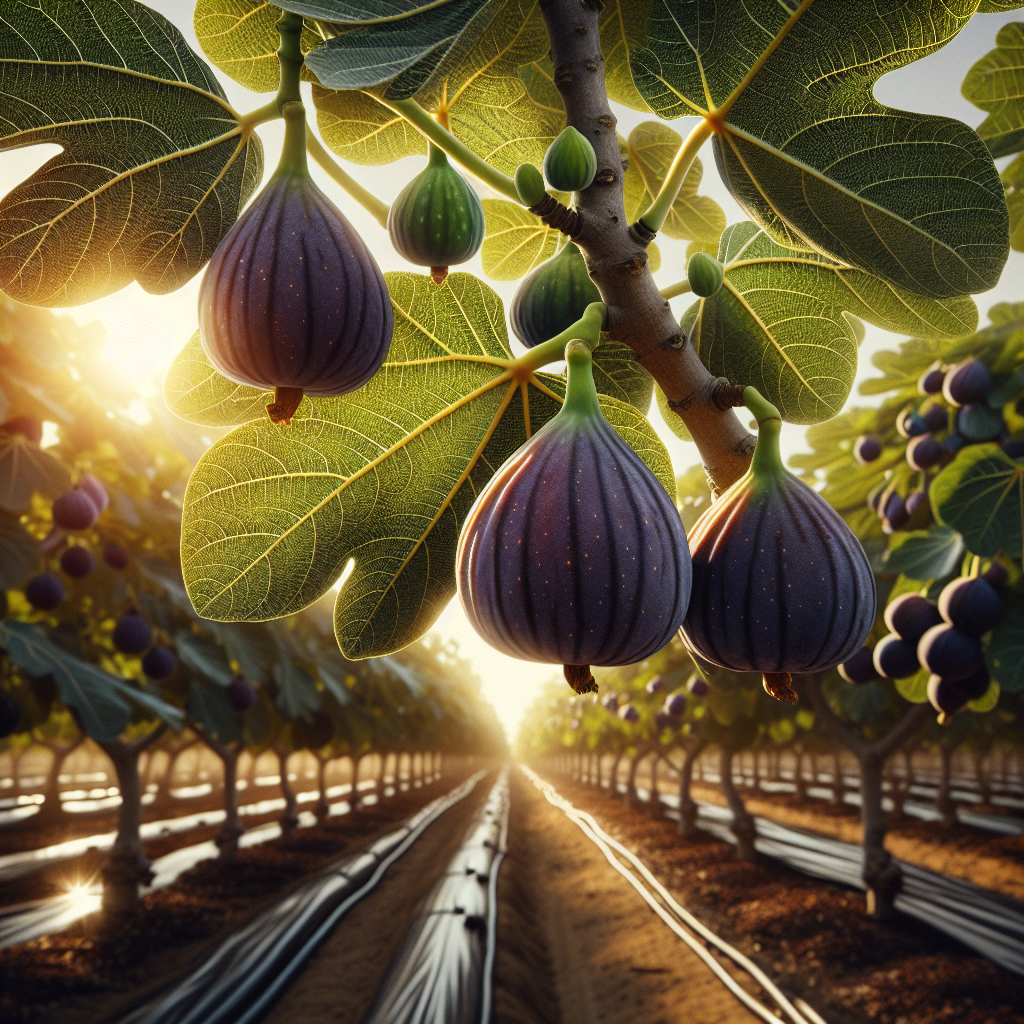
Introduction to Mission Fig
Known historically as Black Mission, this heirloom fig is one of the most recognizable and commercially important dark-skinned figs in North America. It is believed to have been introduced to California by Spanish missionaries in the 18th century, which is the origin of its common name. The fruit is medium to large, with deep purple to nearly black skin, pink to strawberry-red pulp, and a dense, jammy texture when fully ripe. Flavor is typically richer and more complex than many light-skinned figs, with notes often described as berry-like, honeyed, and mildly vinous.
Mission Fig is a common-type fig, meaning it does not require pollination by the fig wasp to set edible fruit in the regions where it is widely grown. That trait makes it especially practical for home orchards and small farms. In suitable climates it can bear a breba crop on overwintered wood, followed by a larger main crop on current season growth, though the reliability of the breba crop depends strongly on winter temperatures and pruning strategy. For growers who want a hardy, forgiving fruit tree with ornamental appeal and strong culinary value, it is among the most rewarding choices. For broader fig background, see the Fig guide.
Botanical Profile of Mission Fig
This cultivar belongs to the mulberry family, Moraceae. Like other figs, it produces milky latex in leaves, shoots, and immature fruit; this sap can irritate skin and should be considered when pruning or harvesting. The tree has a broad, spreading habit, often wider than tall if unpruned, with smooth gray bark and large, palmately lobed leaves that are rough on the upper surface and softly pubescent beneath.
Mature size varies with root restriction, climate, and training system. In open ground, an unpruned Mission Fig can reach 15-30 feet tall and nearly as wide, though most productive orchard trees are maintained in the 8-15 foot range for ease of harvest and light penetration. Internodes are moderate in length, and the tree responds vigorously to hard pruning, often pushing long vegetative shoots that can delay ideal fruiting balance if nitrogen or irrigation is excessive.
The fig "fruit" is technically a syconium, a fleshy inverted inflorescence lined internally with tiny flowers. As the crop matures, the ostiole, or eye, remains relatively small compared with some other cultivars, which can slightly reduce insect entry and spoilage risk, though it does not eliminate it. Mission fruits generally have a teardrop to turbinate shape, often with a short neck. Skin color deepens from green-bronze to reddish purple and finally nearly black at full ripeness. Flesh becomes soft, syrupy, and highly aromatic. Soluble solids can become very high under hot, dry finishing conditions.
Compared with many other fig cultivars, Mission has a strong reputation for drying quality because the flesh remains flavorful and concentrated after dehydration. It is also valued for fresh market sales when harvested at near-tree-ripe stage, although the fruit is delicate and bruises easily once fully soft.
Soil, pH, and Climate Requirements for Mission Fig
Mission Fig performs best in well-drained loam, sandy loam, or gravelly loam with moderate fertility. It tolerates poorer soils better than many fruit trees, but cropping and fruit size improve when the root zone is deep, aerated, and biologically active. The most important soil rule is drainage: prolonged saturation around the root crown sharply increases the risk of root decline, canker, and fruit splitting. Heavy clay can work if planted on a berm or raised row 12-18 inches high, but flat planting in poorly drained ground is rarely successful long term.
An ideal soil pH range is about 6.0-7.5, though trees often tolerate slightly more alkaline conditions better than acid-loving fruits. In very alkaline soils above pH 7.8, iron chlorosis may appear as interveinal yellowing on young leaves, especially where bicarbonates are high or roots are waterlogged. If chlorosis occurs, correcting drainage and organic matter management usually helps more than simply adding fertilizer.
Climate preference is strongly Mediterranean: hot, dry summers and relatively mild winters. The tree is drought-tolerant once established, but drought tolerance should not be confused with maximum productivity. Consistent but not excessive moisture during active shoot growth improves canopy development; slightly reduced irrigation as fruit colors can improve sweetness and reduce splitting. Mission Fig generally thrives where summer temperatures frequently reach 27-35°C (80-95°F). Higher heat can be tolerated if soil moisture is adequate and sunburn is not severe.
Winter cold tolerance is moderate. Established dormant wood may survive around -9 to -12°C (15-10°F) with variable damage depending on exposure, tree health, and acclimation. Young trees are more vulnerable. Breba production is especially sensitive to winter injury because that crop develops on previous year's wood. In colder inland or marginal temperate zones, the main crop is usually more reliable than the breba crop.
Humidity matters. In humid summer climates, Mission Fig is more prone to souring, fruit cracking, and fungal problems than in dry-summer regions. Site selection should prioritize full sun, open airflow, and fast drying after rain or dew. Avoid frost pockets, low basins where cold air settles, and shaded areas near walls that trap humidity without providing full reflected heat.
For moisture, aim to keep the main root zone evenly moist but never swampy. In practical terms, soil in the top 6-8 inches should dry somewhat between irrigations, while the soil at 8-18 inches deep should remain lightly moist during active growth. If the topsoil remains constantly wet, leaves turn overly lush and pale, fruit flavor becomes diluted, and roots become oxygen-starved. Signs of overwatering include yellowing lower leaves, soft vegetative growth, fruit splitting before full sweetness, and sour odor in the root zone. Signs of underwatering include midday leaf droop that persists into evening, small tough fruit, early fruit drop, and marginal leaf scorch.
Step-by-Step Planting & Propagation
Choose a nursery tree that is true to type, disease-free, and either container-grown or freshly dug during dormancy. One-year-old trees often establish faster than oversized stock because root-to-top balance is better after transplanting. Select a site with at least 8 hours of direct sun daily.
- Test drainage before planting. Dig a hole 18 inches deep, fill it with water, let it drain, then refill. If water remains after 12 hours, drainage is too slow for direct planting without a raised mound.
- Prepare a broad planting zone rather than an overly amended pit. Loosen soil 3-4 feet wide. Avoid creating a rich, narrow pocket that encourages circling roots.
- Plant at the same depth as in the nursery container, or slightly high in heavy soils. Do not bury the crown.
- Space trees 12-20 feet apart depending on training system. For backyard open-center trees, 15 feet is a practical minimum; for larger orchard specimens, 18-20 feet reduces crowding.
- Water deeply immediately after planting to settle soil around roots. Apply 2-4 inches of mulch, keeping it 4-6 inches away from the trunk.
Propagation is straightforward and one reason figs have been preserved for centuries. Hardwood cuttings are the standard method. During late winter dormancy, take pencil-thick cuttings 8-12 inches long with 3-5 nodes from healthy one-year wood. Make a flat cut at the base below a node and a slanted cut at the top above a node to preserve orientation. Rooting can be done in a very well-drained medium such as coarse perlite with bark, or directly in a nursery bed in mild climates. Bottom heat around 21-24°C (70-75°F) improves speed and uniformity. Keep media barely moist, not wet; Mission cuttings rot readily in stagnant, saturated conditions.
Layering is also effective. Bend a low branch to the ground, wound the underside lightly, bury a section 3-4 inches deep, and leave the tip exposed. Once rooted, sever and transplant during dormancy.
If growing in a container, begin with at least a 15-25 gallon pot and use a sharply draining mix. Root restriction helps control size but increases irrigation frequency and nutrient leaching, so container Mission Figs require more attentive management than in-ground trees.
Care & Maintenance regimes for Mission Fig
Training should begin immediately. The two most practical forms are open-center and multi-trunk bush. In regions with freeze risk, a multi-trunk system is advantageous because damaged stems can be renewed from the base. In warm orchard conditions, an open vase with 3-5 scaffold branches provides excellent light distribution.
Pruning strategy depends on which crop you prioritize. Heavy winter pruning removes much of the potential breba crop because brebas form on older wood. If your climate reliably supports brebas, prune conservatively: remove dead, crossing, shaded, and weak shoots, then shorten only as needed to keep structure manageable. If you are mainly targeting the main crop, you can prune more assertively to stimulate new fruiting wood while preserving enough canopy to prevent sunburn.
Water management changes through the year:
- Establishment year: irrigate deeply 1-2 times weekly depending on soil texture and temperature. Sandy soils may need smaller, more frequent irrigations; clay soils require less frequent but carefully monitored watering.
- Years 2 and beyond: deep irrigation every 7-14 days is typical in dry climates during active growth, adjusted for heat and soil type.
- Fruit ripening period: avoid sudden swings from dry to saturated soil, which commonly trigger splitting. Maintain moderate, even moisture, then reduce slightly as fruit softens to improve sugar concentration.
A mature in-ground tree may need roughly 10-20 gallons per irrigation event in home conditions, more for large orchard trees in hot weather. The exact number depends on canopy size, soil infiltration, and evapotranspiration. Drip irrigation is ideal; place emitters near the outer half of the canopy rather than against the trunk to encourage a wide feeder-root zone.
Fertilization should be restrained. Excess nitrogen causes rank shoot growth, larger internodes, delayed ripening, and bland fruit. If annual shoot extension is already 12-18 inches on bearing wood, additional nitrogen may be unnecessary. In low-fertility soils, apply a modest balanced organic fertilizer or compost in early spring, then assess leaf color and growth. Young trees can benefit from split spring applications, while mature productive trees often need only light feeding. Potassium supports sugar movement and fruit quality, but gross overapplication is unnecessary if soil biology and organic matter are strong. The principles in soil health strategies are especially useful for maintaining fig vigor without overfertilization.
Mulching improves moisture buffering and reduces weed competition. Use wood chips, leaf mold, or composted bark 2-4 inches deep under the canopy, but keep the trunk flare exposed. Do not cultivate deeply around figs; many feeder roots are shallow and are easily damaged.
In cold regions, wrap young trunks, mound mulch over the root zone before hard freezes, and consider espalier training against a south-facing wall. If dieback occurs, wait until spring growth resumes before removing damaged wood, since apparently dead stems sometimes resprout below injured tissue.
Pests, Diseases & Organic Management
Mission Fig is generally resilient, but pest pressure depends heavily on climate and sanitation. Birds are among the biggest fruit thieves, especially once the crop softens. Exclusion netting is usually the most effective solution. Harvesting as soon as fruit reaches full color and slight neck droop reduces losses.
Ants often move onto ripening fruit to feed on sugars and may farm sap-sucking insects nearby. Use sticky trunk barriers where appropriate and manage honeydew-producing pests. Fruit beetles, dried-Fruit beetles, and Vinegar flies can invade split or overripe figs, particularly where fallen fruit is left beneath trees. Sanitation is critical: collect dropped and damaged figs at least twice weekly during peak ripening.
Nematodes can be problematic in sandy soils, causing weak growth, poor establishment, and chronic nutrient stress. Increasing organic matter and avoiding replanting into heavily infested sites helps. Root-knot pressure is often worse where trees are already moisture-stressed.
Common diseases include Fig rust, Leaf spot, Fruit souring, and various Cankers. Fig rust appears as yellow angular spots on upper leaf surfaces with rusty pustules beneath, leading to defoliation in humid or late-season conditions. Improve air circulation, avoid overhead irrigation, remove heavily infected fallen leaves, and keep nitrogen moderate. Fruit souring is less a single disease than a spoilage syndrome involving yeasts, bacteria, and insects entering the ostiole or damaged skin. It is strongly associated with humid weather, cracked fruit, and delayed harvest.
Root diseases are most likely in poorly drained soil. Organic management begins with prevention: raised planting, mulching without trunk contact, balanced irrigation, and avoiding chronic saturation. Once Root rot is advanced, chemical or organic rescue is rarely very effective compared with correcting the site.
Sunburn can also be considered a physiological disorder. If heavy pruning suddenly exposes scaffold limbs, bark can overheat and crack. Retain enough leaf cover, or whitewash exposed limbs with diluted interior white latex paint if needed.
A strong organic program for Mission Fig includes:
- full sun and airflow
- drip irrigation instead of overhead watering
- prompt harvest of ripe fruit
- removal of fallen fruit and diseased leaves
- trunk barriers for Ants
- bird netting before full ripeness
- moderate fertility rather than lush growth
- diverse insectary planting with Thyme, Yarrow, and Nasturtium
Harvesting, Curing & Optimal Storage
Mission Fig should be harvested only when physiologically ripe, because figs do not meaningfully improve in flavor after picking. The fruit is ready when skin is fully dark, the neck bends slightly, the body softens, and tiny beads of nectar may appear near the eye. A ripe fig often feels heavy for its size and may show slight skin cracking near peak sweetness. Do not rely on color alone; shaded fruit can darken before the interior fully matures.
Pick gently with a slight lift and twist, ideally in the cool morning after surface moisture has dried. Wear gloves if latex sensitivity is an issue. Handle harvested figs in shallow containers no more than 1-2 layers deep to avoid bruising.
For fresh use, rapidly cool to around 0-2°C (32-36°F) if possible. At room temperature, fully ripe fruit may keep only 1 day. Refrigerated, high-quality fresh Mission Figs usually hold 3-5 days before texture declines. Relative humidity around 85-90% helps prevent shriveling, but free moisture encourages mold.
Mission Fig is excellent for drying. Select fully ripe but not fermented fruit. Wash only if necessary and dry surface moisture thoroughly first. Halving fruit speeds dehydration and reduces spoilage risk in humid areas. Dry at about 52-57°C (125-135°F) until leathery but still pliable, with no wet interior pockets. Properly dried figs can be conditioned in jars for a week, shaking daily to equalize moisture. If condensation appears, return them to the dryer. Store fully dried fruit in airtight containers in a cool, dark place; for long storage, refrigeration or freezing preserves quality best.
For preserves, harvest just before peak softness when sugar is high but the fruit still holds shape. Mission's dark skin and red flesh produce richly colored jams, chutneys, and compotes.
Companion Planting for Mission Fig
Companion planting around figs works best when the goals are pollinator support, beneficial insect habitat, living mulch, and shallow-rooted biodiversity that does not aggressively compete with the tree. Avoid planting thirsty annuals directly against the trunk or deep-rooted species that will battle for water in the feeder-root zone.
Low-growing aromatic herbs and insectary flowers are especially useful. Thyme tolerates dry conditions, suppresses some weeds, and attracts beneficial insects when flowering. Yarrow is valuable for parasitoid wasps and predatory insects, while Nasturtium can serve as a trap plant for aphids and provides ground-level cover in some climates. Clover can be used farther from the trunk as a living mulch and nitrogen-contributing understory, though it should be managed so it does not create excessive humidity immediately around the crown.
Keep the first 12-18 inches around the trunk clear of dense plantings and mulch piled against bark. In young orchards, companion strips are best established outside the immediate root crown zone, roughly from the drip line outward. In mature plantings, companions can occupy alleys or the sunny outer edge of the canopy where airflow remains good.
Poor companions include vigorous vines, high-water-demand vegetables, and plAnts requiring frequent tillage. Figs prefer a relatively undisturbed root environment, so permanent or semi-permanent companion species are usually superior to seasonal digging and replanting directly under the canopy.