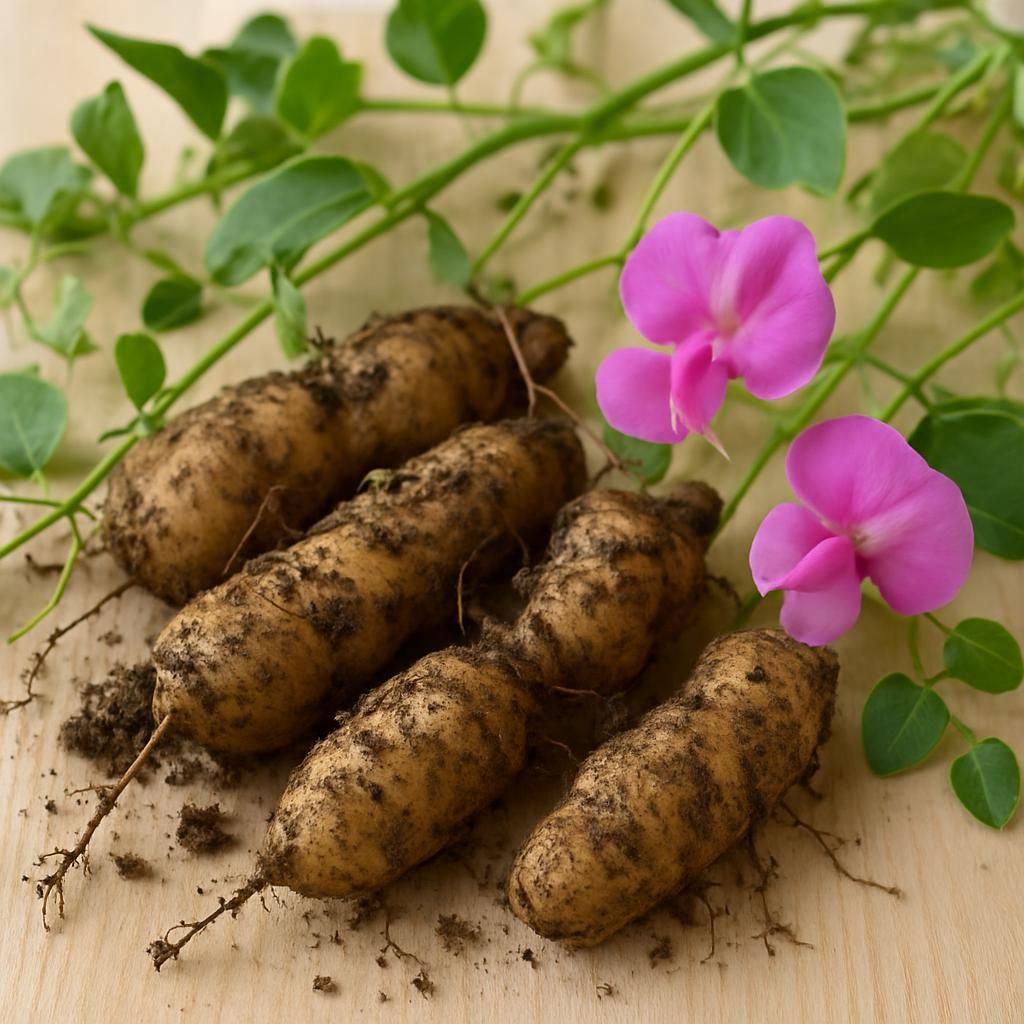
Introduction to Earthnut Pea
Earthnut Pea (Lathyrus tuberosus) is a hardy perennial legume prized for its sweet, chestnut-flavored tubers that develop underground. Native to Europe and parts of Asia, this crop has been cultivated for centuries as a nutritious food source and soil-improving plant. The plant produces slender vines with pink to purple pea-like flowers and fixes atmospheric nitrogen, making it an excellent choice for sustainable gardens and regenerative farming systems.
Unlike annual peas, Earthnut Pea returns each spring from its tuberous roots, providing multi-year harvests with minimal replanting. The tubers are rich in carbohydrates, protein, and minerals, offering a gluten-free alternative to potatoes or chestnuts. Because it tolerates poor soils and requires little fertilizer, it fits well into low-input and organic production.
Botanical Profile of Earthnut Pea
Earthnut Pea belongs to the Fabaceae family. It grows as a climbing or trailing vine reaching 1–2 meters in length, supported by tendrils. The leaves are pinnate with 2–4 pairs of leaflets and a terminal tendril. Flowers appear in axillary racemes from late spring through summer, typically pink to reddish-purple, and are highly attractive to bees. After pollination, slender pods form, each containing 4–8 small seeds.
The most valued part of the plant is the tuber system. These thickened roots develop at the base of the stem and along stolons, ranging from marble-sized to 4 cm in diameter. Tubers have a smooth, tan to reddish-brown skin and crisp white flesh with a sweet, nutty flavor when cooked or roasted. The plant spreads slowly via underground rhizomes, forming expanding patches over several seasons.
Soil, pH, and Climate Requirements for Earthnut Pea
Earthnut Pea performs best in well-drained, moderately fertile loamy soils. It tolerates a wide pH range but yields highest in slightly acidic to neutral conditions. The crop is winter-hardy to approximately −20 °C and thrives in temperate climates with cool springs and warm summers. Excessive heat above 30 °C can reduce flowering and tuber set.
| Parameter | Ideal Range | Notes |
|---|---|---|
| Soil Type | Loam, sandy loam | Avoid heavy clay without amendment |
| Soil pH | 6.0–7.2 | Slightly acidic to neutral |
| Temperature | 15–25 °C daytime | Cool nights improve tuber quality |
| Annual Rainfall | 500–900 mm | Supplemental irrigation in dry periods |
| USDA Zones | 4–8 | Mulch crowns in colder zones |
| Drainage | Excellent | Raised beds recommended on heavy soils |
Step-by-Step Planting & Propagation
Earthnut Pea is most reliably propagated from tubers rather than seed. Select firm, healthy tubers in early spring or late autumn. Plant tubers 5–8 cm deep and 20–30 cm apart in rows spaced 60–75 cm apart. For new plantings, incorporate well-rotted compost or aged manure into the top 20 cm of soil before planting.
Direct sowing of scarified seed is possible but slower; soak seeds 24 hours and sow 2 cm deep in the same spacing. Germination occurs in 10–20 days at 15–20 °C. Because the crop is perennial, choose a permanent bed or edge where spreading can be managed. Support vines with trellis, netting, or pea sticks to improve air circulation and ease of harvest.
Care & Maintenance regimes for Earthnut Pea
Consistent moisture during the first growing season encourages rapid tuber formation. Established plants are moderately drought-tolerant but benefit from 25–40 mm of water weekly during tuber bulking. Mulch with 5–8 cm of straw or leaf mold to suppress weeds and retain soil moisture.
Nitrogen fixation reduces the need for synthetic fertilizers. Apply a balanced organic fertilizer (NPK 5-5-5) at planting and a light top-dress of compost each spring. Avoid high-nitrogen feeds that promote foliage over tubers. Cut back dead foliage in late autumn after frost.
| Growth Stage | Water Schedule | Fertilizer Schedule | Pruning/Maintenance |
|---|---|---|---|
| Establishment (0–8 weeks) | Keep evenly moist, 25 mm/week | Compost + light organic 5-5-5 | Remove weeds; install support |
| Vegetative (8–16 weeks) | 25–40 mm/week during dry spells | Top-dress compost mid-season | Train vines; pinch tips if needed |
| Flowering & Tuber Fill | Maintain moisture; reduce if wet | None additional; mulch only | Deadhead spent flowers if desired |
| Dormancy (Autumn–Winter) | Minimal; natural rainfall | None | Cut back foliage after frost |
Pests, Diseases & Organic Management
Earthnut Pea is relatively pest-resistant but can be affected by Aphids, Slugs, and Root-knot nematodes. Monitor new growth for aphid colonies and blast with water or apply insecticidal soap. Slugs are controlled with beer traps or iron-phosphate baits. Nematode pressure is reduced by crop rotation with Garlic or Marigold and solarization of beds.
Fungal issues such as Powdery mildew and Root rot occur in poorly drained soils. Improve drainage, avoid overhead irrigation, and rotate plantings every 3–4 years. Remove and destroy infected foliage to limit spread. Beneficial nematodes and compost tea applications strengthen plant resistance.
Harvesting, Curing & Optimal Storage
Tubers reach harvestable size 90–120 days after spring emergence. Dig carefully with a garden fork once foliage begins to yellow in late summer or early autumn. Lift tubers, brush off soil, and allow them to cure in a shaded, well-ventilated area for 3–5 days.
Store cured tubers in perforated paper bags or crates at 4–10 °C and 85–90 % humidity. They remain viable for 4–6 months. Smaller tubers can be replanted immediately for the next season or held in moist sand until spring. Seed pods may be collected when fully dry for future propagation if desired.
Companion Planting for Earthnut Pea
Earthnut Pea pairs well with nitrogen-loving crops such as Corn, Tomato, and Squash. Its climbing habit makes it an excellent living trellis for low-growing companions like Lettuce or Radish. Aromatic herbs including Thyme and Rosemary help repel aphids.
Avoid planting near Onion or Garlic families if nematode pressure is high, as these may inhibit tuber formation. Rotate with brassicas or cereals to break pest cycles. Interplanting with Clover or Hairy vetch further enhances soil fertility and biodiversity.