Introduction to Cortland Apple
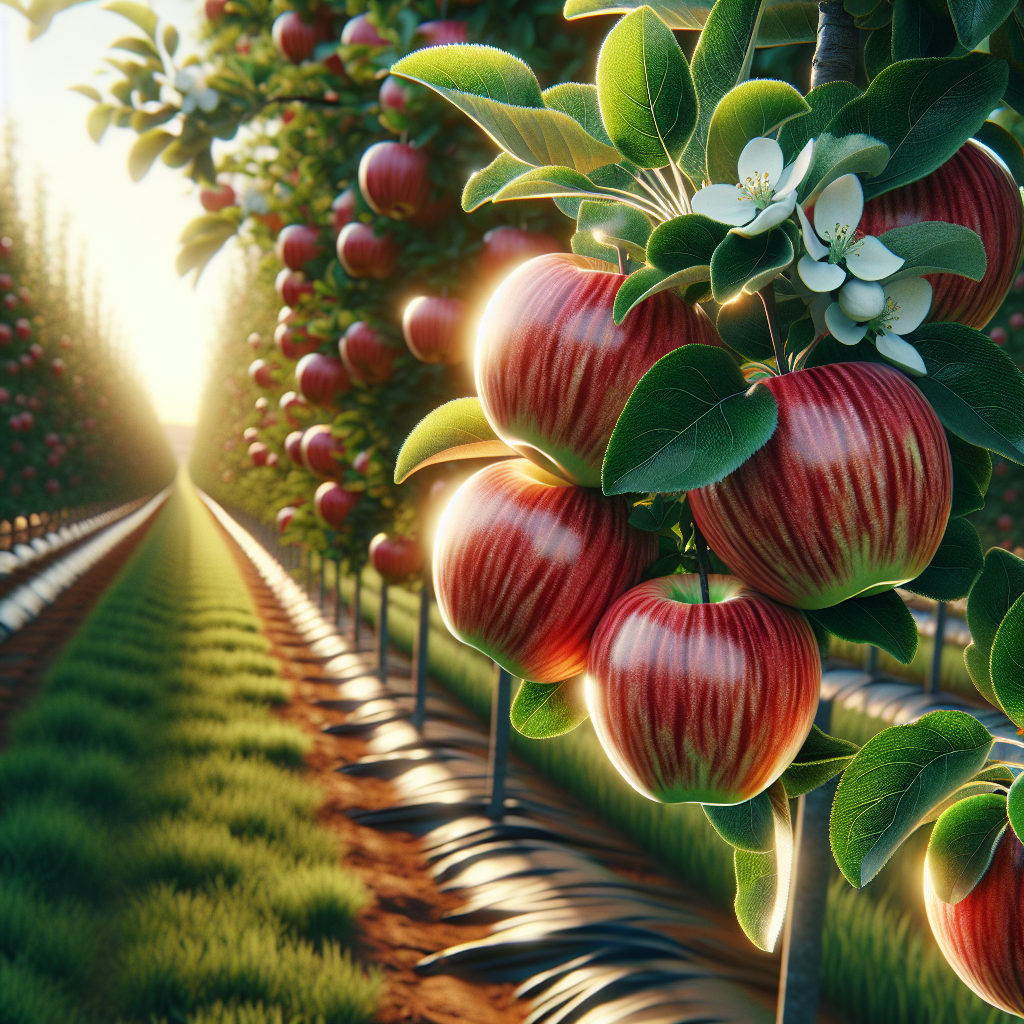
Released in 1915 by the New York State Agricultural Experiment Station in Geneva, New York, this heirloom-era American cultivar remains one of the most recognizable northeastern apples. It was bred from 'McIntosh' × 'Ben Davis', combining the aromatic, tender qualities of McIntosh with improved size and productivity. The fruit is medium to large, round-conical, and typically dark red with green-yellow background color and faint striping. Its flesh is especially notable: bright white, juicy, mildly tart-sweet, and unusually slow to oxidize after slicing, which makes it valuable for fresh eating, salads, platters, and baking where appearance matters.
In orchard terms, it is often considered a mid-season to late-mid-season apple. Fruit quality is highest where days are warm but nights cool near harvest, allowing good color development and balanced sugars. While highly regarded for flavor and texture, it is not the easiest cultivar in humid regions because it can be vulnerable to Apple scab, Fire blight, Cedar apple rust, and bitter pit if nutrition and canopy balance are poorly managed. Growers who understand pruning, sanitation, calcium nutrition, and pollination can produce excellent fruit of premium culinary quality.
For a broader species-level background, see our Apple guide. Cortland is especially worthwhile for growers in USDA zones roughly 4-7 who want a traditional, aromatic apple with strong kitchen value and reliable winter hardiness.
Botanical Profile of Cortland Apple
This cultivar belongs to the rose family, Rosaceae, and is a grafted clone of domesticated apple. Like other apples, it is not grown true from seed if varietal identity matters; commercial and home orchard trees are propagated by grafting onto selected rootstocks. The scion determines fruit identity, while the rootstock influences mature size, precocity, anchorage, disease tolerance, and soil adaptability.
Botanically, the tree is deciduous, with alternate simple leaves, serrated margins, and showy spring blossom clusters. Flowers are typically white to pink in the balloon stage and open in mid-spring, depending on climate. Bloom timing generally overlaps with many mid-season apple cultivars, but Cortland is self-sterile and requires compatible pollen from another apple variety blooming at the same time. Suitable partners often include cultivars such as McIntosh, Empire, or Golden Delicious. Crabapples with overlapping bloom can also serve as pollinizers.
Tree vigor is moderate to strong, especially on semi-dwarf rootstocks. The growth habit tends toward a spreading canopy with somewhat drooping wood as branches age, inherited in part from McIntosh. Annual pruning is important because dense interior shading reduces flower bud formation, fruit color, and air movement, while increasing disease pressure. Fruiting occurs mainly on spurs and short lateral shoots borne on two-year-old and older wood.
Fruit characteristics are central to this cultivar's identity. Typical soluble solids are moderate rather than extremely high, so flavor is aromatic and balanced rather than candy-sweet. Flesh texture is finer and more tender than very crisp modern apples, which some growers and consumers consider a premium trait for sauce and fresh slicing. The skin is thin to medium, which improves eating quality but makes bruising more likely during harvest and packing.
Chill requirement is substantial, typically estimated around 800-1,000 chill hours below 45°F (7°C), making it inappropriate for mild-winter regions. Winter hardiness is good, but flower buds can still be damaged by severe late frosts at bloom. Because its bloom is not especially late, site selection matters in frost pockets.
Soil, pH, and Climate Requirements for Cortland Apple
This cultivar performs best in deep, well-drained loam or sandy loam with high biological activity and moderate water-holding capacity. Ideal soil depth is at least 3 feet (90 cm) before hardpan or restrictive layers. Apples tolerate many mineral soils, but Cortland is less forgiving of chronically wet ground than some growers assume. Saturated soil for even 48-72 hours during active root growth can reduce oxygen around feeder roots, leading to weak shoot growth, nutrient imbalance, and higher susceptibility to collar rot and root decline.
The preferred soil pH is 6.2-6.8. It will often grow in soils as low as 5.8 or as high as 7.2, but nutrient efficiency becomes less predictable outside the ideal range. At low pH, calcium and magnesium may be limiting, and aluminum toxicity can impair root growth. At high pH, iron, manganese, boron, and zinc may become less available, producing chlorosis and weak spur development. If pH is below 6.0, incorporate agricultural lime several months ahead of planting based on a soil test. If pH is above 7.2, sulfur amendments may help gradually, but selecting a more suitable site is often the better long-term decision.
Organic matter around 3-5% is ideal. Excessively rich, heavily manured soils can push lush vegetative growth at the expense of fruiting and worsen Fire blight risk. Good apple soil should be friable, crumble easily when moist, and drain a dug planting hole within a few hours rather than holding standing water overnight.
Climatically, Cortland prefers cool temperate regions with cold winters and moderate summers. USDA zones 4-7 are generally best, with the strongest performance in areas that provide sufficient chill accumulation and a long but not excessively hot ripening period. Extended summer heat above 90°F (32°C), especially with warm nights, can reduce red coloration and soften flavor definition. In humid climates, leaf wetness duration is a major disease driver; morning sun and open airflow are essential.
Rainfall of 30-40 inches (760-1,015 mm) annually can support trees, but rainfall distribution matters more than total amount. During fruit enlargement, trees generally require about 1-1.5 inches (25-38 mm) of water per week from rain or irrigation. Soil moisture should stay evenly moist in the top 8-12 inches, not waterlogged. A practical target is roughly 50-75% of field capacity in the main rooting zone. Signs of adequate moisture include steady shoot growth in spring, healthy dark green leaves, and fruit sizing evenly. Underwatering often shows as dull, slightly cupped leaves, premature fruit drop, small fruit, and reduced return bloom. Overwatering shows as pale leaves, soft extension growth, algae or sour smell near the trunk, and persistent wet soil deeper than 4-6 inches several days after irrigation.
Wind exposure should be moderate. Good airflow helps dry foliage, but strong prevailing wind can scar fruit, damage blossoms, and stress dwarf trees. If possible, plant on a gentle slope rather than in a valley bottom, which traps cold air and increases frost risk.
Step-by-Step Planting & Propagation
Start with a disease-free, named nursery tree on a rootstock matched to your system. For backyard production, M.26 and M.7 are common semi-dwarf options, while B.9 or M.9 suit intensive trellised systems but require permanent support. MM.111 is better for poorer soils and drought tolerance but produces a larger tree and delays bearing somewhat.
- Test the soil 6-12 months before planting. Correct pH, phosphorus, potassium, calcium, magnesium, and boron if deficient.
- Eliminate perennial weeds in a circle at least 3-4 feet wide. Young apple trees suffer badly from grass competition because feeder roots occupy the same upper soil zone.
- Select a site with full sun, at least 8 hours daily, and excellent air drainage.
- Plant while dormant in early spring in cold regions, or late winter where soils remain workable and severe freezes are not expected.
- Dig a hole only as deep as the root system and 2-3 times as wide. Do not create a bathtub-shaped hole in heavy clay; roughen the sides so roots can penetrate native soil.
- Set the tree so the graft union remains 2-4 inches above final soil grade. Burying the graft can allow scion rooting, defeating rootstock size control.
- Spread roots outward naturally. Trim only broken or circling root ends.
- Backfill with native soil, not rich compost in the hole. Excess amendment in the planting hole can create water interface problems and discourage outward rooting.
- Water thoroughly to settle soil, usually 3-5 gallons for a nursery whip or feathered tree, more in sandy soils.
- Stake dwarf and many semi-dwarf trees immediately.
- Mulch 2-4 inches deep over the root zone, but keep mulch 4-6 inches away from the trunk to prevent rodent damage and crown rot.
Spacing depends on rootstock and training system. Dwarf high-density systems may use 3-6 feet between trees and 10-14 feet between rows. Semi-dwarf trees often need 12-16 feet between trees. Larger free-standing trees may require 18-25 feet.
At planting, head an unbranched whip to about 30-36 inches to initiate scaffold formation. If the tree is feathered, retain well-placed lateral branches with wide crotch angles and remove narrow, upright shoots.
Propagation is almost always by bench grafting, whip-and-tongue grafting, chip budding, or T-budding onto rootstocks. Seed propagation is only for breeding or rootstock experimentation, not for maintaining true Cortland fruit characteristics. Scionwood should be taken from healthy dormant one-year shoots and stored cool and moist until grafting.
Because pollination is mandatory, plant at least one compatible pollinizer within 50-100 feet, closer if bee activity is inconsistent. Do not rely on a single isolated tree unless nearby ornamental or orchard apples bloom at the same time.
Care & Maintenance regimes for Cortland Apple
The first three years determine the long-term structure and productivity of the orchard. Priority tasks are weed control, balanced watering, branch training, moderate nitrogen management, and early disease prevention.
Watering should be deliberate, not casual. Newly planted trees generally need deep irrigation once or twice weekly depending on soil type. In sandy soil, 2 irrigations of 3-5 gallons may be better than one large event. In loam, one deep irrigation of 5-7 gallons may suffice. Mature trees need less frequent but deeper watering, especially from petal fall through harvest. The critical periods are bloom, fruit set, and the 6-8 weeks before harvest when fruit sizing is rapid. Avoid wide swings between drought and saturation because such fluctuation contributes to bitter pit, cracking in some seasons, and erratic fruit size.
Nutrition should be based on leaf and soil testing, but general guidance helps. In young trees, do not overapply nitrogen. Excess nitrogen produces long, sappy shoots, delayed bearing, and greater Fire blight susceptibility. As a rough annual target, a non-bearing young tree may receive the equivalent of 0.05-0.1 lb actual nitrogen in split applications, adjusted to vigor and soil organic matter. Bearing trees may need 0.1-0.2 lb actual nitrogen annually in home systems, but this varies widely. Shoot extension is a useful indicator: 12-18 inches of terminal growth on bearing trees is often adequate; much more suggests over-vigorous nutrition.
Calcium is especially important for fruit quality. Cortland can be prone to bitter pit, particularly on vigorous trees or under irregular moisture. Maintain soil calcium through lime or gypsum where appropriate, and in problem orchards use foliar calcium sprays during fruit development, typically beginning after petal fall and repeated at 10-14 day intervals according to local recommendations.
Pruning is essential. Train to a central leader or tall spindle system for best light interception and fruit quality. Remove dead, diseased, crossing, and vertical water sprouts. Favor scaffold branches with 60-75° crotch angles for strength and early fruiting. Thin dense interior wood to ensure dappled light reaches lower spurs. Heavy winter pruning stimulates vigor; summer pruning can be used lightly to calm excessively vigorous shoots and improve color.
Fruit thinning is non-negotiable for this cultivar if you want consistent annual cropping and good fruit size. Thin within 2-4 weeks after petal fall, ideally leaving one fruit per cluster and spacing fruit about 6-8 inches apart on branches. If overcropped, Cortland tends to produce smaller fruit, weaker flavor, and stronger biennial bearing. Early thinning also reduces branch breakage and improves next year's flower bud initiation.
Weed management should maintain a vegetation-free strip under the canopy at least 2-4 feet wide in young plantings. Grass competition can reduce tree growth more than many insect pests during establishment. Organic systems often use wood chips, shredded bark, or repeated shallow cultivation, but avoid damaging surface roots.
Trunk protection matters in winter. Use guards against vole, rabbit, and sunscald damage, especially in snowy climates. Keep guards loose enough to prevent moisture trapping and check them annually.
For broader orchard floor and fertility strategy, the principles in soil health mastery can be adapted effectively to apple systems.
Pests, Diseases & Organic Management
Disease pressure is the main limiting factor for this cultivar in humid apple-growing regions. Apple scab is often the most important issue. It causes olive-brown leaf lesions and dark corky fruit spots, reducing marketability and weakening trees through premature defoliation. Organic control begins with sanitation: shred or remove fallen leaves, apply compost teas only with realistic expectations, and consider autumn urea sprays where permitted to accelerate leaf breakdown. Canopy pruning to shorten leaf wetness duration is critical. Sulfur and lime sulfur programs may help in organic systems, timed from green tip through primary infection periods.
Fire blight is a bacterial disease that can blacken blossoms, wilt shoots into a shepherd's crook, and invade larger wood. Cortland is not the most susceptible apple, but it is vulnerable enough that excessive nitrogen, rank growth, and warm wet bloom conditions are dangerous. Prune out strikes 8-12 inches below visible symptoms during dry weather, sterilizing tools between cuts when pressure is high. Avoid heavy dormant pruning that stimulates water sprouts in blight-prone sites.
Cedar apple rust can cause bright orange leaf lesions and fruit blemishes where junipers are nearby. Management includes resistant pollinizers, removing nearby alternate hosts if practical, and protective fungicide timing in severe regions.
Powdery mildew may appear on young shoots in dry but humid-air conditions. Open canopies, avoid excess nitrogen, and remove infected shoot tips.
Among insects, Codling moth is the signature internal fruit feeder. Monitor with pheromone traps and target control around egg hatch. Bagging fruit, sanitation of dropped fruit, and kaolin clay can all reduce damage in smaller plantings. Apple maggot causes tunneling and fruit breakdown; red sticky sphere traps and prompt harvest help. Plum curculio scars and distorts young fruit shortly after petal fall; perimeter monitoring and sanitation are essential. Aphids, Scale, Mites, and Leafrollers can all build up if beneficial populations are disrupted.
Organic management works best as an integrated program rather than a single input. Use dormant oil for Scale, mite eggs, and aphid suppression before green tissue becomes too advanced. Maintain flowering insectary strips away from the trunk zone to support predators and pollinators. Remove mummified fruit, dropped fruit, and blighted shoots. Keep nitrogen moderate, improve airflow, and scout weekly from bud break to harvest.
Animal pests are often underestimated. Deer browse young shoots and can destroy tree form in one night. Rodents girdle trunks under mulch or snow. Birds may peck ripening fruit, especially after cracking or insect injury. Fencing and trunk guards are often more effective than repellents.
Harvesting, Curing & Optimal Storage
Harvest timing is crucial because fruit picked too early can taste starchy and lack aroma, while fruit picked too late softens quickly and stores poorly. In many northern regions, harvest falls from mid-September to early October, but local climate and rootstock shift timing. Good maturity indicators include background color turning from strong green to yellow-green, easier fruit separation with an upward twist, seeds turning brown, and starch conversion progressing on iodine tests. Red color alone is not a reliable maturity index because shaded fruit can remain undercolored while fully mature, and exposed fruit may color before internal readiness.
Pick by hand, lifting and rolling the fruit upward so the stem stays attached. Never yank downward. Cortland bruises relatively easily because of its tender flesh and thinner skin, so lined picking bags and shallow picking buckets are preferable. Keep fruit shaded in the field and cool it quickly after harvest.
Unlike onions, garlic, or winter squash, apples are not "cured" in the traditional dry-down sense. What matters is prompt pre-cooling and stabilization. Cool fruit to near storage temperature as soon as possible, ideally within 24 hours. The best storage range is about 32-34°F (0-1°C) with 90-95% relative humidity. At lower humidity, fruit shrivels and loses its juiciness. At warmer temperatures, respiration increases and texture declines rapidly.
In ordinary refrigeration, Cortland typically keeps for several weeks to a few months, depending on maturity and handling. It is not generally considered a very long-storage apple compared with firmer late cultivars. For best eating quality, sort out bruised, insect-damaged, or cracked fruit first and use them immediately for sauce, slices, drying, or baking. Store only clean, unwashed, sound fruit with stems intact.
A key postharvest advantage is slow flesh browning after cutting. This makes it especially suitable for fresh-cut use, school lunches, pies, and charcuterie boards. However, that same tender white flesh can absorb bruising pressure quickly, so pack gently in shallow layers or padded crates.
Companion Planting for Cortland Apple
Useful companions in apple systems serve one or more of four functions: pollinator support, beneficial insect habitat, weed suppression, and nutrient cycling. The best companions are not random flowers tucked near the trunk, but carefully placed support species that do not compete aggressively with the tree's feeder roots.
Thyme is a strong low-growing companion because it forms a modest mat, flowers for pollinators, and does not usually create tall shade or severe competition. It works well at the sunny outer edge of the mulch ring rather than directly against the trunk.
Clover is valuable in row middles or alleys, especially as a living groundcover that supports pollinators and can contribute some nitrogen cycling. It should be mowed and kept out of the immediate trunk zone of young trees, since very young apples still need a low-competition weed-free strip.
Yarrow attracts hoverflies, parasitic wasps, and predatory insects while tolerating orchard conditions. Its umbels provide accessible nectar for many beneficial species. Plant it in patches, not dense rings, so airflow remains open.
Nasturtium can help draw Aphids and certain chewing pests away from more valuable growth while also attracting pollinators. In cooler regions it fits well in diversified orchard edges and can serve as a seasonal understory accent.
Avoid heavy-feeding annual vegetables directly under the canopy, where they compete for moisture and complicate spray access, sanitation, and harvesting. Also avoid piling dense mulch or companion vegetation against the trunk, as this encourages rodents and disease. The most effective orchard companion strategy is often a clean trunk zone, mulched dripline, and biologically rich but managed flowering strips nearby rather than an overplanted guild crowded around the tree.