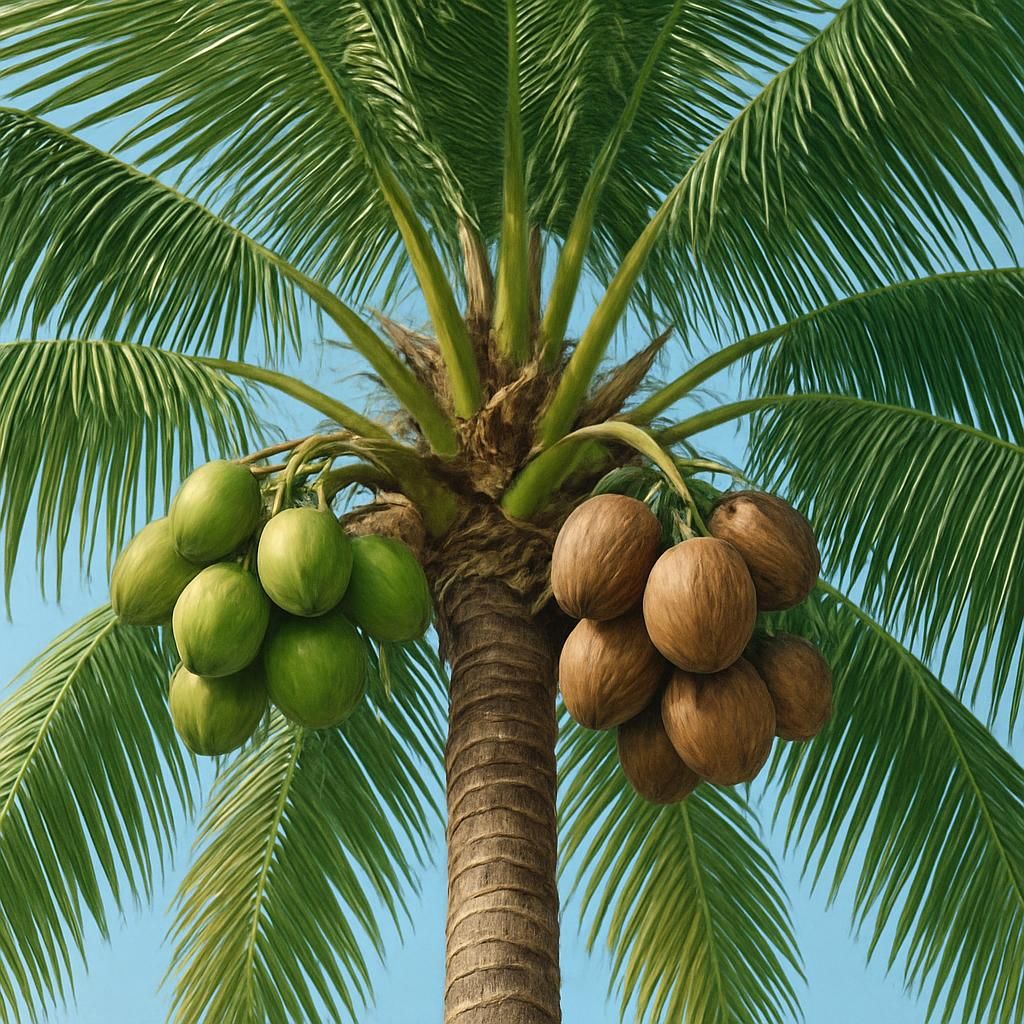
Introduction to Coconut (Fiji Dwarf)
The Fiji Dwarf coconut palm is a compact cultivar of the widely cultivated Coconut palm that offers exceptional productivity within a smaller stature. Unlike the tall varieties that can reach 30 meters, the Fiji Dwarf typically matures at 8–12 meters, making harvesting safer and more economical. It begins bearing fruit within 3–4 years after planting and produces high-quality nuts with abundant water and meat. This variety is especially valued in the Pacific Islands, Southeast Asia, and parts of the Caribbean for its resilience to wind and certain diseases. Its smaller canopy also makes it suitable for intercropping systems and urban landscapes.
Botanical Profile of Coconut (Fiji Dwarf)
The Fiji Dwarf belongs to the Arecaceae family and is botanically classified as Cocos nucifera 'Fiji Dwarf'. It features a slender, smooth gray trunk with prominent leaf scars and a crown of 25–35 pinnate fronds. Each frond measures 4–5 meters long with leaflets arranged in a single plane. The inflorescence is monoecious, bearing both male and female flowers on the same spadix. Female flowers develop into large, ovoid nuts weighing 1.2–2 kg with thick husks and high water content. The variety is self-pollinating but benefits from cross-pollination with nearby palms for higher yields.
Soil, pH, and Climate Requirements for Coconut (Fiji Dwarf)
Coconut (Fiji Dwarf) thrives in well-drained sandy loam to loamy soils with good organic matter content. It tolerates slightly saline conditions but performs best in fertile soils. The following table summarizes the ideal growing conditions:
| Parameter | Ideal Range | Notes |
|---|---|---|
| Soil Type | Sandy loam to loamy | Avoid heavy clay; ensure good drainage |
| Soil pH | 5.5 – 8.0 | Slightly acidic to mildly alkaline |
| Temperature | 21 – 32 °C (70 – 90 °F) | Minimum 15 °C; sensitive to frost |
| Annual Rainfall | 1,500 – 2,500 mm | Evenly distributed; supplement in dry seasons |
| Relative Humidity | 70 – 85 % | High humidity supports growth |
| Sunlight | Full sun (6+ hours daily) | Essential for fruit production |
| Elevation | 0 – 600 m | Performs best at low to mid elevations |
Step-by-Step Planting & Propagation
Propagation of the Fiji Dwarf is achieved through seed nuts. Select mature, disease-free nuts from high-yielding mother palms. Soak selected nuts in water for 24–48 hours before planting to accelerate germination. Prepare nursery beds or polybags with a 1:1:1 mix of sand, topsoil, and well-rotted manure. Plant nuts horizontally at a depth of 5–8 cm and maintain consistent moisture. Germination occurs in 3–6 months. Transplant seedlings to the field when they reach 1–1.5 meters tall, typically at 6–12 months of age. Dig planting holes 60 × 60 × 60 cm and space palms 7–8 meters apart in a triangular pattern. Backfill with topsoil mixed with compost and rock phosphate. Water immediately after planting and provide partial shade for the first 2–4 weeks.
Care & Maintenance regimes for Coconut (Fiji Dwarf)
Regular care ensures sustained productivity and tree health. The following table outlines recommended schedules for water, fertilizer, and pruning:
| Activity | Frequency | Details |
|---|---|---|
| Watering | Weekly during dry season | 20–30 liters per palm; mulch to retain moisture |
| Fertilizer | 4 applications per year | Apply 1–2 kg NPK 14-14-14 + micronutrients at 3-month intervals |
| Pruning | Twice annually | Remove dead or damaged fronds; avoid excessive cutting of green leaves |
| Mulching | Renew every 6 months | 10–15 cm layer of organic mulch around base, keep 30 cm from trunk |
| Weeding | Every 2–3 months | Manual or mechanical; maintain weed-free circle of 1.5 m radius |
Pests, Diseases & Organic Management
Common pests of the Fiji Dwarf include the Rhinoceros beetle, Red palm weevil, and scale insects. Regular monitoring and pheromone traps help reduce populations. The Black-headed caterpillar can cause significant defoliation; biological control with Trichogramma wasps is effective. Major diseases include Bud rot caused by Phytophthora palmivora and Stem bleeding. Organic management includes improving drainage, removing infected tissues, and applying copper-based fungicides or Trichoderma bio-agents. Maintaining palm vigor through balanced nutrition reduces susceptibility.
Harvesting, Curing & Optimal Storage
Fiji Dwarf palms begin producing harvestable nuts 3–4 years after planting. Mature nuts are harvested every 45–60 days when the husk turns brown and water content is high. Use a pole harvester or climbing equipment for safety. After harvest, nuts can be stored in a cool, shaded area for up to 4–6 weeks. For copra production, split nuts and dry the meat in the sun or mechanical dryers to 6–7 % moisture. Store dried copra in ventilated sacks in a dry warehouse. Coconut water can be pasteurized and bottled for commercial sale.
Companion Planting for Coconut (Fiji Dwarf)
The wide spacing of Fiji Dwarf palms allows excellent opportunities for intercropping. Compatible companions include Pineapple, Banana, and Cassava during the first 3–5 years. Leguminous cover crops such as Pigeon pea and Gliricidia improve soil fertility and provide additional income. Aromatic herbs like Thai Basil can help deter certain insect pests. Avoid planting tall crops that compete for light once palms reach full height. Proper companion selection enhances biodiversity, reduces erosion, and maximizes land productivity.