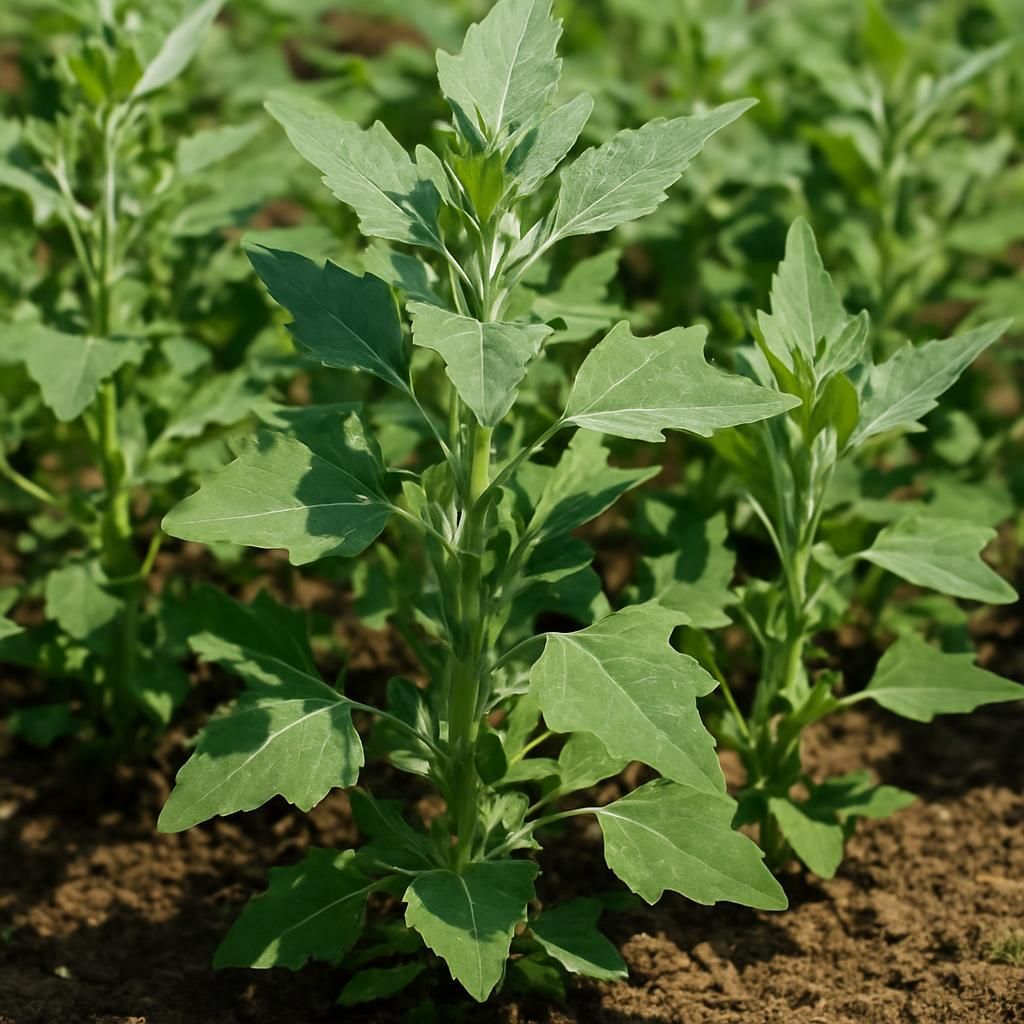
Introduction to Chenopodium album
Chenopodium album, widely recognized as lamb's quarters or fat hen, stands as one of the most adaptable and nutrient-dense leafy greens available to modern growers. Originating from temperate regions but now naturalized globally, this annual plant has served as both a cultivated crop and a resilient weed for centuries. Its leaves deliver exceptional levels of vitamins A and C, calcium, iron, and protein while the seeds provide a gluten-free pseudocereal option similar to Quinoa.
Farmers and home gardeners prize Chenopodium album for its rapid growth cycle, tolerance of marginal soils, and minimal input requirements. The plant reaches harvestable size in 30–45 days and continues producing tender leaves throughout the season with proper management. Its dual-purpose nature—supplying both fresh greens and edible seeds—enhances its value in sustainable and regenerative systems.
Beyond nutrition, Chenopodium album supports soil health through its deep taproot, which improves structure and brings nutrients to the surface. As interest in underutilized crops rises, this species offers a low-cost, high-return option for small farms and urban gardens alike.
Botanical Profile of Chenopodium album
Chenopodium album belongs to the Amaranthaceae family and grows as an erect annual reaching 30–200 cm in height. The stems are grooved, often reddish or streaked, and support alternate, triangular to diamond-shaped leaves with irregular teeth or lobes. Young leaves exhibit a characteristic mealy or powdery coating that helps reduce transpiration.
The plant produces dense terminal and axillary panicles of tiny greenish flowers lacking petals. These give way to numerous small, black, lens-shaped seeds enclosed in a thin pericarp. Chenopodium album exhibits high genetic variability, allowing it to adapt to a wide range of environments from temperate fields to disturbed urban lots.
Its rapid life cycle—germination to seed set in 60–90 days—enables multiple harvests per season in suitable climates. The species is predominantly self-pollinating yet maintains enough outcrossing to generate diverse populations suited to local conditions.
Soil, pH, and Climate Requirements for Chenopodium album
Chenopodium album performs across a broad spectrum of soil types but achieves maximum productivity in fertile, well-drained loams. It tolerates sandy and clay soils provided drainage prevents waterlogging. The plant prefers neutral to slightly alkaline conditions but succeeds in mildly acidic environments.
| Parameter | Ideal Range | Notes |
|---|---|---|
| Soil Type | Loam to sandy loam | Clay ok with raised beds; avoid compaction |
| Soil pH | 6.5–8.0 | Tolerates 6.0–8.5; lime if below 6.0 |
| Temperature Range | 15–28 °C (day) | Germinates 4–30 °C; frost tolerant to –4 °C |
| Annual Rainfall | 400–800 mm | Supplemental irrigation in dry spells |
| Sunlight | Full sun to partial shade | 6+ hours optimal for leaf production |
| Altitude | 0–2500 m | Thrives from sea level to high plateaus |
Adequate organic matter improves moisture retention and nutrient availability. Raised beds or ridges are recommended in heavy soils to prevent root rot.
Step-by-Step Planting & Propagation
- Site Selection & Preparation: Choose a sunny location with good drainage. Remove existing weeds and incorporate 5–8 cm of well-rotted compost or aged manure.
- Soil Testing & Amendment: Aim for pH 6.5–8.0. Apply lime if pH < 6.0 and balanced organic fertilizer based on soil test results.
- Seed Sowing: Direct sow in early spring when soil reaches 10 °C. Sow seeds 0.5 cm deep in rows 30–45 cm apart; thin seedlings to 15–20 cm within rows.
- Succession Planting: Sow new blocks every 2–3 weeks until mid-summer for continuous leaf harvest.
- Transplant Option: Start seedlings indoors 3–4 weeks before last frost; transplant at 4–6 true leaves, spacing 20 cm apart.
- Irrigation at Establishment: Keep seedbed consistently moist until germination (5–10 days). Reduce frequency once plants are established.
Care & Maintenance regimes for Chenopodium album
Regular attention to water, nutrition, and canopy management maximizes both leaf and seed yields.
| Growth Stage | Water Schedule | Fertilizer Schedule | Pruning / Thinning Schedule |
|---|---|---|---|
| Germination–4 weeks | Light daily watering to keep moist | None; rely on soil reserves | Thin to 15 cm spacing at 3–4 leaf stage |
| Vegetative (4–8 wks) | 25–30 mm/week; deep infrequent | Side-dress 2–3 kg N/ha at 4 weeks | Remove lower yellowing leaves weekly |
| Pre-flowering | Reduce to 15–20 mm/week | Optional light compost tea | Pinch growing tips to encourage bushiness |
| Seed Fill | Minimal; allow soil to dry slightly | None | Cut seed heads when 50 % mature |
Mulch with straw or leaf mold to suppress weeds and conserve moisture. Avoid over-fertilization to prevent excessive vegetative growth at the expense of seed quality.
Pests, Diseases & Organic Management
Chenopodium album is generally hardy but may encounter several common challenges.
- Aphids: Cluster on tender shoots; control with strong water sprays or insecticidal soap.
- Spider Mites: Cause stippling on leaves in hot, dry conditions; increase humidity and release predatory mites.
- Flea Beetles: Create shot-hole damage; use floating row covers and maintain healthy soil biology.
- Powdery Mildew: White fungal growth in humid weather; improve airflow and apply neem oil or potassium bicarbonate.
- Leaf Spot Diseases: Caused by various fungi; remove infected foliage and rotate crops.
- Root-knot Nematodes: Stunt plants in sandy soils; solarize beds and incorporate marigold residues.
Preventive cultural practices—crop rotation, sanitation, and balanced fertility—remain the most effective long-term strategies.
Harvesting, Curing & Optimal Storage
Harvest young leaves when 10–15 cm long for tender greens; cut outer leaves or entire plants at 15–20 cm height. Multiple cuts are possible every 10–14 days.
For seed production, allow plants to mature fully. Cut seed heads when seeds turn black and rub to separate. Winnow and dry seeds to 10–12 % moisture before storage.
Store fresh greens in perforated plastic bags at 0–2 °C for up to 7 days. Dried leaves retain quality for 6–12 months in airtight containers away from light. Seeds keep 2–3 years at cool, dry temperatures.
Companion Planting for Chenopodium album
Chenopodium album pairs well with many garden crops. It benefits Tomato and Pepper plantings by attracting beneficial insects while its deep roots improve soil structure for shallow-rooted neighbors. Avoid planting near Spinach or Beet to reduce shared pest pressure.
Interplant with Carrot, Onion, and aromatic herbs such as Thyme to enhance biodiversity and deter pests. Use Chenopodium album as a living mulch between rows of slower-growing crops like Cabbage or Broccoli for weed suppression and nutrient cycling.
For further reading on companion planting strategies, see Summer Companion Planting: 10 Organic Pairings to Boost Small Farm Resilience.