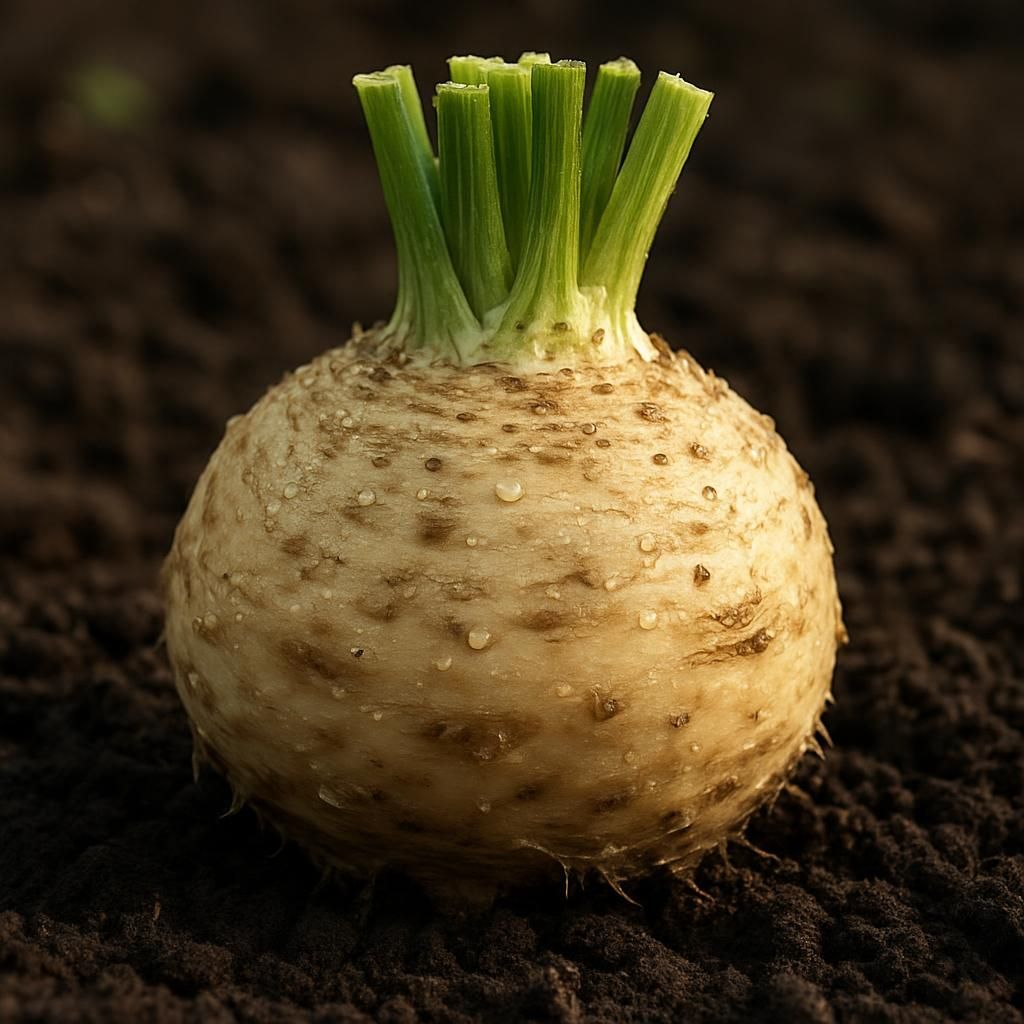
Introduction to Celeriac (Mars)
Celeriac (Mars) is a specialized cultivar of celery grown primarily for its swollen, nutty-tasting root rather than its stalks. The variety 'Mars' is noted for its smooth, round hypocotyl, resistance to bolting, and reliable performance in cool climates. Home gardeners and small-scale commercial growers value it for its long storage life and versatility in soups, mashes, and raw preparations.
Unlike standard celery, celeriac tolerates light frosts and develops its best flavor after exposure to cool autumn temperatures. The plant forms a dense rosette of dark-green, deeply divided leaves above a globe-shaped root that can reach 10–15 cm in diameter at maturity. Because the edible portion grows mostly underground, careful soil management and consistent moisture are essential.
Botanical Profile of Celeriac (Mars)
Celeriac belongs to the Apiaceae family and is botanically classified as Apium graveolens var. rapaceum. The 'Mars' cultivar was selected for uniform root shape, reduced side-rooting, and improved disease tolerance. The plant is a biennial but is grown as an annual for root production. It produces a thick taproot that enlarges into the edible hypocotyl while the true root system continues downward.
Leaves are pinnately compound with serrated margins and long petioles. Small white flowers appear in compound umbels if the plant is vernalized and allowed to overwinter, but most commercial crops are harvested before flowering. The cultivar exhibits moderate tolerance to Cercospora leaf spot and Alternaria leaf spot.
Soil, pH, and Climate Requirements for Celeriac (Mars)
Celeriac (Mars) performs best in deep, fertile, moisture-retentive soils. Heavy clay soils should be amended with well-rotted organic matter to improve structure. The crop is sensitive to both drought and waterlogging; consistent moisture without saturation is critical for smooth root development.
| Parameter | Ideal Range | Notes |
|---|---|---|
| Soil Type | Loam to sandy loam | Deep, friable, stone-free |
| Soil pH | 6.0–7.0 | Slightly acidic to neutral |
| Organic Matter | 3–5 % | Incorporate compost or well-rotted manure |
| Temperature Range | 15–21 °C day / 7–13 °C night | Cool-season crop; tolerates light frost |
| Frost Tolerance | Down to −5 °C | Improves flavor; protect seedlings |
| Spacing | 30–40 cm between plants | 45–60 cm between rows |
| Days to Maturity | 110–130 days | From transplant |
Step-by-Step Planting & Propagation
- Start seeds indoors 10–12 weeks before the last expected frost. Sow thinly on the surface of sterile seed-starting mix and press lightly; do not cover as light aids germination.
- Maintain soil temperature at 18–21 °C and keep evenly moist. Germination occurs in 14–21 days.
- Harden off seedlings for 7–10 days when they have 4–6 true leaves.
- Transplant outdoors after all danger of hard frost has passed and soil has warmed to at least 10 °C. Plant at the same depth as in flats; avoid burying the crown.
- Water thoroughly after transplanting and apply a light mulch to conserve moisture and suppress weeds.
Direct seeding is possible in mild climates but requires excellent weed control and consistent moisture until establishment.
Care & Maintenance regimes for Celeriac (Mars)
Consistent moisture and balanced fertility are the keys to large, smooth roots. Side-dress with nitrogen early, then shift to potassium-rich feeds as roots enlarge. Remove lower leaves periodically to improve air circulation.
| Growth Stage | Watering Schedule | Fertilizer Schedule | Pruning / Other Tasks |
|---|---|---|---|
| Establishment (0–4 wks) | Keep soil moist; 25–30 mm/week | Low-nitrogen starter at transplant | Weed control; mulch application |
| Vegetative (4–10 wks) | 25–40 mm/week; avoid water stress | High-nitrogen side-dress at 4 and 8 weeks | Remove yellowing leaves; hill soil gently |
| Bulking (10–16 wks) | Maintain even moisture | Potassium-rich feed every 3–4 weeks | Remove lower leaves for airflow |
| Pre-harvest (last 3 wks) | Reduce slightly to firm roots | Cease nitrogen; continue potassium | Monitor for pests; maintain weed-free |
Pests, Diseases & Organic Management
Common insect pests include aphids, carrot fly (if present in region), and cutworms. Monitor with yellow sticky traps and use floating row covers during early growth. Slugs and snails can damage young leaves; employ beer traps or iron-phosphate baits.
Fungal diseases such as Cercospora leaf spot and Alternaria leaf spot appear as small, dark lesions. Practice 3–4 year crop rotation, remove infected debris, and apply copper-based fungicides or neem oil at first sign. Root-knot nematodes can be managed with marigold cover crops and solarization.
Harvesting, Curing & Optimal Storage
Harvest when roots reach 8–12 cm in diameter, typically 110–130 days after transplant. Loosen soil with a fork and lift carefully to avoid bruising. Trim foliage to 2–3 cm above the crown. Cure roots for 2–3 days in a cool, shaded area with good airflow.
Store at 0–2 °C and 90–95 % relative humidity. Roots keep 4–6 months in perforated plastic bags or moist sand. Check periodically and remove any showing soft rot.
Companion Planting for Celeriac (Mars)
Celeriac benefits from association with Onion, Garlic, and Leek which deter carrot fly and aphids. Aromatic herbs such as Thyme and Rosemary improve pest resistance. Avoid planting near Potato or Celery to reduce shared disease pressure. Nasturtium can serve as a trap crop for aphids.
For more on building resilient cropping systems, see Summer Companion Planting: 10 Organic Pairings to Boost Small Farm Resilience.