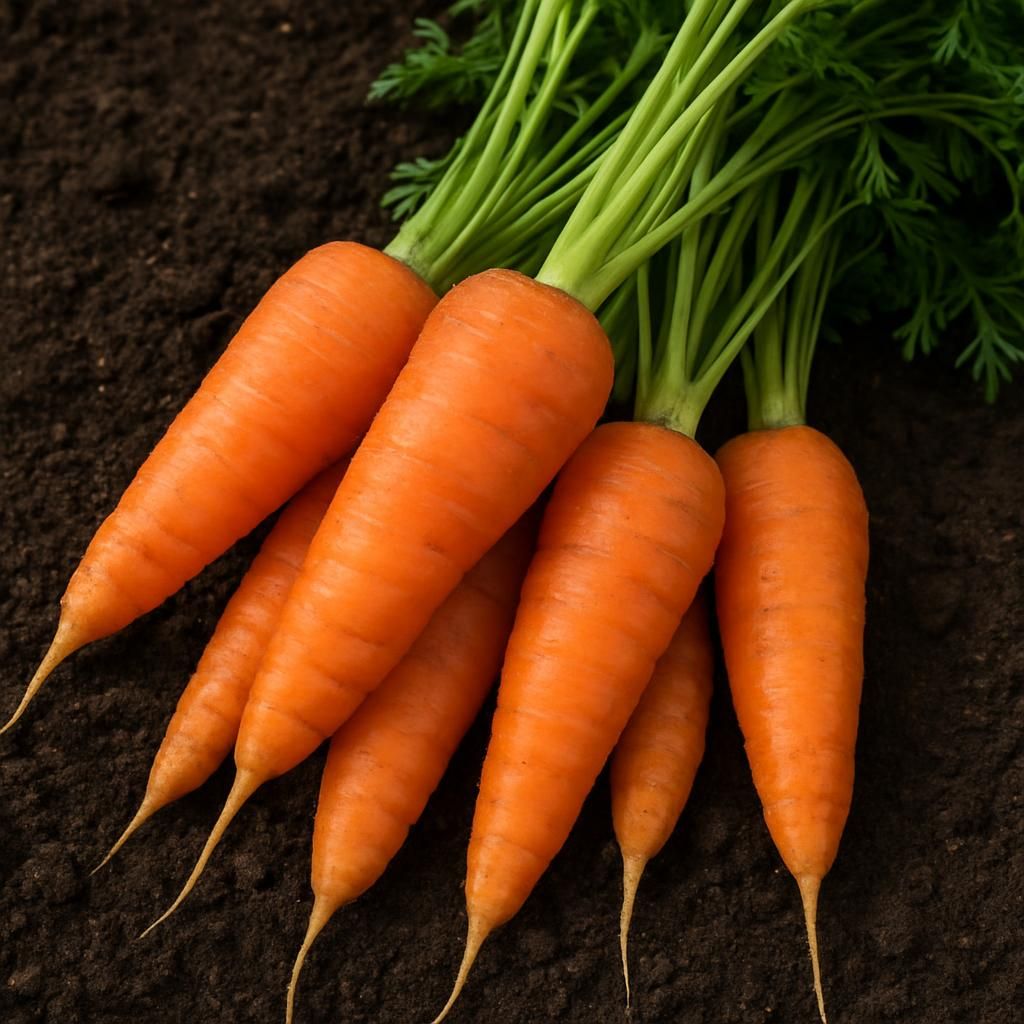
Introduction to Carrot (Chantenay Red Cored)
Chantenay Red Cored carrots originated in the Chantenay region of France in the late 19th century and were developed specifically for heavy soils. The variety produces short, broad-shouldered roots that typically reach 5–7 inches in length and 2–2.5 inches at the crown. Their deep orange interior and high sugar content deliver exceptional flavor whether eaten raw, roasted, or juiced. Because the roots remain tender even at larger diameters, Chantenay Red Cored is prized by both market gardeners and home cooks.
Botanical Profile of Carrot (Chantenay Red Cored)
Carrot (Chantenay Red Cored) belongs to the Apiaceae family. The plant produces a rosette of finely divided, feathery leaves arising from a central taproot. The edible portion is a swollen hypocotyl and upper root that stores carbohydrates and carotenoids. Flowers are small, white, and borne in compound umbels that attract beneficial pollinators when allowed to bolt. Seeds are small, ribbed, and require light for optimal germination.
Soil, pH, and Climate Requirements for Carrot (Chantenay Red Cored) (MUST INCLUDE A MARKDOWN TABLE OF IDEAL CONDITIONS)
Chantenay Red Cored performs best in loose, well-drained loam or sandy loam amended with generous amounts of organic matter. Avoid fresh manure, which causes forking. The variety tolerates heavier soils better than longer types such as Imperator Carrot thanks to its short, stout shape.
| Parameter | Ideal Range | Notes |
|---|---|---|
| Soil Type | Sandy loam to loam | Avoid compacted clay without heavy amendment |
| Soil pH | 6.0–6.8 | Slightly acidic to neutral |
| Soil Temperature | 45–85 °F (7–29 °C) | Optimal germination 55–75 °F |
| Air Temperature | 60–75 °F (16–24 °C) | Tolerates light frost |
| Spacing | 2–3 inches between plants | Rows 12–18 inches apart |
| Depth | Seeds ¼ inch deep | Firm soil gently after sowing |
Step-by-Step Planting & Propagation
- Prepare beds by removing stones and breaking up clods to 12 inches deep.
- Mix in 2–3 inches of well-rotted compost or aged manure.
- Sow seeds directly ¼ inch deep in moist soil when temperatures reach 55 °F.
- Space rows 12–18 inches apart; thin seedlings to 2–3 inches when they reach 2 inches tall.
- Keep seedbed consistently moist until germination (7–14 days).
- For succession planting, sow every 3 weeks until 10 weeks before first frost.
Care & Maintenance regimes for Carrot (Chantenay Red Cored) (MUST INCLUDE A MARKDOWN TABLE OF WATER, FERTILIZER, AND PRUNING SCHEDULES)
Consistent moisture prevents cracking and bitter flavor. Side-dress with a balanced organic fertilizer once at the four-leaf stage. Mulch with 2 inches of straw to retain moisture and suppress weeds. Avoid high-nitrogen fertilizers after roots begin to swell.
| Stage | Watering Schedule | Fertilizer Schedule | Pruning/Thinning Schedule |
|---|---|---|---|
| Germination (0–14 days) | Keep top 1 inch moist daily | None | None |
| Seedling (2–4 weeks) | 1 inch per week | Light fish emulsion at week 3 | Thin to 1 inch spacing |
| Vegetative (4–8 weeks) | 1–1.5 inches per week | Side-dress ½ cup 5-5-5 per 10 ft row | Thin to final 2–3 inch spacing |
| Root Development | Even moisture; avoid fluctuations | Light compost tea every 3 weeks | Remove flower stalks if bolting occurs |
| Pre-Harvest | Reduce watering slightly 1 week prior | None | None |
Pests, Diseases & Organic Management
Common pests include carrot rust fly, wireworms, and aphids. Use floating row covers to exclude carrot rust fly adults. Practice crop rotation and apply beneficial nematodes for wireworm control. Diseases such as Alternaria leaf spot and powdery mildew are managed with neem oil and improved airflow. Avoid overhead irrigation to reduce foliar disease pressure.
Harvesting, Curing & Optimal Storage
Chantenay Red Cored carrots reach maturity in 65–75 days. Harvest when roots are ¾–1 inch in diameter at the crown for peak sweetness. Loosen soil with a fork and pull gently. Remove tops immediately and rinse soil. Cure in a shaded, well-ventilated area for 1–2 hours. Store at 32–38 °F with 95 % humidity for 4–6 months. For long-term storage, pack in moist sand or sawdust.
Companion Planting for Carrot (Chantenay Red Cored)
Carrots pair well with onion, leek, and radish to deter pests. Tomato and lettuce provide light shade in summer heat. Avoid planting near dill or parsley which may cross-pollinate or attract similar pests. Marigold and nasturtium offer additional pest-repelling benefits when interplanted in borders.