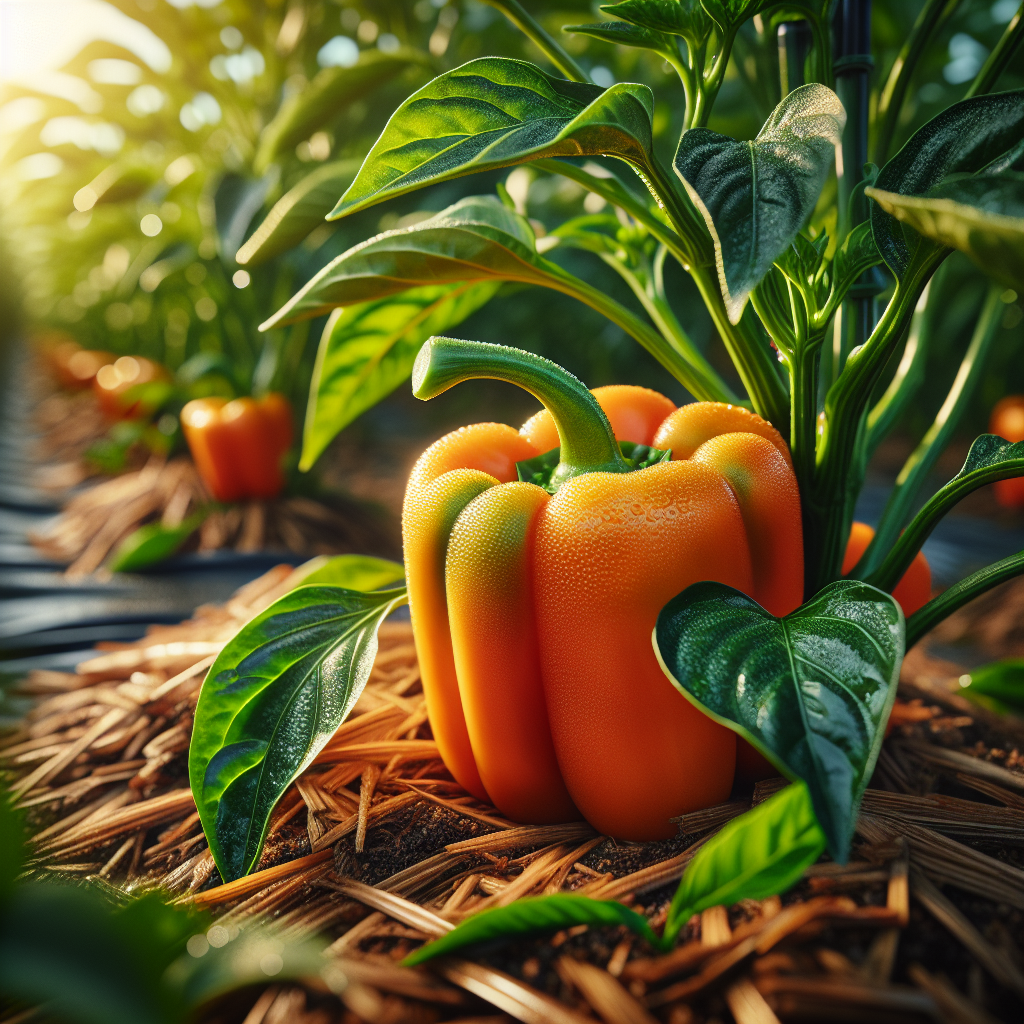
Introduction to Bell Pepper (Orange Sun)
A premium sweet pepper selection within the species Capsicum annuum, this cultivar is grown for medium to large blocky fruits that mature from green to a vivid orange. Orange-fruited bells are often favored by growers and chefs because they bridge the grassy flavor of green peppers and the higher sugar, lower bitterness profile of fully ripe red peppers, producing a sweet, crisp fruit with broad culinary appeal.
Like most bell peppers, it originated through intensive selection from Mesoamerican pepper ancestors domesticated thousands of years ago. Modern orange bell types were bred for improved uniformity, fruit thickness, color stability, and field performance. In practical production terms, this variety is best treated as a high-value warm-season vegetable requiring more precision than beans or squash but less complexity than greenhouse-only crops. If managed well, plants can be highly productive over a long harvest window.
Orange Sun performs especially well where daytime warmth is consistent, nights are not excessively cold, and soil fertility is balanced rather than overly nitrogen-rich. Excess vegetative growth delays flowering and fruit color development, so successful growers aim for steady, moderate vigor rather than lush, dark-green overgrowth. For a broader overview of pepper culture, see our Bell Pepper guide. A useful background resource on soil-building practices is this soil health article.
Botanical Profile of Bell Pepper (Orange Sun)
This cultivar belongs to the nightshade family, Solanaceae, alongside tomato, eggplant, and potato. It is a frost-tender, short-lived perennial in tropical climates but grown as an annual in most temperate systems. The plant typically forms a branching, upright to semi-spreading canopy with smooth green leaves, white star-shaped flowers, and hollow, multi-lobed berries marketed as vegetables.
Bell peppers are non-pungent because they carry recessive genetics associated with very low or absent capsaicin production in the fruit placenta. That means Orange Sun is grown for sweetness, flesh thickness, and visual maturity rather than heat. Fruits are usually blocky, often 3- to 4-lobed, with substantial wall thickness that gives them a firm, crunchy bite and good shelf presence.
Physiologically, peppers have a relatively delicate root system compared with larger-framed crops. Most feeder roots occupy the upper 20-30 cm of soil, which is why shallow drying, crusting, or waterlogging quickly affects flowering and fruit quality. Flower retention is strongly influenced by environmental stress: sudden heat spikes, cold nights, drought, or excessive ammonium nitrogen can all contribute to blossom drop.
Fruit color progression matters commercially and nutritionally. Immature fruit is green because chlorophyll dominates. As fruit ripens, chlorophyll degrades and carotenoid pigments accumulate, producing the characteristic orange tone. At this stage, sugar levels rise, acids soften, and vitamin content generally improves. Fully orange fruit also command higher market value in mixed-color pepper packs.
Soil, pH, and Climate Requirements for Bell Pepper (Orange Sun)
The ideal soil is a fertile, well-drained loam or sandy loam high in stable organic matter, with enough structure to hold moisture but enough porosity to maintain oxygen around the root zone. Compacted clay can be used if deeply amended and formed into raised beds, but poorly drained soil is one of the fastest ways to stunt pepper plants. Roots deprived of oxygen become inefficient at nutrient uptake, leading to pale foliage, slow growth, blossom drop, and higher disease pressure.
Target a soil pH of 6.2 to 6.8. Peppers will grow outside that range, but performance often slips below pH 6.0 because calcium, magnesium, and phosphorus availability can become limiting, while manganese and aluminum can become more problematic in acidic conditions. Above pH 7.2, iron and manganese deficiency may appear as interveinal chlorosis on young leaves. If pH is low, use finely ground agricultural lime several months before planting. If pH is high, elemental sulfur and repeated organic matter incorporation help over time, though correction is slower.
Before transplanting, aim for moderate to high fertility with good phosphorus and potassium reserves. A soil rich in compost alone is not always enough for heavy fruiting peppers; testing is strongly recommended. A reasonable pre-plant target in field soil is organic matter around 3-5% and balanced nutrient status rather than maximal nitrogen. Excess nitrogen creates large canopies, delays fruit set, and may increase susceptibility to soft, weak growth.
Temperature is critical. Seed germination is strongest at 27-32°C. Below about 18°C, germination slows dramatically and may become erratic. For vegetative growth, peppers prefer warm days around 21-29°C and nights above 15°C. Night temperatures below 12-13°C can cause stress, purpling, and stalled growth. Day temperatures above 32-35°C, especially with dry wind or low humidity, can reduce pollen viability and cause flower abortion.
Orange Sun does best in full sun, ideally 8 or more hours daily. In very hot climates, however, light afternoon shade can protect fruit from sunscald when temperatures remain extreme for extended periods. Fruit exposed suddenly after aggressive pruning or defoliation is especially vulnerable to bleached, papery sun injury.
Soil moisture should remain consistently even, not swinging between drought and saturation. In practical terms, the top 2-3 cm of soil may dry slightly between irrigations, but the root zone below should remain lightly moist. If soil at 10 cm depth forms a weak ball in the hand and breaks with slight pressure, moisture is often near ideal. If it is powdery, irrigation is overdue. If it smears, smells sour, or stays sticky for days, drainage is too poor or watering is excessive.
Step-by-Step Planting & Propagation
Propagation is almost always by seed. Because peppers are slow starters compared with many summer vegetables, begin seeds indoors 8-10 weeks before the intended outdoor transplant date. Sow into a sterile seed-starting medium at 0.5-1 cm depth. Maintain media temperature at 27-30°C for rapid and uniform emergence. Bottom heat is especially valuable; cool flats often germinate irregularly and invite damping-off.
Once seedlings emerge, provide strong light immediately. A common professional target is 14-16 hours of bright supplemental light daily if sunlight is insufficient. Leggy seedlings rarely recover into top-performing field plants. Air temperature after emergence can be reduced slightly to about 21-24°C by day and 18-20°C by night to encourage sturdy growth.
Transplant seedlings into larger cells or pots once true leaves expand and roots begin to hold the plug together. Avoid allowing roots to become heavily circling or pot-bound, as peppers often pause after transplant if root systems are stressed. A transplant with 6-8 true leaves, a thick stem, and a compact canopy is ideal.
Harden plants gradually over 7-10 days before field setting. Expose them first to protected outdoor shade, then increasing sun and wind. Do not transplant into cold soil. Wait until danger of frost has passed and soil temperature is at least 18°C, preferably closer to 20°C. Planting into cool ground frequently results in weeks of stagnation that later plantings can outperform.
Set transplants slightly deeper than the plug line, but not as deeply as tomatoes are buried. Standard spacing is 30-45 cm between plants in rows 60-90 cm apart, depending on fertility and whether plants will be staked. Tighter spacing can improve shading of fruit and reduce sunscald, but overcrowding raises humidity and disease risk. In raised beds, two staggered rows per bed often work well.
Water transplants immediately after setting to eliminate air pockets. A starter solution containing balanced nutrients with modest phosphorus can help establishment, but avoid strong fertilizer salts in dry soil. Organic mulches such as straw can be applied once soil has warmed; black plastic mulch is widely used in commercial settings to accelerate soil warming, suppress weeds, and conserve moisture.
Direct sowing is possible only in long, warm seasons, and even then is usually inferior for this cultivar because peppers establish slowly and are easily overtaken by weeds. For most growers, transplanting is the standard method.
Care & Maintenance regimes for Bell Pepper (Orange Sun)
The first priority after establishment is uniform growth without stress shocks. Irrigate deeply enough to moisten the main root zone, usually 15-20 cm deep, then allow only mild surface drying before the next irrigation. During early establishment, this may mean watering every 3-5 days in loam soils, while mature fruiting plants in hot weather may need water every 1-3 days depending on soil type and mulch. Sandy soils require more frequent irrigation in smaller doses.
A mature fruiting pepper plant commonly needs roughly 25-40 mm of water per week, but this number should be adjusted for heat, wind, soil type, and plant size. Drip irrigation is preferred because it keeps foliage dry and reduces foliar disease. Moisture stress during flowering reduces fruit set; moisture swings during fruit fill can increase blossom-end rot and misshapen fruit.
Signs of underwatering include temporary midday wilt that progresses into morning wilt, dull gray-green foliage, slowed new growth, and thin-walled fruit. Signs of overwatering include persistent droop despite wet soil, yellow lower leaves, edema-like blistering, sour-smelling soil, and roots that are tan-brown rather than bright white. Chronic oversaturation can mimic nutrient deficiency because roots cannot respire properly.
Nutrient management should emphasize balance. Incorporate compost before planting, but back it up with measured fertility. A practical feeding strategy is to provide modest nitrogen early, then shift toward balanced or slightly potassium-forward fertility once flowering begins. Too much early nitrogen pushes foliage; too little reduces leaf area and final yield. Calcium consistency is also important for fruit quality, but foliar calcium sprays cannot compensate for erratic soil moisture, which is the main driver of calcium-related disorders.
If using soluble feeding, many growers apply low-dose fertigation weekly rather than occasional heavy feeding. Tissue-dark, very lush plants with delayed flowering usually indicate overfeeding, particularly with nitrogen. Pale older leaves and thin stems indicate underfeeding or root stress. Magnesium deficiency may show as interveinal yellowing on older leaves, while iron deficiency appears first in new growth.
Support is often overlooked with bell peppers. Though not vine crops, Orange Sun plants carrying multiple thick-walled fruits can lodge or split branches in wind or after rain. Use stakes, Florida weave, or low support netting if plants are in exposed sites or high-fertility ground. Support also keeps fruit off the soil, improving quality.
Weed control matters most in the first 6-8 weeks after transplant. Peppers do not compete well when young. Avoid deep cultivation near plants because roots are shallow and easily damaged. Mulching is one of the best cultural tools for reducing weeds and stabilizing moisture.
Pruning is minimal in outdoor bell pepper production. Remove only damaged leaves, diseased tissue, or the occasional low branch touching soil. Over-pruning exposes fruit to sunscald and reduces the plant's ability to buffer heat stress. In protected culture, some growers prune to a few main stems, but in open-field production natural branching is typically preferred.
Pests, Diseases & Organic Management
The major insect pests include aphids, thrips, spider mites, flea beetles, whiteflies, and occasionally pepper maggot or caterpillars depending on region. aphids cluster on tender growth and leaf undersides, causing curling and sticky honeydew; they also vector viruses. thrips are especially important because they scar flowers and can spread tomato spotted wilt virus. spider mites proliferate in hot, dry weather and cause stippling, bronzing, and fine webbing.
Organic management begins with monitoring. Inspect underside leaves weekly, and increase to twice weekly during hot spells or when nearby crops carry infestations. Yellow or blue sticky cards can help detect whiteflies and thrips in tunnels or high-value plantings. Strong populations are easier to prevent than to reverse.
Cultural suppression is essential: remove weeds that harbor pests, avoid excessive nitrogen that attracts sap-feeding insects, and maintain habitat for beneficial insects. Thai Basil, Onion, and Nasturtium are often used nearby to diversify the planting and support pest management. A hard stream of water can suppress aphids early. Insecticidal soap works best on soft-bodied pests when coverage is thorough and temperatures are not excessively hot. Neem-based products may help, but label timing matters to avoid leaf burn.
Common diseases include bacterial leaf spot, anthracnose, powdery mildew, Phytophthora root and crown rot, damping-off in seedlings, and several viral diseases such as cucumber mosaic virus and tomato spotted wilt virus. bacterial leaf spot produces small water-soaked lesions that turn dark and may be surrounded by yellow halos. It spreads rapidly in warm, wet conditions, especially when plants are handled while foliage is wet.
Prevent disease by starting with clean seed or reputable transplants, rotating away from peppers and other solanaceous crops for at least 3 years where possible, using drip irrigation, and spacing plants for air movement. Remove and destroy badly infected plants quickly; do not compost severely diseased pepper residues unless composting is thermophilic and well managed.
Phytophthora is especially devastating in waterlogged soils. Symptoms include sudden wilt, dark stem lesions near the soil line, and root collapse despite seemingly adequate moisture. There is no rescue for heavily infected plants; drainage improvement and rotation are the main defenses.
Blossom-end rot is not a pathogen but a physiological disorder linked to inconsistent calcium movement in developing fruit, usually caused by uneven watering, root damage, salinity, or excessive ammonium nitrogen. It appears as a sunken dark patch at the blossom end. The cure is steadier root-zone moisture and moderated fertility, not simply adding more calcium to leaves.
Harvesting, Curing & Optimal Storage
Harvest timing depends on market goal. Fruits can be picked green once full-sized and firm, but Orange Sun reaches its best sweetness, color, and culinary value when allowed to ripen fully to orange. Full color may take 2-3 weeks beyond green maturity, depending on temperature, plant load, and nutrition.
Use pruners or a sharp knife rather than pulling fruit by hand. Pepper branches are brittle, and tearing fruit free can split stems or uproot shallow-rooted plants. Harvest with a short stem attached if possible to reduce fruit damage. Pick regularly to maintain plant productivity; leaving overmature fruit too long can slow new set, especially late in the season.
For best quality, harvest during the cooler part of the day after dew has dried but before afternoon heat builds. Wet harvests increase disease spread and shorten storage life. Fruits intended for fresh market should be free of sunscald, insect puncture, soft spots, and shriveling.
Bell peppers do not require curing in the same sense as onions or winter squash, but they benefit from gentle postharvest handling and rapid field heat removal. Keep harvested fruit shaded immediately. Wash only if necessary, and dry thoroughly before packing. Ideal storage is around 7-10°C with 90-95% relative humidity. Below about 7°C, chilling injury can develop, showing as pitting, water-soaked areas, and poor flavor. At room temperature, peppers lose moisture quickly and soften within days.
Under proper cool storage, high-quality ripe orange peppers often keep for 2-3 weeks, though the sweetest fully colored fruit is generally best marketed or consumed sooner. Avoid storing with ethylene-sensitive produce concerns in mind; peppers are moderately sensitive, and prolonged exposure to high ethylene may accelerate senescence.
Companion Planting for Bell Pepper (Orange Sun)
Useful companions are those that either improve pest balance, use space efficiently, or avoid direct competition with the pepper root zone. Thai Basil is one of the most practical pairings because it occupies nearby space without overshadowing peppers and is commonly used by growers seeking aromatic diversity around solanaceous crops. Onion and other alliums fit well on bed edges where their upright habit does not crowd pepper foliage. Nasturtium can function as a living companion that attracts pollinators and may draw certain pests away from the main crop.
Companions should still be managed sensibly. Dense intercrops can trap humidity around pepper foliage and raise disease pressure, especially in humid climates. Keep airflow open, especially after rain or irrigation. Low-growing companions are preferable to tall, aggressive species that shade the canopy or compete heavily for water.
Avoid pairing peppers too closely with crops that spread aggressively or demand similar heavy feeding in the same shallow root band. Also avoid repeating peppers in the same place after tomatoes, eggplants, or potatoes because shared disease cycles are more important than any supposed companion benefit.
In small gardens and diversified market beds, the best companion strategy is usually simple: one aromatic herb, one vertical allium, and one insectary flower nearby, all spaced to preserve light and airflow. That approach supports crop health without turning the pepper bed into an overcrowded polyculture.