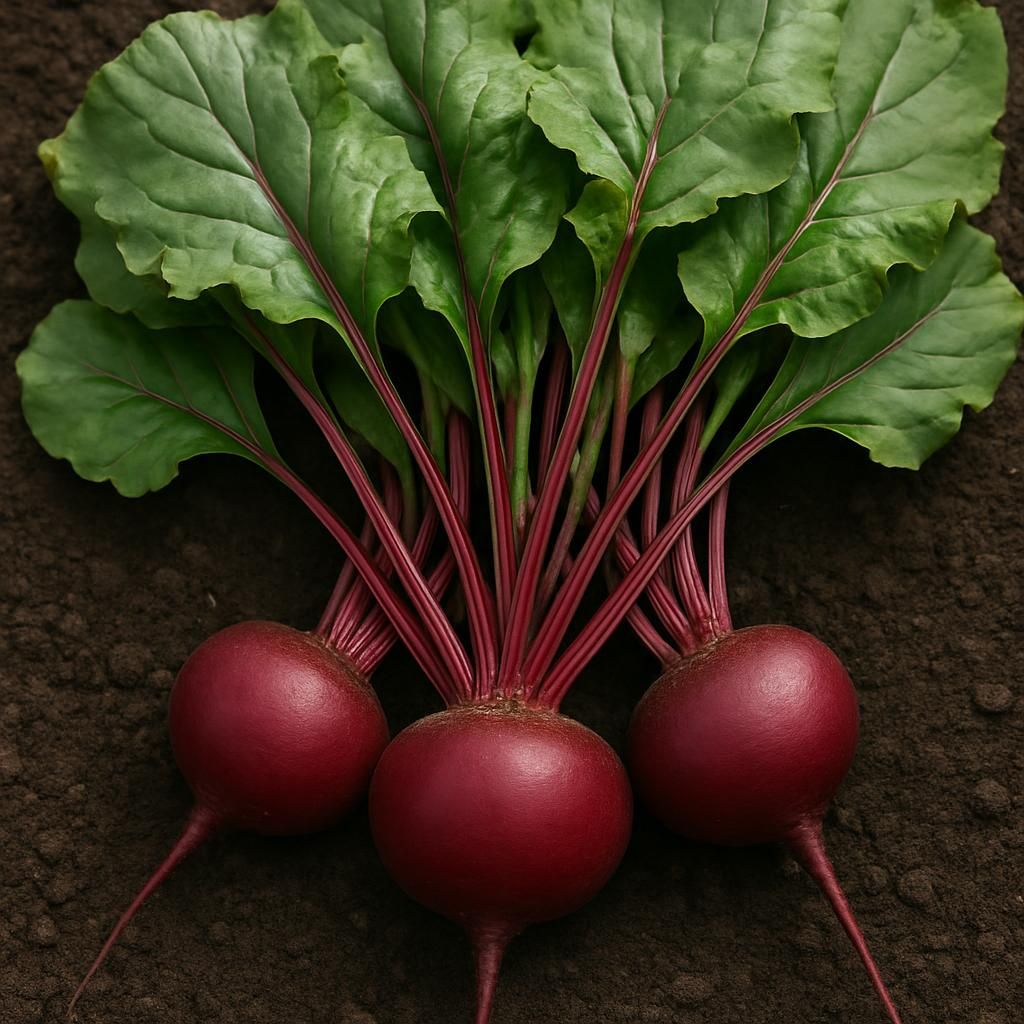
Introduction to Beet (Lutz Green Leaf)
Lutz Green Leaf beet (Beta vulgaris subsp. vulgaris) is a heritage European variety renowned for its large, smooth-skinned roots and exceptionally productive, tender foliage. Unlike many modern beet cultivars bred exclusively for root size, Lutz Green Leaf offers balanced production of both edible roots and vitamin-rich greens, making it ideal for small farms and home gardens seeking maximum return per square foot.
The variety originated in Germany and has been maintained for generations due to its cold tolerance, bolt resistance, and ability to remain tender even at larger sizes. Roots can reach 4–6 inches in diameter while retaining excellent flavor and texture, and the dark green leaves are milder and less fibrous than those of standard red beets.
Growers appreciate Lutz Green Leaf for its versatility in the kitchen and its extended harvest window. The crop performs well in both spring and fall plantings and stores exceptionally well for winter use. Beet production generally benefits from consistent moisture and fertile soil, principles that apply directly to this variety.
Botanical Profile of Beet (Lutz Green Leaf)
Lutz Green Leaf belongs to the Amaranthaceae family and is a biennial grown as an annual for its swollen taproot and foliage. The plant develops a deep, fleshy root that stores carbohydrates and a rosette of broad, crinkled leaves supported by prominent midribs.
The root skin is smooth and deep red-purple, while the flesh is uniformly red with faint zoning. Leaves are large, dark green, and slightly savoyed, providing substantial biomass for harvest as greens. Flowers, if allowed to develop in the second year, are small, greenish, and wind-pollinated.
The variety exhibits moderate bolt resistance and maintains root quality longer than many cylindrical types. Its vigorous growth habit supports both direct seeding and transplanting approaches common in intensive vegetable systems.
Soil, pH, and Climate Requirements for Beet (Lutz Green Leaf)
Beets require well-drained, fertile loam with good structure to allow unobstructed root expansion. Heavy clay soils should be amended with organic matter to prevent compaction and forking. Avoid fresh manure applications immediately before planting to reduce the risk of scab and misshapen roots.
| Parameter | Ideal Range | Notes |
|---|---|---|
| Soil Type | Sandy loam to loam | Good drainage essential |
| Soil pH | 6.0–7.0 | Below 6.0 increases scab risk |
| Soil Temperature | 50–65°F (10–18°C) at planting | Germination fails above 85°F |
| Air Temperature | 60–75°F (15–24°C) daytime | Tolerates light frost |
| Spacing (in-row) | 3–4 inches | 12–18 inches between rows |
| Depth | ½–1 inch | Keep seedbed consistently moist |
Adequate boron availability is critical; deficiency causes internal black spots. A soil test prior to planting is strongly recommended. The crop prefers full sun but tolerates partial shade in hot climates.
Step-by-Step Planting & Propagation
- Perform a soil test and amend with well-rotted compost or aged manure to reach target fertility levels.
- Sow seeds directly 2–4 weeks before the last spring frost when soil reaches 50°F. For fall crops, seed 8–10 weeks before first expected frost.
- Plant seeds ½ inch deep in moist soil, spacing seeds 1 inch apart initially, then thin to 3–4 inches once seedlings reach 2 inches tall.
- Maintain even moisture during germination (7–14 days). Use row covers for early plantings to accelerate warming.
- Successive sowings every 3 weeks extend the harvest window through late fall.
Transplanting is possible but less common; use 4-week-old cell-grown seedlings and handle roots carefully to avoid damage.
Care & Maintenance regimes for Beet (Lutz Green Leaf)
Consistent moisture prevents woody or bitter roots. Mulch after emergence to suppress weeds and retain soil moisture. Side-dress with a balanced organic fertilizer or compost tea when roots reach 1 inch in diameter.
| Growth Stage | Water Schedule | Fertilizer Application | Pruning/Thinning |
|---|---|---|---|
| Germination (0–14 days) | Keep top 1 inch moist daily | None | None |
| Seedling (2–4 weeks) | 1 inch per week, even moisture | Light compost tea at true leaf stage | Thin to 3–4 inches |
| Vegetative (4–8 weeks) | 1–1.5 inches weekly | Side-dress balanced organic NPK | Remove yellowing outer leaves |
| Root Bulking (8–12 weeks) | Deep watering 2× weekly | Light potassium-rich amendment | Harvest outer greens sparingly |
| Pre-Harvest | Reduce slightly 7 days before harvest | None | Remove damaged foliage |
Monitor boron levels; foliar applications of soluble boron (1–2 ppm) may be needed on deficient soils. Avoid over-fertilization with nitrogen, which promotes leafy growth at the expense of root quality.
Pests, Diseases & Organic Management
Common pests include Aphids, flea beetles, and cutworms. Row covers during early growth stages provide effective physical exclusion. Beneficial insects such as lady beetles and lacewings help control aphid populations.
Diseases of concern are Cercospora leaf spot, Alternaria leaf spot, and Rhizoctonia crown and root rot. Practice 3–4 year crop rotation and remove crop debris after harvest. Copper-based fungicides and neem oil offer limited organic suppression when applied preventively.
Maintain good airflow by proper spacing and avoid overhead irrigation late in the day to reduce foliar disease pressure.
Harvesting, Curing & Optimal Storage
Harvest roots when they reach 2–4 inches in diameter for optimal tenderness, typically 55–70 days after sowing. Gently loosen soil with a fork and pull by the foliage. For greens, harvest outer leaves continuously or cut the entire plant at 4–6 inches.
Cure roots by allowing them to air-dry in a shaded, well-ventilated area for 1–2 hours. Remove tops, leaving 1 inch of stem to prevent bleeding. Store at 32–40°F (0–4°C) with 90–95% humidity for up to 4–6 months. Smaller roots store best; larger ones may become woody over time.
Companion Planting for Beet (Lutz Green Leaf)
Beets pair well with Onion, Garlic, Lettuce, and Bush beans. Aromatic alliums help deter flea beetles and aphids. Avoid planting near Pole beans which can compete for nutrients.
Carrot and Radish are also compatible, allowing efficient use of space and differing root depths. Include Nasturtium as a trap crop for aphids. Rotate beets with nitrogen-fixing legumes to improve soil fertility for subsequent plantings.