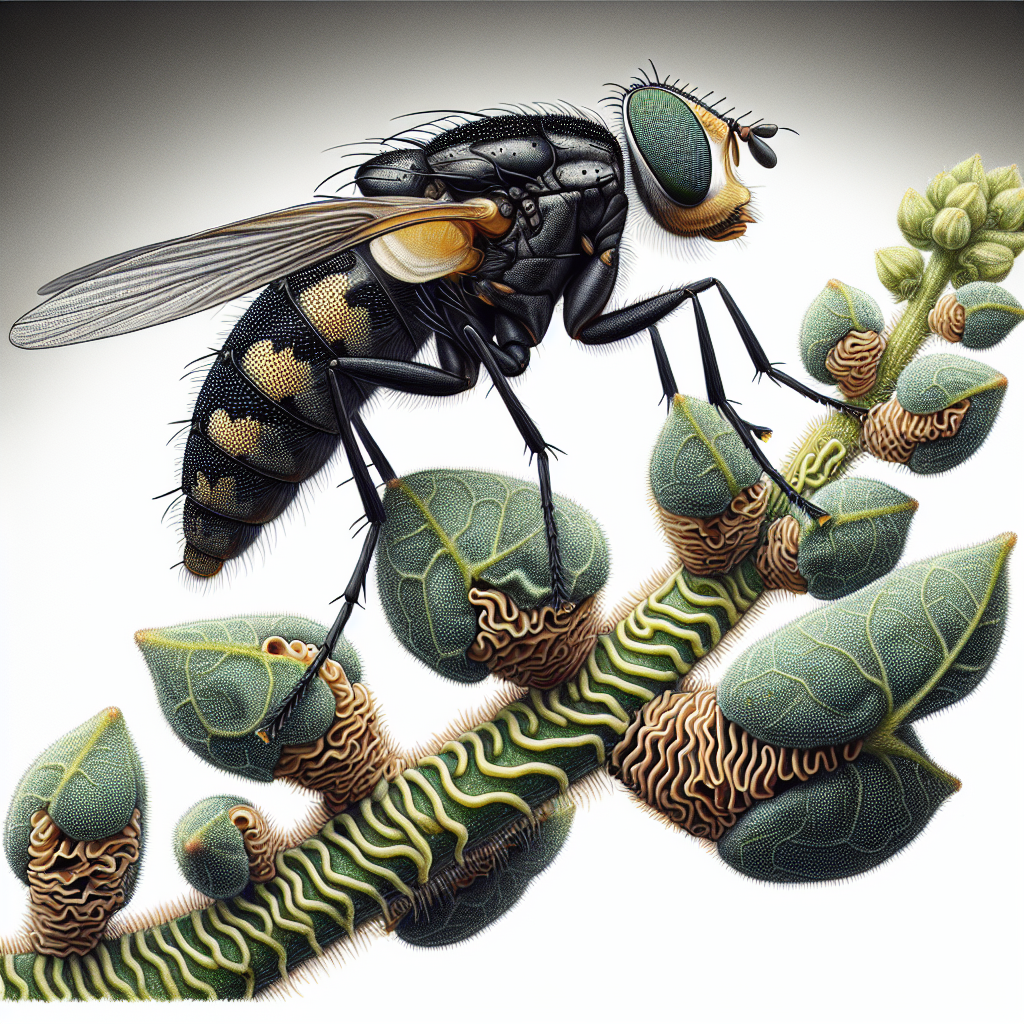
Introduction to bean flies
Bean flies (Ophiomyia phaseoli and Ophiomyia spencerella) represent a significant threat to legume production worldwide, particularly in tropical and subtropical regions. These tiny, metallic flies, often no larger than 1-2 mm, belong to the family Agromyzidae and are notorious for their stem-mining larvae that inflict severe damage to young bean plants. First identified as major pests in Africa and Asia, bean flies have spread to parts of the Americas, Australia, and beyond, causing yield losses of up to 100% in susceptible varieties under favorable conditions.
The economic impact is profound for smallholder farmers relying on beans as a staple crop. In regions like East Africa, where common beans are a dietary cornerstone, bean fly infestations exacerbate food insecurity and poverty. Understanding bean flies is crucial for integrated pest management (IPM), as their cryptic lifecycle makes detection challenging until damage is evident. This guide provides professional-grade diagnostics, lifecycle insights, and actionable organic strategies to safeguard your legume crops. For broader pest context, see our detailed entry on soybeans, a closely related host.
Farmers often confuse bean fly damage with drought stress or root-knot nematodes, underscoring the need for precise identification. With global warming expanding their range, proactive management is no longer optional but essential for sustainable agriculture.
Identifying Symptoms & Damage
Early detection of bean fly infestation hinges on recognizing subtle symptoms before widespread plant death occurs. Adult flies are shiny black or dark green, with yellowish legs and a distinctive white or yellow patch on the thorax, measuring 1.5-2 mm in length. However, adults are rarely seen; damage manifests through larval activity.
Primary Symptoms:
- Stem mining: Larvae create narrow, zigzag tunnels filled with frass (insect waste) inside the stem, visible as silvery or brownish lines under the epidermis. This disrupts vascular tissue, leading to wilting.
- Seedling collapse: Young plants (1-3 weeks old) exhibit sudden drooping of leaves, followed by yellowing and death. Affected stems show a characteristic 'pinch' or constriction at the soil line.
- Pod deformation: In older plants, larvae may tunnel into petioles, causing distorted pods and reduced seed fill.
Damage Progression:
- Mild infestation: Scattered wilting, with 10-20% leaf yellowing.
- Moderate: Up to 50% plant stand loss, stems brittle and hollowed.
- Severe: Fields appear patchy, with 'dead hearts' where central stems collapse.
Differentiate from mimics:
| Symptom | Bean Fly | Drought/Fusarium | Aphids |
|---|---|---|---|
| Wilting | Sudden, stems mined | Gradual, no mines | Sticky honeydew |
| Stem | Zigzag tunnels | Brown rot | No internal damage |
| Recovery | None without control | Possible with water | Variable |
Use a hand lens (10x) to confirm larvae (white, legless, 3-5 mm) inside stems. For real-world scouting tips, check our Spring Pest Patrol blog post. Secondary signs include ants farming honeydew from concurrent aphids or increased flea beetles on stressed plants.
Lifecycle and Progression of bean flies
Bean flies complete 10-20 generations per year in tropical climates, with lifecycle duration of 15-25 days depending on temperature (optimum 25-30°C). Understanding this rapid cycle is key to timing interventions.
Egg (1-2 days): Females lay 20-50 eggs singly or in clusters on leaf undersides or stem bases of 1-7 day-old seedlings. Eggs are white, cylindrical, 0.3 mm.
Larva (5-10 days): Hatches in 1-2 days; three instars mine downward from stem base to roots. Mature larvae (8-10 mm) exit to pupate in soil.
Pupa (7-10 days): Barrel-shaped, 3 mm, in soil 2-5 cm deep.
Adult (7-14 days): Emerges, mates within hours; females oviposit immediately. Peak activity at dawn/dusk.
Seasonal Progression:
- Dry season: Diapause in pupae.
- Wet season: Explosive populations coincide with bean planting.
Generational overlap means multiple life stages coexist, complicating control. Monitor with yellow sticky traps (10-20 per hectare) to track adult flights, which peak 7-10 days post-emergence.
Environmental Triggers & Risk Factors
Bean flies thrive in warm, humid conditions, with populations surging when temperatures exceed 24°C and rainfall >50 mm/month. Key triggers include:
- Monsoon onset: High humidity favors egg-laying.
- Poor soil drainage: Waterlogging keeps pupae viable.
- Continuous cropping: No rotation allows buildup.
- Susceptible varieties: Bush beans more vulnerable than climbing types.
Risk Assessment:
- High risk: Tropical lowlands, pH 5.5-7, clay soils.
- Moderate: Subtropics with irrigation.
- Low: Temperate zones, sandy soils.
Weeds like cowpea (not listed, but analogous) and crop residues harbor pupae. Over-fertilization with nitrogen boosts host attractiveness. Climate change extends seasons, increasing risk by 20-30% in marginal areas.
Organic Control & Treatment Plans
Organic management emphasizes IPM, avoiding broad-spectrum insecticides that harm beneficials like parasitoids (e.g., Neochrysocharis sp.).
Cultural Controls (Foundation, 60% efficacy):
- Plant at higher density (20-30 cm spacing) for shading.
- Use resistant varieties (e.g., KAT B9, GLP 2).
- Intercrop with maize or trap crops like sunflower.
Biological Controls (30% efficacy):
- Release Trichogramma wasps (5000/ha/week 1-3).
- Conserve ground beetles via mulch.
Organic Treatments (Step-by-Step):
- Seed treatment: Soak in neem seed kernel extract (5%) for 6 hours.
- Foliar sprays: Alternate neem oil (3 ml/L) + garlic-chili extract weekly from day 7. Apply evenings.
- Soil drench: Trichoderma viride (5 g/L) at planting.
- Traps: Yellow pan traps with soapy water (1/100 m²).
Threshold: Spray if >5 mines/plant or 10% stand loss.
Integrated Plan: Week 1: Seed treat + traps. Week 2-4: Scout + spray. Post-harvest: Deep plow.
Efficacy: 70-90% with compliance. Avoid pyrethroids (not organic).
Preventing bean flies in the Future
Long-term prevention builds resilient systems:
- Crop rotation: 2-3 years with cereals like rice or wheat; breaks pupal dormancy.
- Sanitation: Destroy residues, flood fields 2 weeks pre-planting.
- Timing: Plant early morning, avoid peak fly periods.
- Varietal selection: Multi-line cultivars (mix 3 resistant types).
- Soil health: Solarization (6 weeks summer) kills 80% pupae.
- Monitoring tech: Pheromone traps for early warning.
Annual checklist:
| Month | Action |
|---|---|
| Pre-plant | Rotate, solarize |
| Planting | Treat seeds, traps |
| Growth | Scout weekly |
| Harvest | Plow deep |
Success stories from Uganda show 50% yield gains via rotation alone.
Crops Most Affected by bean flies
Bean flies target Fabaceae, with severity tied to growth habit:
- Primary Hosts (High Damage): Common bean (Phaseolus vulgaris), mung bean mung bean, cowpea.
- Secondary: Soybean soybeans, pigeon pea, lablab.
- Minor/Occasional: Chickpea chickpeas, lentil lentils, peanut peanuts.
Global hotspots: Sub-Saharan Africa (common bean), Southeast Asia (mung), Latin America (snap bean). Avoid monoculture; intercropping with non-hosts like cassava reduces incidence by 40%. Wild hosts (e.g., Phaseolus lunatus) serve as reservoirs.