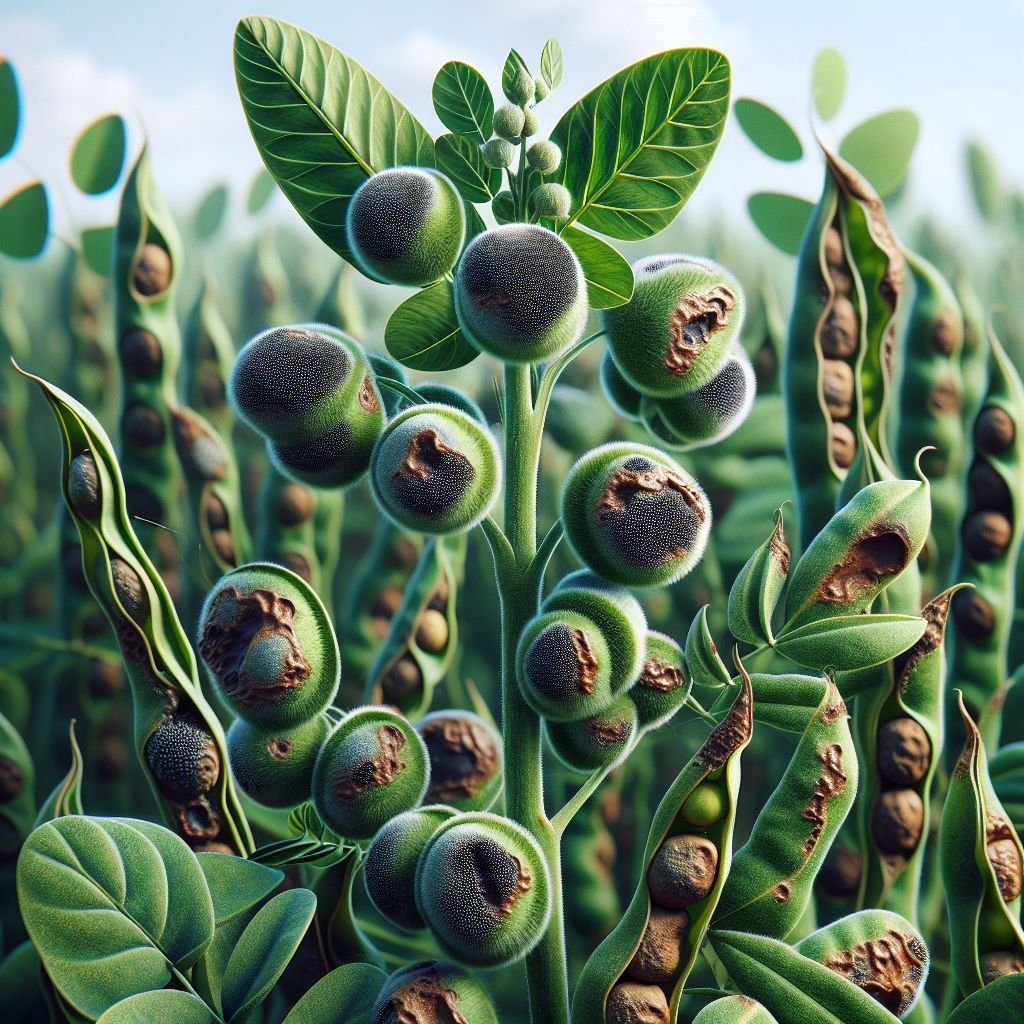
Introduction to Ascochyta rabiei
Ascochyta rabiei, commonly referred to as chickpea ascochyta blight or chickpea blight, is one of the most destructive foliar diseases impacting chickpea (Cicer arietinum) production worldwide. Caused by the necrotrophic fungus Ascochyta rabiei (teleomorph: Didymella rabiei), this pathogen thrives in cool, moist environments, leading to rapid epidemics that can destroy entire crops if unchecked. First identified in the early 20th century, it has become a major constraint in chickpea-growing regions such as the Mediterranean basin, Middle East, Australia, North America, and parts of South Asia, where chickpeas are a vital pulse crop for food security and soil health in rotations with wheat and barley.
The disease manifests as dark lesions on leaves, stems, pods, and seeds, often accompanied by profuse pycnidiospore production under favorable conditions. Yield losses can exceed 50-100% in severe outbreaks, with economic impacts amplified by reduced seed quality and market value. Understanding its biology is crucial for sustainable management, especially as climate variability increases wet periods during flowering and podding stages. This definitive guide equips farmers, agronomists, and researchers with diagnostic tools, lifecycle knowledge, organic treatments, and prevention strategies to protect chickpea yields effectively. For more on integrated pest management, check this Spring Pest Patrol blog.
Chickpeas, including varieties like Kabuli Chickpeas and Desi Chickpeas, are particularly susceptible due to their indeterminate growth habit, which prolongs exposure to infection. Global production, exceeding 14 million tons annually, faces ongoing threats from evolving pathogen races, underscoring the need for resistant cultivars and cultural practices. Early intervention is paramount, as infections start on lower leaves and progress upward, girdling stems and blighting pods.
Identifying Symptoms & Damage
Accurate diagnosis of Ascochyta rabiei begins with recognizing its characteristic symptoms, which appear 7-14 days after initial infection under optimal conditions (10-20°C with leaf wetness >12 hours). On leaves, small, water-soaked spots evolve into circular to irregular lesions (2-10 mm) with dark brown to black borders and grayish-white centers dotted with black pycnidia—flask-shaped fruiting bodies producing infectious spores. Lesions often merge, causing blighting and premature defoliation, especially on lower canopy leaves first.
Stem infections produce elongated, dark brown lesions up to 5 cm long, sometimes girdling the stem and causing lodging. These lesions may show concentric zonation and crack longitudinally, exposing vascular tissue. Pods exhibit sunken, tan to black spots that spread, leading to shriveled seeds with dark staining; infected seeds often fail to germinate or transmit the pathogen. Seedlings show hypocotyl lesions and damping-off, mimicking root rot but distinguished by pycnidia.
Damage quantification varies: foliar blight reduces photosynthetic area by 30-70%, stem cankers cut pod set by 40-80%, and pod infections degrade seed quality, rendering 20-50% unmarketable. Secondary invaders like Botrytis may complicate diagnosis, but Ascochyta's pycnidia and salmon-colored spore ooze in humid conditions are diagnostic. Use a 10x hand lens to confirm; lab confirmation via culturing on PDA media reveals the pathogen's septate conidia (10-25 x 2-4 μm). Differentiate from Alternaria leaf spot by lesion shape and pycnidia absence, or Septoria leaf spot by smaller, more numerous spots without girdling.
Scout weekly from seedling stage, focusing on field edges and low-lying areas. Symptom progression accelerates post-rainfall, with epidemics if >10% plants show symptoms at flowering. Yield impacts are nonlinear: 1% foliar severity at podding correlates to 5-10% loss, escalating exponentially.
Lifecycle and Progression of Ascochyta rabiei
Ascochyta rabiei survives primarily as pycnidia in infected debris, seeds, and volunteer plants, with longevity up to 3 years in dry soil but rapid decay in tilled fields. Primary inoculum includes seedborne pycnidiospores (up to 20% contamination) and ascospores from pseudothecia on residue. Germination occurs in free water at 5-30°C (optimum 15-20°C), with pycnidiospores splashing up to 1m via rain or irrigation.
The polycyclic lifecycle features 5-10 infection cycles per season: conidia germinate, penetrate via stomata or wounds, colonize intercellularly, and produce new pycnidia in 7-10 days. Ascospores, sexually produced in pseudothecia, enable long-distance spread via wind. Progression starts at vegetative stage (GS 20-30), peaks during flowering/podding (GS 50-80), driven by prolonged leaf wetness (>48 hours cumulative). Latency period shortens from 14 days at 10°C to 5 days at 20°C.
Epidemics follow a logistic model: initial slow build-up, rapid exponential phase with R0 >4, then plateau. Overwintering on peas or lentils bridges seasons. Understanding this informs timely fungicide timing, targeting early lesions to truncate cycles.
Environmental Triggers & Risk Factors
Cool (8-22°C), wet conditions are ideal, with infection nil above 28°C or below 5°C. Leaf wetness duration >6 hours nightly sustains spore germination; rainfall >20mm/week during reproductive stages triggers outbreaks. High humidity (>85%) promotes pycnidiospore release.
Risk factors include susceptible varieties like older Desi types, narrow-row spacing (<30cm) increasing humidity, no-till residue retention (>20%), and seed lots with >1% infection. Continuous chickpea monoculture amplifies inoculum; irrigation overhead boosts splash dispersal. Climate change extends risky windows in temperate zones. Monitor via weather stations for wetness hours; thresholds: >50 hours at 10-20°C signal high risk. Fields near last year's stubble or with poor drainage are hotspots.
Organic Control & Treatment Plans
Organic management relies on an integrated approach avoiding synthetic fungicides. Start with certified disease-free seeds treated with hot water (50°C for 20 min) or trichoderma-based biocontrols. Deploy resistant varieties like CDC Frontier or Amit, offering 20-50% less severity.
Cultural tactics: rotate with non-hosts like corn or sorghum for 3+ years; till residue to accelerate decay; space rows 40-50cm for airflow; avoid overhead irrigation, favoring drip. Apply compost teas or potassium bicarbonate sprays (5g/L) at first symptoms, repeating every 7-10 days up to 3x. Biocontrols: Trichoderma harzianum or Bacillus subtilis (e.g., Serenade) at 10^9 CFU/L, timed for 80% humidity.
Remove and destroy early lesions (rogueing); mulch with straw to reduce splash. Nutrition: balanced NPK, avoid excess N; silicon amendments (20kg/ha potassium silicate) enhance resistance. Monitor with disease forecasting apps; apply copper oxychloride (1-2kg/ha) if permitted organically, but rotate modes of action. In trials, IPM reduces severity by 60-80% vs. untreated.
Treatment plan: Week 1 (early spots): biocontrol + bicarbonate. Week 2-4: repeat + sanitation. Post-harvest: deep plow + solarization.
Preventing Ascochyta rabiei in the Future
Prevention hinges on breaking the lifecycle. Use seed indexing (<0.1% infection); hot water or thiram if allowed. Plant resistant cultivars: Amit, CDC Luna (MR rating). Site selection: well-drained slopes, away from previous chickpea fields. Crop rotation: 1:3 with cereals like oats.
Optimize planting: early (avoid late wet seasons), wide rows (45cm), low density (20 plants/m²). Fungicide-free buffers around fields. Forecast models (e.g., Ascochyta Alert) predict risk from weather data. Post-harvest: destroy residue via grazing/flailing; solarize soil in summer. Scout rigorously; zero tolerance at flowering. Long-term: breed for QTL-linked resistance; diversify with quinoa intercropping. These yield 20-40% higher in endemic areas.
Crops Most Affected by Ascochyta rabiei
Primarily chickpeas (Kabuli Chickpeas, Desi Chickpeas), with occasional spillover to lentils, peas, and fava bean (broad bean). Chickpeas suffer most due to host specificity; wild Cicer spp. act as reservoirs. No significant impact on grains like wheat or barley, but rotation aids control. Global hotspots: Australia (50% acreage affected), Canada, India.