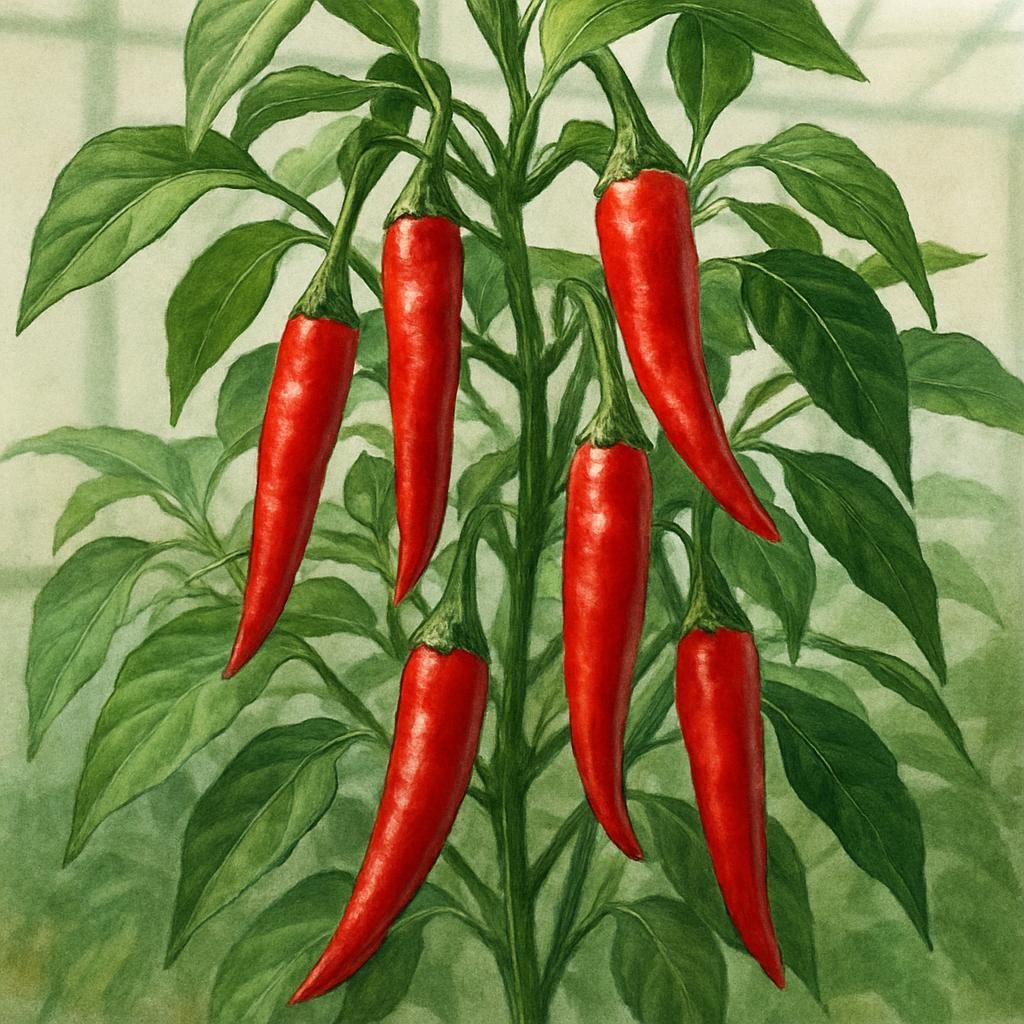
Introduction to Arbol Chili
Arbol Chili (Capsicum annuum var. arbol) is a slender, upright pepper that matures from green to a brilliant, glossy red. Native to Mexico, it is valued for its clean, sharp heat (15,000–30,000 Scoville Heat Units) and thin walls that dry quickly into attractive, long-lasting ristras. Commercial growers and home gardeners alike appreciate its relatively compact plant habit, high fruit set, and tolerance to both fresh-market and dehydration uses.
Beyond culinary appeal, Arbol Chili supports small-farm diversification because it stores well, commands premium prices when sold as dried pods, and fits into intensive cropping systems. The variety performs reliably in warm temperate to subtropical climates and responds well to precise fertigation and integrated pest management.
Botanical Profile of Arbol Chili
Arbol plants are indeterminate, reaching 60–90 cm in height with a narrow canopy that benefits from staking. Leaves are lanceolate, dark green, and relatively small, allowing good light penetration to fruiting nodes. Flowers are small, white, and self-pollinating, although bees increase fruit set under field conditions.
Fruit are cylindrical, 7–10 cm long and 0.8–1.2 cm wide, with thin pericarp that facilitates rapid moisture removal during curing. The cultivar belongs to the same species as Chili Pepper and shares many cultural requirements with Cayenne Pepper.
Soil, pH, and Climate Requirements for Arbol Chili
Arbol Chili demands warm soil temperatures, consistent moisture without waterlogging, and a slightly acidic to neutral pH. The table below summarizes ideal parameters for commercial production.
| Parameter | Ideal Range | Notes |
|---|---|---|
| Soil Type | Sandy loam to loam | Good drainage essential; raised beds recommended |
| Soil pH | 6.0–6.8 | Below 5.8 increases blossom-end rot risk |
| Soil Temperature | 21–29 °C (70–85 °F) | Germination halts below 15 °C |
| Air Temperature (day) | 24–32 °C (75–90 °F) | Optimal fruit set; above 35 °C causes drop |
| Air Temperature (night) | 18–21 °C (65–70 °F) | Maintains flower viability |
| Annual Rainfall | 600–900 mm | Supplemental irrigation required |
| Relative Humidity | 50–70 % | Lower humidity reduces fungal pressure |
| Frost Tolerance | None | Protect below 10 °C |
Step-by-Step Planting & Propagation
- Start seeds indoors 8–10 weeks before last frost. Maintain soil temperature at 24–27 °C; germination occurs in 7–14 days.
- Transplant seedlings when they have 4–6 true leaves and night temperatures remain above 15 °C.
- Space plants 40–50 cm apart in rows 75–90 cm wide; stagger double rows for higher density.
- Install drip irrigation and trellis supports at transplanting to minimize root disturbance.
- Mulch immediately with 5–7 cm of organic straw or plastic film to conserve moisture and suppress weeds.
Care & Maintenance regimes for Arbol Chili
Consistent water and nutrient delivery are critical. The following schedule assumes drip irrigation and fertigation capability.
| Growth Stage | Irrigation Frequency | Fertilizer (NPK) | Pruning Action |
|---|---|---|---|
| Seedling (0–4 wks) | Light daily mist to 60 % FC | 10-20-10 at 50 ppm N weekly | None |
| Vegetative (4–8 wks) | 2–3× week, 15–20 mm | 20-10-10 at 100 ppm N bi-weekly | Remove lower leaves below 15 cm |
| Flowering (8–12 wks) | 3× week, 20–25 mm | 10-10-20 at 120 ppm K weekly | Top at 30 cm to encourage branching |
| Fruiting (12+ wks) | 3–4× week, 25–30 mm | 5-5-15 at 80 ppm K weekly | Remove damaged or shaded branches |
Side-dress with calcium nitrate at first fruit set to prevent blossom-end rot. Monitor EC of fertigation solution; keep below 2.5 mS cm⁻¹ to avoid salt stress.
Pests, Diseases & Organic Management
Arbol Chili is susceptible to Aphids, Spider Mites, Thrips, and Whiteflies. Fungal threats include Powdery Mildew and Phytophthora. Implement weekly scouting and release beneficial insects (lady beetles, lacewings, predatory mites) at first detection. Neem oil and insecticidal soaps provide acceptable organic knockdown. Maintain strict crop rotation with non-solanaceous crops to reduce soil-borne inoculum.
Harvesting, Curing & Optimal Storage
Harvest mature green fruit at 70–80 days or wait for full red color at 85–95 days. Pick every 5–7 days to encourage continuous production. For drying, spread pods in single layers at 35–40 °C with 15–20 % relative humidity until moisture content reaches 8–10 %. Store dried chilis in airtight containers away from light; viability remains above 80 % for 12 months under cool, dark conditions.
Companion Planting for Arbol Chili
Pair Arbol Chili with Thai Basil, Marigold, and Nasturtium to repel aphids and nematodes. Interplant with Tomato or Eggplant in rotation schemes that break disease cycles. Avoid planting near Fennel or Dill, which can inhibit pepper growth.
For deeper insights into seasonal timing and small-farm resilience, read The Overlooked Art of Seasonal Harvest Timing for Small Farm Profit.