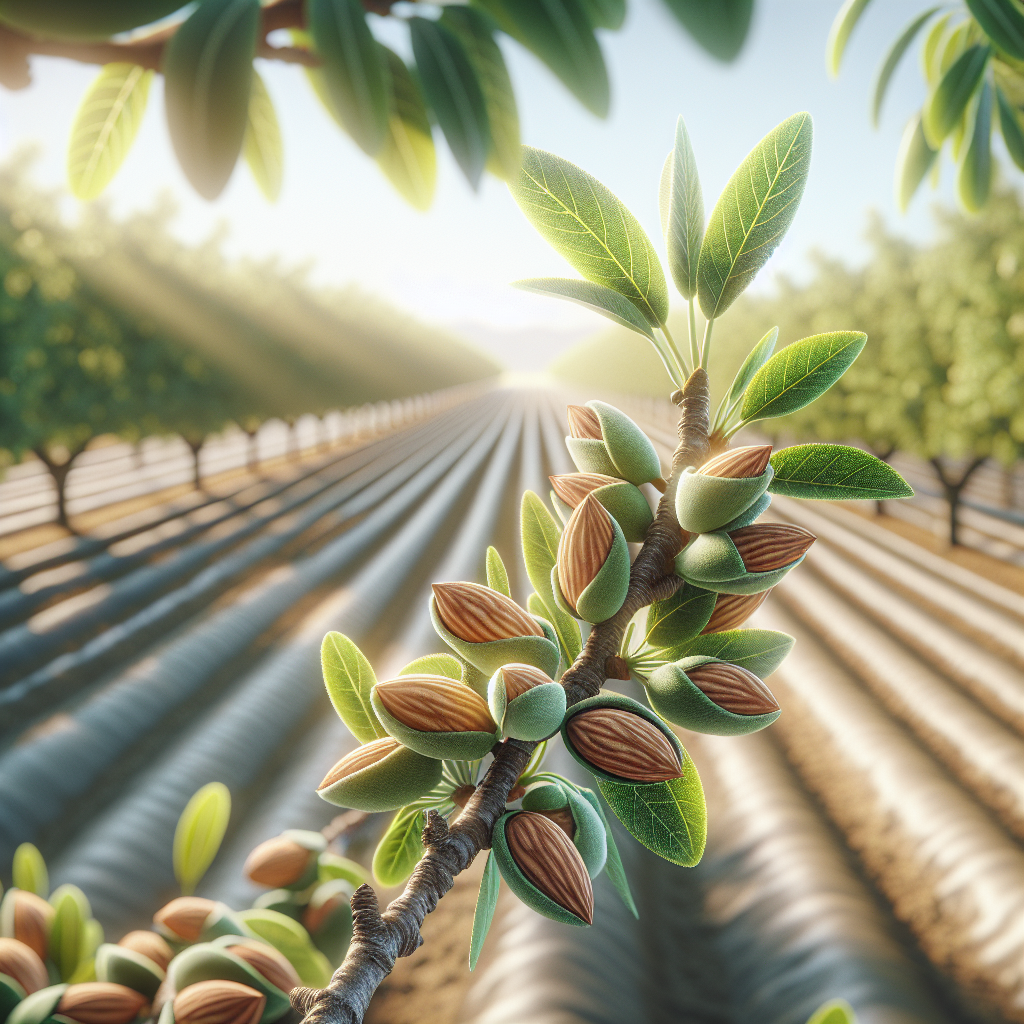
Introduction to Almond (Ne Plus Ultra)
A historic California almond cultivar, 'Ne Plus Ultra' has long been recognized for its paper-thin shell, well-filled kernel, and usefulness in mixed orchards as an effective pollinizing companion for other early-blooming almonds. It belongs to the rose family and shares many cultural requirements with peach and other stone fruits, but it is less forgiving of bloom-time rain, late spring frost, and prolonged root-zone saturation. The cultivar is commercially important less for extreme modern yield than for kernel quality, shelling ease, and its value in compatible pollination systems.
The tree is vigorous to moderately vigorous, typically upright to somewhat spreading with age, and tends to bloom early. That early bloom is both its advantage and its risk: it allows early season pollination overlap with classic cultivars, but flowers and young fruit are highly exposed to frost injury. In suitable districts, especially those with cool winters and dry springs, it can be a rewarding orchard tree for specialty nut production.
From a horticultural perspective, this cultivar is best approached as a precision-managed crop rather than a casual backyard nut tree. Site selection, drainage, pollinizer planning, and canopy hygiene determine success more than almost any fertilizer program. For broader almond culture basics, see our Almond guide. A useful background read on orchard floor and fertility management is this article on soil health.
Botanical Profile of Almond (Ne Plus Ultra)
This cultivar is a deciduous nut tree species, botanically a drupe producer rather than a true botanical nut. The edible kernel is the seed inside a split hull and a thin, often fragile shell. In 'Ne Plus Ultra', the shell is exceptionally soft, which improves shelling efficiency and kernel recovery but also increases vulnerability to insect entry, weather injury, and rough handling after harvest.
Typical mature tree size ranges from about 4.5 to 7.5 meters tall on standard or semi-vigorous rootstocks, though final height depends heavily on rootstock, pruning, soil depth, and irrigation strategy. Leaves are lanceolate, finely serrated, and emerge after or during bloom. Flowers are usually pale pink to nearly white, five-petaled, and borne on short spurs and one-year wood. Spur productivity is critical in mature trees, so pruning must preserve fruitful wood while maintaining light penetration.
'Ne Plus Ultra' is generally self-incompatible, meaning it needs compatible cross-pollination from another almond cultivar blooming at the same time. It is especially known historically as a pollinizer for cultivars such as Nonpareil. Without pollinizer overlap and active bee movement, fruit set can be erratic even when bloom looks abundant.
Bloom is early, often among the first wave in almond districts. Chilling needs are moderate by almond standards, and inadequate winter chill can produce delayed, uneven leaf-out and weak bloom. Fruit consists of an outer green hull, a shell, and the kernel. Hull split marks the approach of harvest, at which point careful timing is needed to avoid Navel orangeworm pressure and kernel quality decline.
A key cultivar characteristic is premium kernel appearance: elongated, attractive, and relatively easy to blanch. However, because of the soft shell and early bloom habit, it is less rugged than harder-shell cultivars under high pest pressure or unstable spring weather.
Soil, pH, and Climate Requirements for Almond (Ne Plus Ultra)
Deep, well-drained loam to sandy loam is ideal. The best sites have at least 1.5 meters of penetrable soil, good internal drainage, and no restrictive hardpan within the main rooting zone. Almond roots require oxygen; when soil pores remain water-filled for too long, root respiration falls, feeder roots die back, and trees become vulnerable to Phytophthora and crown decline.
Target soil pH is 6.5 to 7.8, with optimum performance often around 6.8 to 7.5. Trees can tolerate mildly alkaline soils better than many fruit crops, but micronutrient lock-up, especially zinc and iron, becomes more likely above pH 7.8. If pH rises above 8.0, expect chlorosis in susceptible soils unless fertility is managed precisely. Avoid highly sodic or poorly structured clay soils unless drainage has been substantially improved.
Preferred climate is Mediterranean or warm temperate: cool winters for dormancy, frost-limited springs, hot dry summers, and low humidity during hull split and harvest. Winter chilling of roughly 200-500 hours below 7.2°C is usually sufficient for many almond cultivars, though site performance varies by local adaptation. Spring frost below about -2°C during open bloom can damage flowers severely, while even slightly colder temperatures after petal fall may kill young developing nuts.
Summer heat is valuable for nut fill and disease suppression, with daytime temperatures of 27-35°C generally favorable if irrigation is adequate. Trees tolerate hot spells above 38°C, but prolonged heat combined with moisture stress can reduce kernel fill, shrink nut size, and trigger premature leaf drop.
Annual water demand in production orchards often falls in the range of 900-1300 mm equivalent, depending on soil type, canopy size, humidity, and evapotranspiration. The goal is not constant wetness but steady access to moisture in the active root zone. During the key period from leaf-out through kernel fill, avoid swings from saturation to severe dryness.
Soil moisture is best maintained at roughly 60-80% of field capacity through the primary growing season. In practical terms, a hand-squeezed sample from 20-40 cm depth should feel cool and cohesive but not release free water. Warning signs of overwatering include yellowing inner canopy leaves, soft rank shoot growth, sour-smelling soil, algae near emitters, gumming at the crown, and midday wilt despite wet soil. Warning signs of underwatering include dull gray-green foliage, shortened shoots, small hard kernels, hulls that split unevenly, and leaf scorch beginning at margins.
Wind exposure matters more than many growers expect. Strong spring winds can reduce bee activity during bloom and increase flower desiccation. Shelterbelts at a distance, rather than dense close windbreaks that shade the orchard, are preferred.
Step-by-Step Planting & Propagation
Commercially, trees are established as grafted nursery stock rather than grown from seed. Seedling-grown almonds are genetically variable and unsuitable when predictable nut quality and bloom timing are required. Choose certified disease-free nursery trees budded or grafted onto rootstocks adapted to your soil: vigorous peach-almond hybrids are often chosen for well-drained soils, while plum hybrid rootstocks may be better in sites with heavier texture or certain replant concerns.
Select the orchard site carefully. Choose full sun, air drainage, and a slight slope if possible. Avoid frost pockets, low basins, and any area where water stands longer than 24 hours after heavy rain.
Test soil before planting. Measure pH, electrical conductivity, sodium adsorption risk, organic matter, and key nutrients. Also inspect for hardpan by digging pits to at least 1 meter. Rip or subsoil compacted layers before planting if needed.
Prepare the ground. Remove perennial weeds thoroughly. Incorporate compost only if soil organic matter is low and drainage is not compromised. Do not create rich, water-holding planting pockets in otherwise heavy ground; roots may remain trapped there.
Plan cultivar layout for pollination. Because 'Ne Plus Ultra' is not reliably self-fertile, include compatible pollinizer rows or alternating trees with overlapping bloom. Bee access is essential; most orchards need managed honeybee hives placed just before 10% bloom.
Plant during dormancy. Late winter planting is standard in mild climates after severe freeze risk has eased but before active budbreak. In colder regions, early spring planting is safer.
Set trees at correct depth. Dig a broad hole only as deep as the root system. Keep the graft union clearly above the soil line, usually 10-15 cm above finished grade. Planting too deep encourages scion rooting and crown disease.
Backfill with native soil. Break clods and eliminate air pockets by watering in lightly. Do not heavily amend the planting hole alone.
Head back at planting if appropriate. Bare-root trees are often cut back to 70-90 cm to encourage scaffold formation. Container trees may need lighter heading depending on structure.
Install irrigation immediately. Young trees need a wetted zone that expands with root growth. Drip systems should encourage outward rooting rather than keeping all moisture tight to the trunk.
Train the framework early. Use an open center or modified central leader system depending on region and machinery needs, but always prioritize light penetration and strong scaffold angles.
Propagation beyond nursery production is usually by budding onto rootstocks in summer or bench grafting in dormant season. For growers, top-working existing trees can be done if a rootstock is sound, but it requires skilled grafting and careful disease sanitation.
Spacing commonly ranges from 5 x 5 meters to 7 x 7 meters in lower-density systems. High-density plantings are possible but demand more pruning and precise irrigation. Backyard trees should still be given enough room for airflow and pollinizer placement.
Care & Maintenance regimes for Almond (Ne Plus Ultra)
The first three years determine orchard architecture and future productivity. Young trees should be pushed toward steady, moderate growth rather than lush, overly succulent growth. Excess nitrogen early on can produce weak wood and greater aphid or disease pressure.
Irrigation: In year one, apply water frequently enough to keep the primary root zone evenly moist but never soggy. On sandy soil this may mean 2-4 irrigations per week in hot weather; on loam, 1-2 deep irrigations may suffice. Mature trees benefit from deeper, less frequent cycles that wet the soil to 60-90 cm depth during active growth. Critical periods are bloom through nut set, shell hardening, and kernel fill. Mild strategic deficit after hull split is sometimes used to reduce Hull rot risk, but severe stress at that stage can reduce next year's bloom wood and promote defoliation.
A practical monitoring method is to inspect soil with a probe at 30 cm and 60 cm. If the 30 cm layer is drying but 60 cm remains moist, irrigation may wait briefly on deep soils. If both depths are dry and leaves begin to lose gloss by midday, the tree is entering avoidable stress.
Fertilization: Almonds have notable nitrogen and potassium demand. Young nonbearing trees often need split nitrogen applications totaling roughly 30-60 g actual N per tree annually, increasing with vigor and size. Mature bearing trees may require 100-250 kg N per hectare depending on yield target and leaf analysis. Apply nitrogen in multiple doses from leaf-out through early summer rather than one large shot. Late excessive nitrogen delays hardening and can increase disease susceptibility.
Leaf tissue analysis in midsummer is the professional standard for adjusting fertility. Watch especially zinc, boron, potassium, and nitrogen. Boron is important for flower fertility and nut set, but overapplication can be toxic; use only when confirmed necessary. Zinc deficiency appears as small leaves, shortened internodes, and rosetting on shoot tips, especially in alkaline soils.
Pruning: During training, select 3-4 well-spaced scaffolds with wide crotch angles. In mature trees, remove dead, crossing, shaded, and diseased wood while preserving fruitful spurs. Heavy annual pruning is usually less desirable than regular moderate pruning. The aim is a canopy that allows dappled light into the interior. Poor light distribution reduces spur renewal and shifts production outward where branches are more prone to breakage.
Weed and orchard floor management: Keep a vegetation-free strip around young trunks to reduce competition. In bearing orchards, mowed middles and managed cover crops can improve infiltration and soil structure, but cover growth must not rob moisture during spring demand. Clover is often used in orchard alleys for soil cover and pollinator support where water is sufficient.
Pollination management: Place strong hives at orchard edge and within blocks before peak bloom. Avoid insecticide sprays during bloom. Cool, windy, or rainy weather can sharply reduce bee flights; this is one reason early-blooming cultivars can produce inconsistently in marginal climates.
Sunburn and trunk care: Young trunks may need white latex paint diluted 1:1 with water to prevent southwest injury. Keep mulch away from the trunk by 10-15 cm to prevent crown moisture accumulation.
Pests, Diseases & Organic Management
Because 'Ne Plus Ultra' has a soft shell, integrated pest management is especially important. Insects that would be less damaging in harder-shelled almonds can directly affect kernel quality here.
Navel orangeworm is among the most serious threats. It infests mummy nuts and then moves into new crop nuts after hull split. Sanitation is essential: remove or shake all overwintering mummy nuts from trees and destroy those on the ground before the next bloom season. Timely harvest is one of the strongest controls.
Peach twig borer can damage shoots and nuts. Dormant oil and well-timed biological sprays such as Bacillus thuringiensis may help depending on local pressure and life cycle timing.
Aphids and Mites stress foliage and reduce tree vigor. Encourage natural enemies by maintaining flowering insectary strips and minimizing disruptive broad-spectrum products. Yarrow near orchard margins can support beneficial insects. For Mites, dust reduction on farm roads is often as important as direct control.
Ants may interfere with biological control and protect honeydew-producing pests. Baits and orchard floor sanitation are useful, especially in dry climates.
Brown rot blossom blight can be severe during wet bloom periods. Remove blighted twigs and mummified tissue, prune for airflow, and avoid overhead irrigation during bloom. Organic copper or biological fungicides may offer partial suppression when used preventively, but timing is critical.
Shot hole causes leaf lesions and can defoliate trees when spring moisture persists. Good airflow, sanitation, and avoidance of prolonged leaf wetness are central management tools.
Hull rot is encouraged by excessive nitrogen and overirrigation as hulls begin to split. Reduce late-season nitrogen excess and avoid maintaining a constantly saturated root zone. Symptoms include sudden death of fruiting wood associated with infected hulls.
Phytophthora crown and root rot develops in poorly drained soils or with emitters placed too close to the trunk. Keep trunk bases dry, improve drainage, and use resistant rootstocks where disease history exists.
Bacterial canker is more likely where trees are stressed by poor drainage, frost, or pruning wounds during wet weather. Prune during dry periods and avoid unnecessary injury.
Organic management succeeds best when built on prevention: sanitation, resistant rootstock choice, irrigation discipline, balanced nutrition, and canopy openness. Soft-shell cultivars do not tolerate neglect well.
Harvesting, Curing & Optimal Storage
Harvest timing is based on hull split, shell dryness, kernel maturity, and pest risk. In most climates, harvest begins when the majority of nuts show a clean split of the hull and the shell within is dry and firm. Delaying too long invites insect damage, weathering, and fungal contamination.
For small-scale production, nuts can be hand-picked or limbs gently shaken onto clean tarps. Commercial blocks are mechanically shaken. Avoid bruising or crushing because the thin shells of 'Ne Plus Ultra' crack easily.
Immediately after harvest, remove hulls as soon as practical. Nuts left in wet hulls heat rapidly and may discolor or mold. Dry the in-shell nuts in a single layer in a warm, shaded, well-ventilated area until kernel moisture falls to about 6% or lower for safe storage. In practical terms, shells should feel dry and brittle, and kernels should snap cleanly rather than bend.
Do not cure in direct intense sun for prolonged periods in very hot climates, as kernel flavor can deteriorate. Forced-air drying at low to moderate temperature is more reliable if humidity is high.
Store in-shell almonds in cool, dry, dark conditions. Ideal long-term storage is near 0-10°C with low relative humidity, generally below 65%. Shelled kernels, because of their oil content, keep best under refrigeration or freezing in airtight containers. Exposure to heat, oxygen, and light accelerates rancidity.
Inspect stored nuts regularly for insect activity, moisture condensation, or off odors. Soft-shell almonds are especially vulnerable to storage pests if not dried thoroughly.
Companion Planting for Almond (Ne Plus Ultra)
Companion planting around almond orchards should focus on ecological services rather than crowding the tree root zone. The best companions attract pollinators and beneficial insects, improve soil cover, suppress erosion, and reduce dust without competing aggressively for water directly under the canopy.
Clover is one of the strongest orchard companions because it provides living ground cover, supports pollinators when allowed to flower, and contributes biologically fixed nitrogen over time. It is most useful in alleyways or between rows where irrigation and mowing can be managed.
Thyme works well along dry orchard borders and berms because it is low-growing, aromatic, and attractive to beneficial insects while using relatively modest water once established. It also helps occupy open soil where weeds would otherwise colonize.
Yarrow is valuable in insectary strips, drawing hoverflies, parasitic wasps, and predatory insects that help moderate aphid populations. Its deep roots can also improve soil structure in non-cultivated margins.
Nasturtium can function as a trap and nectar plant in diversified home orchards, though it is less commonly used in commercial nut systems. Keep it away from the trunk and avoid heavy irrigation that would create humid conditions near the tree base.
Avoid planting thirsty annual vegetables directly within the main feeder-root zone of young trees. Also avoid dense, unmanaged understory vegetation during spring if soil moisture is limited. The most effective almond companion system is usually a managed alley cover plus clean, dry trunk zones and open, sunny canopy conditions.