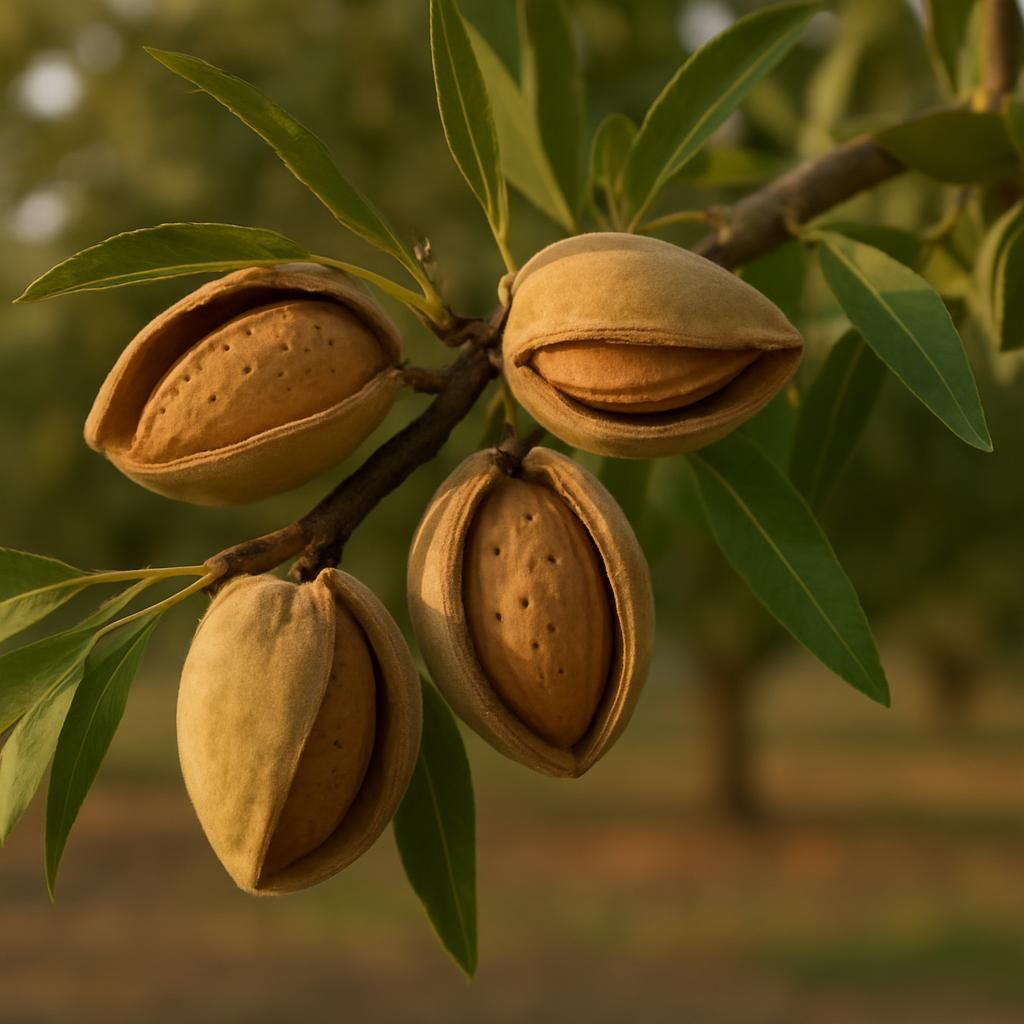
Introduction to Almond (Mission)
The Mission almond (Prunus dulcis 'Mission') is a late-blooming, hard-shell cultivar originating from early California plantings. Growers value it for its rich, intense flavor, elevated oil percentage, and superior post-harvest stability compared to soft-shell varieties. Because bloom occurs after most spring frosts, Mission offers reliable yields in regions where earlier cultivars suffer losses. The tree exhibits a vigorous, upright habit with dense foliage that supports heavy nut loads when properly managed.
Mission almonds are primarily grown for the kernel market, though the hard shells are also utilized in biomass and livestock bedding. The variety performs best in Mediterranean climates with hot, dry summers and cool, wet winters. Commercial orchards typically plant Mission at densities of 100–150 trees per acre on vigorous rootstocks. Home gardeners appreciate its dual-purpose value as both a productive nut tree and an attractive landscape specimen.
Successful production demands attention to chilling requirements, irrigation scheduling, and integrated pest management. This guide provides step-by-step protocols for soil preparation, planting, nutrition, pruning, and harvest tailored specifically to the Mission cultivar.
Botanical Profile of Almond (Mission)
Mission belongs to the Rosaceae family and is botanically classified as Prunus dulcis 'Mission'. The tree reaches 15–25 feet at maturity with a rounded to vase-shaped canopy. Leaves are lanceolate, 3–5 inches long, with finely serrated margins and a glossy green upper surface. Flowers are pale pink to white, appearing in late February to early March depending on location.
The fruit is a drupe consisting of a leathery hull, hard shell, and edible kernel. Mission kernels are medium-sized, plump, and darker than Nonpareil types, with approximately 55–60% oil content. The shell is extremely hard, providing natural protection against navel orangeworm and birds. Trees are self-incompatible and require cross-pollinators such as Nonpareil Almond or Ne Plus Ultra Almond.
Root systems are deep and extensive on sandy loam soils but remain shallow on heavy clays. Mission exhibits moderate drought tolerance once established yet responds dramatically to consistent irrigation during kernel fill. The cultivar demonstrates good resistance to hull rot but remains susceptible to Phytophthora root rot in poorly drained sites.
Soil, pH, and Climate Requirements for Almond (Mission)
Mission almonds demand deep, well-drained soils with high fertility. Heavy clay or saline soils reduce root function and increase disease pressure. The ideal pH range is 6.5–8.0; values below 6.0 require liming at least six months before planting.
| Parameter | Ideal Range | Notes |
|---|---|---|
| Soil Texture | Sandy loam to loam | Avoid heavy clays and shallow hardpans |
| Soil Depth | Minimum 4–6 ft | Critical for root development and drought tolerance |
| Soil pH | 6.5–8.0 | Adjust with lime or sulfur as needed |
| Salinity (EC) | <2.0 dS/m | Sensitive to sodium and chloride |
| Chilling Hours | 400–500 hours below 45°F | Required for uniform bloom and set |
| Summer Temperature | 85–105°F daytime | Promotes kernel oil accumulation |
| Winter Temperature | 35–55°F average | Avoid prolonged freezes below 15°F |
| Annual Rainfall | 10–20 inches (supplemental irrigation required) | Dry summers essential to reduce disease |
Site selection should prioritize south- or west-facing slopes with good air drainage to minimize frost risk during bloom. Windbreaks are recommended in areas with frequent spring winds exceeding 15 mph.
Step-by-Step Planting & Propagation
Soil Testing and Amendment: Conduct comprehensive soil tests for pH, macro- and micronutrients, and nematodes. Incorporate 2–4 tons of agricultural lime per acre if pH is below 6.3. Add 20–30 tons of well-composted manure or cover crop biomass six months prior to planting.
Rootstock Selection: Use vigorous rootstocks such as Nemaguard or Hansen 536 for sandy soils. On heavier soils, consider Krymsk 86 or Rootpac-R for improved anchorage and moderate vigor control.
Planting Density and Layout: Space trees 18–22 feet apart in rows 22–26 feet wide for traditional orchards. High-density systems on dwarfing rootstocks allow 12 × 18 foot spacing but require intensive pruning.
Planting Technique: Dig holes twice the width of the root ball and equal in depth. Position the graft union 2–3 inches above final soil level. Backfill with native soil amended with 10% compost. Water thoroughly to settle soil and eliminate air pockets.
Initial Irrigation and Mulching: Apply 5–10 gallons of water per tree immediately after planting. Install 3–4 inches of organic mulch in a 3-foot radius, keeping mulch 4 inches from the trunk to prevent rot.
First Season Training: Select three to four well-spaced scaffold branches during dormancy. Remove all other growth below 36 inches to establish a strong framework.
Care & Maintenance regimes for Almond (Mission)
Mission requires disciplined irrigation, nutrition, and pruning to achieve commercial yields of 2,000–3,000 pounds of kernels per acre.
| Growth Stage | Water Schedule | Fertilizer Application | Pruning Action |
|---|---|---|---|
| Dormant (Dec–Jan) | None unless soil is extremely dry | Apply 40–60 lbs N/acre as compost or manure | Remove dead/diseased wood; select scaffolds |
| Bloom–Petal Fall | Maintain field capacity; 0.8–1.0 in/week | 20 lbs N/acre split; boron foliar at 0.5 lb/acre | Minimal; only water sprout removal |
| Nut Development | Increase to 1.5–2.0 in/week | 60–80 lbs N/acre; zinc and potassium as needed | Light tipping of vigorous shoots |
| Kernel Fill | Peak demand: 2.0–2.5 in/week | Final N application; avoid excess late N | Summer prune to open canopy for light |
| Post-Harvest | Reduce to 0.5–0.8 in/week | None; focus on soil health cover crops | Structural pruning; remove crossing branches |
Monitor soil moisture with tensiometers or capacitance probes installed at 12, 24, and 36 inches. Deficit irrigation during hull split can reduce hull rot incidence but must be carefully managed to avoid kernel shrivel.
Pests, Diseases & Organic Management
Mission almonds face pressure from several key pests and diseases. Navel orangeworm is the primary insect threat; sanitation through timely harvest and winter sanitation of mummy nuts is the foundation of control. Peach twig borer and mites also require monitoring.
Major diseases include Phytophthora root rot, hull rot, and shot hole. Cultural practices such as improving drainage, avoiding over-irrigation, and maintaining open canopies significantly reduce incidence.
Organic management relies on mating disruption for navel orangeworm, Bacillus thuringiensis for peach twig borer, and predatory mites for spider mite suppression. Copper-based sprays during dormancy help control shot hole and bacterial canker. Regular monitoring with degree-day models allows timely intervention before economic thresholds are reached.
Harvesting, Curing & Optimal Storage
Mission almonds reach physiological maturity when hulls begin to split. Harvest timing is critical: delays increase navel orangeworm damage and aflatoxin risk. Shake trees when 100% of nuts on lower scaffolds show hull split, typically late August to early September.
Sweep or pick up nuts within 24–48 hours and transport to a drying yard. Spread in a single layer on clean tarps or concrete and turn daily. Target moisture content of 5–6% for safe storage. Use forced-air dryers at 110–115°F if ambient humidity is high.
Store kernels in sealed containers or bulk bins at 35–40°F and <65% relative humidity. Mission’s hard shell and high oil content allow 18–24 months of storage with minimal quality loss when conditions are maintained.
Companion Planting for Almond (Mission)
Almond orchards benefit from strategic understory and perimeter plantings. Clover and hairy vetch cover crops fix nitrogen, improve soil structure, and support beneficial insects. Marigold borders repel nematodes and attract pollinators during bloom.
Interplanting with Thyme or Rosemary provides aromatic pest deterrence while offering secondary income from essential oils. Avoid planting Tomato or Potato nearby due to shared susceptibility to Verticillium wilt. Perimeter hedgerows of Elderberry or native shrubs create habitat for predatory birds and insects that reduce pest pressure.
Maintain 4–6 foot strips of native vegetation or insectary plantings between tree rows to enhance biodiversity without competing with almond roots for water and nutrients.