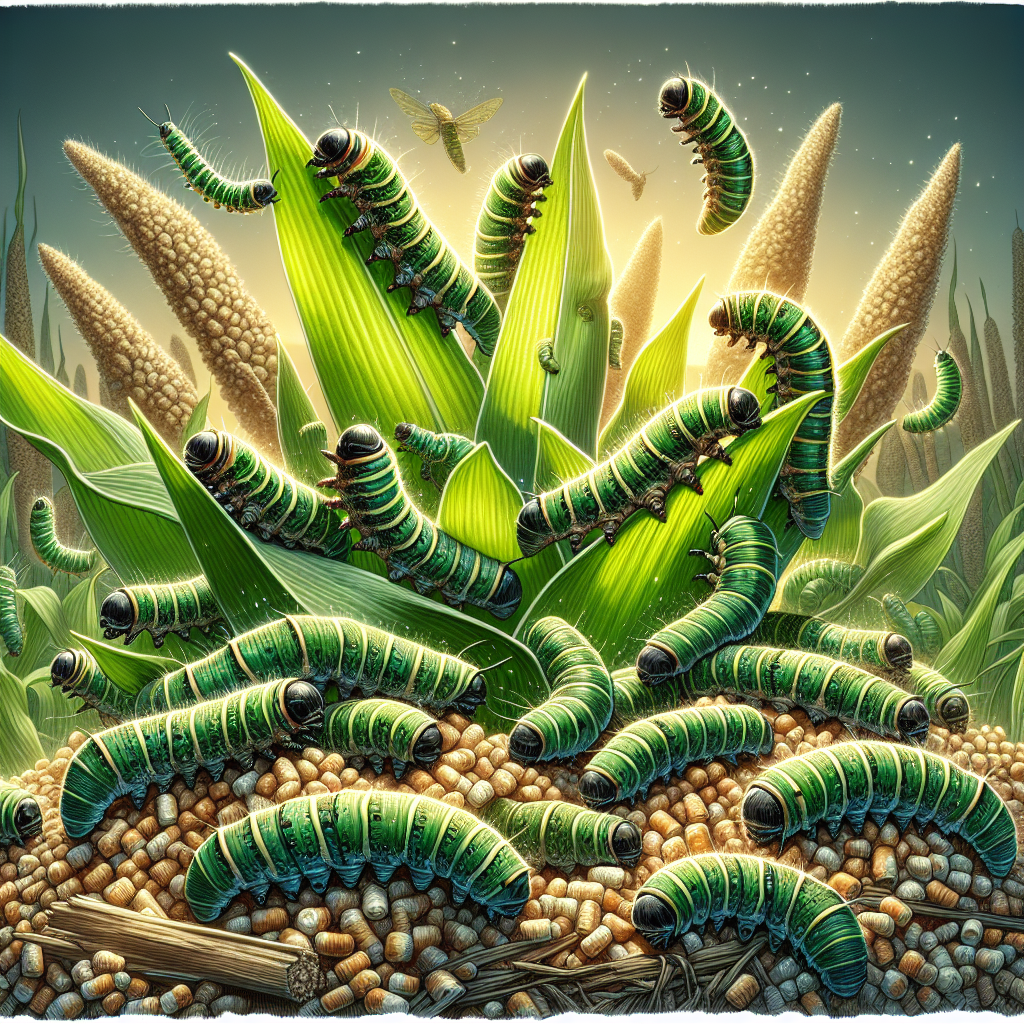
Introduction to African armyworm
The African armyworm, scientifically known as Spodoptera exempta, stands as one of the most formidable pests in African agriculture, particularly targeting cereal crops in sub-Saharan regions. Unlike solitary caterpillars, this pest exhibits gregarious behavior, forming vast armies of larvae that march across fields, voraciously consuming foliage and causing widespread defoliation. First documented in the early 20th century, outbreaks can span thousands of hectares, leading to crop losses exceeding 50-100% in severe infestations. Farmers from Kenya to Zimbabwe have long battled this nocturnal invader, whose sudden appearances can devastate entire harvests. Understanding its biology is crucial for timely intervention, as adult moths migrate long distances on wind currents, laying eggs that hatch into destructive larvae within days. This guide provides professional-grade diagnostic tools, lifecycle insights, and organic management strategies to safeguard your fields. For broader context on similar pests, see the Armyworms wiki page.
Annual outbreaks correlate with the rainy seasons, when favorable conditions trigger population explosions. In 2022 alone, African armyworm invasions affected over 1.5 million hectares in East Africa, underscoring the need for vigilant monitoring. Smallholder farmers, who produce 80% of the region's staples, suffer the most, but integrated approaches can mitigate damage effectively.
Identifying Symptoms & Damage
Early identification is key to minimizing African armyworm damage. Scout fields at dawn or dusk when larvae are active. Look for small, pale green eggs laid in clusters of 100-500 on leaf undersides, often covered with scales from the female moth. Newly hatched larvae (1-2mm) are dark with black heads, feeding gregariously and skeletonizing leaves.
As they mature (up to 40mm), caterpillars turn greenish-brown with longitudinal stripes and a dark dorsal line. Characteristic signs include:
- Rapid defoliation: Entire plants stripped to stalks within 24-48 hours.
- Windowing: Transparent leaf patches from surface feeding.
- Frass piles: Black, granular droppings under plants.
- Marching bands: Larvae moving en masse to new fields, often crossing roads.
Damage peaks in the larval stage (3-4 weeks), affecting vegetative and reproductive growth. On young corn plants, whorls show ragged holes; on sorghum, panicles are clipped. Differentiate from fall armyworm by the inverted 'Y' mark on the adult forewing and lack of a white dorsal spot on larvae. Use pheromone traps for confirmation—males are attracted to specific lures. Severe infestations leave fields resembling grazed pastures, with secondary issues like birds pecking at weakened plants.
Lifecycle and Progression of African armyworm
Spodoptera exempta completes its lifecycle in 25-40 days, depending on temperature (optimal 25-30°C). Here's the progression:
- Eggs (3-5 days): Spherical, ribbed eggs in clusters on grasses or cereals. Hatching triggered by humidity >70%.
- Larvae (14-21 days, 6 instars): Most destructive phase. Early instars feed in groups; later ones disperse. Full-grown larvae pupate in soil.
- Pupa (7-10 days): Brown, spindle-shaped in 5-10cm soil depth.
- Adults (5-10 days): Mottled brown moths with 3cm wingspan. Females lay 500-2000 eggs over 3-4 nights.
Multiple generations (3-6) per season, with density-dependent phase polyphenism: solitary at low densities, gregarious at high. Moths migrate 100-500km nightly, guided by moonlight and winds. Overwintering occurs as diapausing pupae in dry soils. Monitor with light traps during new moons for peak flights.
Environmental Triggers & Risk Factors
Outbreaks are predictable with environmental cues. Primary triggers include:
- Heavy rains: >50mm initiates egg hatch; prolonged wet spells boost survival.
- Warm temperatures: 24-32°C accelerates development.
- Grass hosts: Initial buildup on native millet or wild grasses spills over to crops.
- Wind patterns: Southerly trades carry moths northward.
Risk factors: Monoculture fields, late-planted crops, poor scouting. Drought-followed-by-rain sequences amplify invasions, as survivors emerge en masse. Climate change extends outbreak windows, with models predicting 20-30% more frequent events by 2050. High nitrogen soils promote lush growth attractive to larvae. Companion crops like cowpeas (related legume) can dilute infestations.
Organic Control & Treatment Plans
Prioritize organic methods for sustainable management. For more on organic strategies, check this Spring Pest Patrol blog post.
Immediate Action (Threshold: 20% whorl damage or 1 larva/plant):
- Hand collection: Effective for small plots; drop into soapy water.
- Biopesticides: Apply Bacillus thuringiensis (Bt) var. kurstaki at 1-2kg/ha evenings. Targets larvae <3rd instar.
- NPV viruses: Nuclear polyhedrosis virus (1x10^12 OBs/ha) causes 90% mortality.
Cultural Controls:
- Destroy volunteer grasses.
- Intercrop with desmodium (traps moths).
- Early planting escapes peak migrations.
Biological Agents:
- Parasitoids: Cotesia vestalis (60% control).
- Predators: Ants, birds, spiders.
Barrier Methods: Trench digging halts marching larvae. Neem oil (5% extract) deters feeding. Rotate with non-hosts like cassava. Avoid broad-spectrum sprays to preserve predators.
Integrated Plan: Scout weekly, trap moths, apply Bt at first sign, follow with NPV. Yields recover 70-90% with timely action.
Preventing African armyworm in the Future
Prevention hinges on breaking the lifecycle and reducing risk:
- Crop rotation: 2-3 years with legumes like soybeans.
- Resistant varieties: Use armyworm-tolerant maize hybrids (e.g., DKC 8033).
- Trap crops: Border plantings of Sudan grass.
- Field sanitation: Deep plow post-harvest buries pupae.
- Monitoring networks: Community pheromone traps forecast outbreaks.
- Push-pull technology: Intercrop desmodium (pushes moths), napier grass (pulls).
Forecast using rainfall data; act pre-outbreak. Mulching suppresses soil pupae. Healthy soils via compost resist secondary stress. Long-term: Breed for tolerance, promote biodiversity.
Crops Most Affected by African armyworm
African armyworm targets over 100 Gramineae species, prioritizing cereals:
- Maize (corn): 70% outbreaks; whorl damage up to 100%.
- Sorghum (sorghum): Panicle clipping.
- Millet (millet): Seedhead loss.
- Rice (rice), wheat (wheat), barley (barley): Secondary hosts.
Grasses like Pennisetum serve as reservoirs. Losses: 1-13 million tons maize/year continent-wide. Diversify to reduce vulnerability.