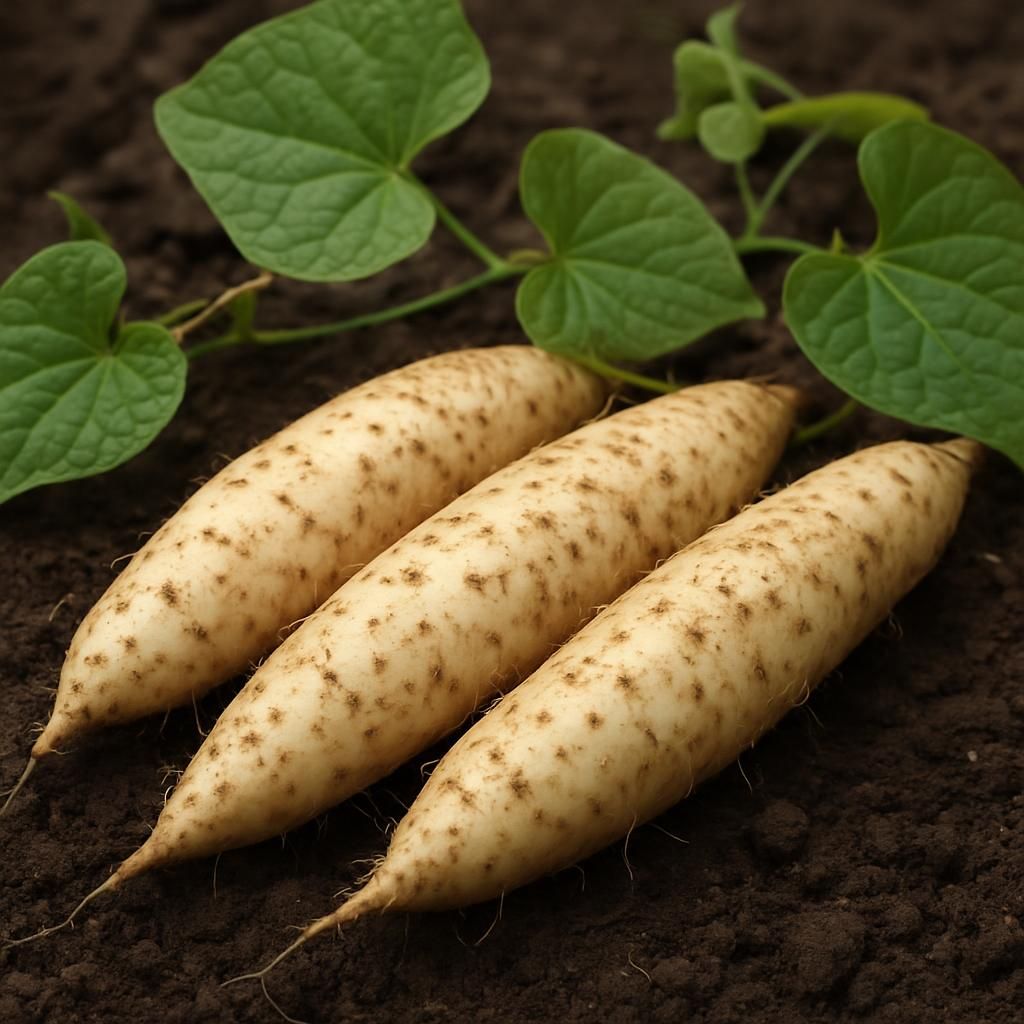
Introduction to Yam (Dioscorea polystachya - Nagaimo)
Dioscorea polystachya, widely known as Nagaimo or Chinese yam, is a temperate-climate perennial vine native to East Asia. The plant produces long, slender tubers with crisp white flesh that becomes mucilaginous when grated, making it a staple in Japanese, Korean, and Chinese cuisines. Unlike many tropical yams, Nagaimo tolerates cooler winters and can be grown successfully in USDA zones 5–9 with proper winter protection. Commercial and home gardeners value it for both culinary versatility and its reputed health benefits, including prebiotic fiber and anti-inflammatory compounds.
Botanical Profile of Yam (Dioscorea polystachya - Nagaimo)
Nagaimo is a dioecious, twining herbaceous perennial in the Dioscoreaceae family. Vines can reach 3–5 meters, supported by opposite or alternate cordate leaves and small greenish-white flowers that appear in late summer. The edible tubers are cylindrical to club-shaped, 30–100 cm long, and covered by a thin, light-brown skin. Aerial bulbils sometimes form in leaf axils and can be used for propagation. The species is distinct from tropical Dioscorea species such as Yam and Sweet Potato in both morphology and climatic adaptation.
Soil, pH, and Climate Requirements for Yam (Dioscorea polystachya - Nagaimo)
Nagaimo thrives in well-drained, fertile loamy soils with high organic matter. Heavy clay or waterlogged conditions cause tuber rot, while sandy soils require frequent irrigation and organic amendments. The plant prefers slightly acidic to neutral pH and moderate temperatures during active growth.
| Parameter | Ideal Range | Notes |
|---|---|---|
| Soil Type | Loam to sandy loam | High organic matter, friable texture |
| Soil pH | 5.5–6.8 | Avoid alkaline soils above 7.5 |
| Temperature (Growing) | 15–28 °C day / 10–18 °C night | Optimal tuber bulking at 18–24 °C |
| Temperature (Dormancy) | -10 to 5 °C | Mulch or bury tubers for winter protection |
| Annual Rainfall | 800–1500 mm | Supplemental irrigation in dry periods |
| Light | Full sun to partial shade | 6–8 hours direct sun maximizes yield |
Step-by-Step Planting & Propagation
- Site Preparation: Choose a sunny, well-drained bed. Incorporate 5–8 cm of well-rotted compost or aged manure to 30 cm depth. Create raised ridges 20–25 cm high spaced 1.2 m apart.
- Propagation Material: Use 8–12 cm tuber sections (setts) with at least two buds, or small whole tubers weighing 50–80 g. Bulbils may also be planted.
- Planting Window: Plant setts when soil temperature reaches 12 °C, typically early to mid-spring after last frost.
- Planting Depth & Spacing: Place setts 8–10 cm deep, 30 cm apart within rows. Allow 1.2 m between rows to accommodate trellising.
- Trellising: Install 2 m stakes or a horizontal wire trellis immediately after planting to support vigorous vines.
- Initial Watering: Water thoroughly after planting to settle soil and initiate sprouting.
Care & Maintenance regimes for Yam (Dioscorea polystachya - Nagaimo)
Consistent moisture, balanced nutrition, and vine management are critical for high-quality tubers. Mulch with 5–8 cm of straw or wood chips to moderate soil temperature and suppress weeds.
| Growth Stage | Watering Schedule | Fertilizer Application | Pruning / Training Schedule |
|---|---|---|---|
| Pre-emergence | Keep soil moist; 25 mm/week | None | None |
| Vegetative (0–8 wks) | 25–35 mm/week; avoid waterlogging | 10-10-10 NPK at 200 kg/ha at 4 weeks | Train vines to trellis weekly |
| Tuber Bulking (8–16 wks) | 35–45 mm/week; deep infrequent watering | Side-dress with 5-10-10 at 150 kg/ha at 10 wks | Remove lower leaves and lateral shoots below 30 cm |
| Late Season (16+ wks) | Reduce to 20 mm/week to encourage maturity | Optional light potassium top-dress | Cut back dead vines after first frost |
Pests, Diseases & Organic Management
Common pests include Aphids, Spider Mites, and Slugs. Nematodes can damage tubers in sandy soils. Major diseases are Anthracnose, Pythium root rot, and Fusarium wilt. Organic controls include neem oil for aphids and mites, diatomaceous earth for slugs, and crop rotation plus well-drained beds to limit soil-borne fungi. Beneficial nematodes and compost teas further suppress pathogens.
Harvesting, Curing & Optimal Storage
Harvest 150–180 days after planting when vines begin to yellow. Carefully dig tubers to avoid skin damage. Cure at 25–30 °C and 85–90 % RH for 7–10 days to heal wounds and reduce moisture. Store cured tubers at 5–10 °C and 70–80 % RH in ventilated crates; they remain viable for 4–6 months. Avoid refrigeration below 5 °C to prevent chilling injury.
Companion Planting for Yam (Dioscorea polystachya - Nagaimo)
Nagaimo benefits from nitrogen-fixing companions such as Peas and Beans. Aromatic herbs including Thyme and Rosemary deter aphids and spider mites. Shallow-rooted leafy greens such as Lettuce and Spinach utilize inter-row space without competing for nutrients. Avoid planting near Potato or Tomato to reduce shared nematode and fungal pressures.