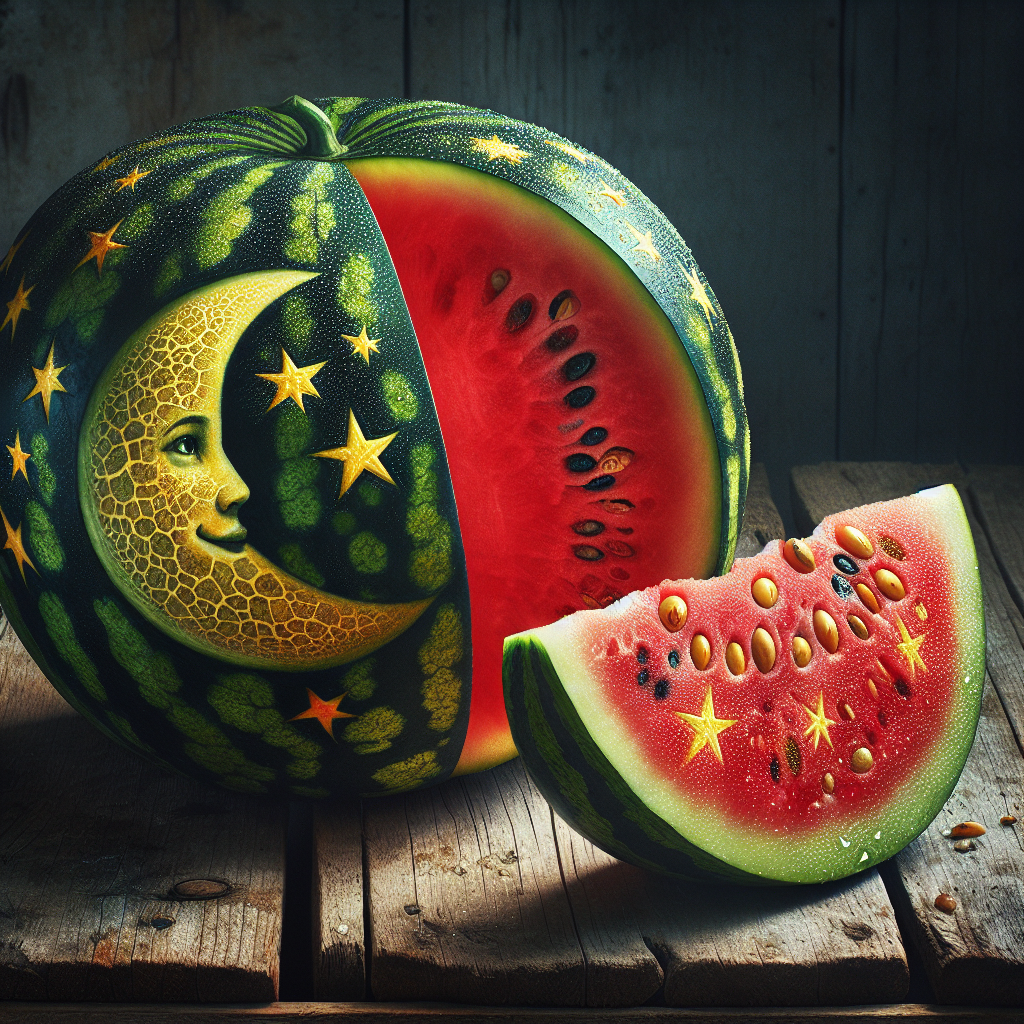
Introduction to Watermelon (Moon and Stars)
Watermelon (Moon and Stars), or Citrullus lanatus 'Moon and Stars', stands out as one of the most visually captivating heirloom watermelon varieties available to growers today. Originating from the American South in the late 19th century, this cultivar earned its name from the distinctive yellow spots resembling a starry night sky on its rind, with larger 'moon' blotches adding to its celestial charm. Beneath this cosmic exterior lies vibrant red, fine-grained flesh bursting with classic watermelon sweetness (around 10-12% Brix), balanced by minimal seeds and exceptional juiciness.
This variety typically produces oblong fruits averaging 25-40 pounds, though smaller fruits can be encouraged through careful spacing and pruning for superior flavor concentration. Vines are vigorous, sprawling 10-15 feet, making it ideal for dedicated rows or trellising in smaller spaces. Moon and Stars watermelons mature in 85-95 days, offering a reliable harvest window in warm-season gardens. Beyond its delectable taste—perfect for fresh eating, salads, or pickling rinds—it's prized for mild disease tolerance, including some resistance to anthracnose and Fusarium wilt.
For small-scale farmers, this crop shines in direct markets due to its unique appearance, commanding premium prices at farm stands or CSAs. Its adaptability to organic methods and pollinator-friendly flowers make it a cornerstone for biodiversity-focused operations. Whether you're a novice gardener or seasoned grower, mastering Moon and Stars unlocks juicy rewards amid summer's heat. Read our comprehensive Soil Health Mastery guide for foundational prep tips applicable to this thirst-loving melon.
Botanical Profile of Watermelon (Moon and Stars)
Belonging to the Cucurbitaceae family, Watermelon (Moon and Stars) is an annual trailing vine with deeply lobed, dark green leaves up to 12 inches long. Stems are rough-textured, pentagonal in cross-section, and bear tendrils for climbing support. Monoecious flowers—bright yellow, funnel-shaped blooms 2 inches across—appear singly on 2-6 inch stalks, with male flowers outnumbering females 10:1. Pollination relies heavily on bees, so nearby hives boost set rates.
Fruits develop from female flowers, featuring the signature rind: dark green background with 1-3 large irregular yellow 'moons' (2-6 inches) and numerous small starry flecks. Flesh is deep crimson, seedless tendencies low but manageable via thinning. Roots form a extensive, shallow system (top 24 inches), with fibrous laterals spreading 10-20 feet, demanding ample horizontal space.
Heirloom genetics trace to Russian stock introduced to Kansas by immigrants around 1910, selected for ornamental beauty and flavor. Compared to modern hybrids like Crimson Sweet Watermelon, Moon and Stars offers superior taste nuance—hints of floral honey—but slightly lower uniformity. Germination occurs at soil temps above 70°F (21°C), with optimal growth at 77-95°F (25-35°C). Photoperiod neutral, it fruits under long summer days.
Nutritionally, per 100g serving: 91% water, 0.6g protein, 7.6g carbs (including 6g sugars), rich in vitamin C (8mg), A (569 IU), and lycopene (4532µg)—an antioxidant powerhouse. Yield potential: 2-4 fruits per plant in good conditions, equating to 50-100 lbs per 100 sq ft.
Soil, pH, and Climate Requirements for Watermelon (Moon and Stars)
Moon and Stars watermelons demand well-drained, sandy loam soils with high organic matter (3-5%) for peak performance. Heavy clays lead to root issues like root rot, so amend with compost, aged manure, or coarse sand to achieve loose tilth. Ideal pH: 6.0-6.8; test and adjust with dolomitic lime if below 5.8 or sulfur if exceeding 7.2. Phosphorus-rich soils (40-60 ppm) promote fruit set, while potassium (150-250 ppm) enhances rind strength and flavor.
Climate-wise, this variety revels in full sun (8+ hours daily) and hot, humid summers. USDA zones 3-11 as annual; frost-sensitive, plant after last freeze when soil hits 70°F. Optimum air temps: 75-90°F day, 65-75°F night. Heatwaves above 95°F can cause blossom drop, but mulching mitigates stress—check strategies in our heatwave survival blog post. Rainfall needs: 1-2 inches weekly; drought tolerance moderate once established, but irrigate deeply during fruit swell.
Avoid low-lying frost pockets; elevate beds 6-12 inches for drainage. Wind protection via fences or hedges prevents vine desiccation. In cooler climates (under 150 frost-free days), use black plastic mulch and row covers to extend season, pushing maturity within 90 days.
Step-by-Step Planting & Propagation
Seed Selection & Starting: Source heirloom seeds from reputable suppliers; viability 4-5 years if stored cool/dry. Direct sow or start indoors 3-4 weeks pre-last frost in 4-inch pots with seed-starting mix. Plant 1 inch deep, 70-90°F bottom heat for 4-7 day germination. Thin to strongest seedling.
Site Prep: Till 6-8 inches deep, incorporate 2-4 inches compost per 100 sq ft. Form 12-18 inch wide hills or rows 8-10 feet apart. Space plants 3-5 feet apart in rows for sprawling vines.
Transplanting: Harden off seedlings 7-10 days. Set out at 12-18 inches tall, burying stem to first leaves for adventitious roots. Water deeply post-plant.
Mulching: Apply 4-6 inches straw or black plastic immediately to suppress weeds, retain moisture, and warm soil.
Succession Planting: Sow every 2-3 weeks for extended harvest; interplant with corn for windbreak.
Propagation via seeds only; no viable cuttings. Save seeds from ripest fruits, ferment pulp 2-3 days, dry thoroughly.
Care & Maintenance regimes for Watermelon (Moon and Stars)
Irrigation: Consistent moisture critical first 50 days; 1-1.5 inches/week via drip or soaker hoses. Reduce during ripening to concentrate sugars—wilting indicates need. Avoid overhead wetting to prevent foliar diseases.
Fertilization: Side-dress at vine-run (3-4 true leaves) with 5-10-10 (1 lb/50 ft row). Foliar calcium (Epsom salts) prevents blossom end rot. Micronutrients: boron for pollination.
Pruning & Training: Pinch tips after 2-3 fruits set to focus energy. Trellis for small spaces, supporting fruits in slings. Thin to 2-3 fruits/plant for 30+ lb melons.
Weeding: Hand-pull or hoe shallowly; mulch suppresses 90%.
Monitoring: Scout weekly for pests; ensure bee activity.
Pests, Diseases & Organic Management
Common pests: Cucumber beetles (vector bacterial wilt), squash bugs, vine borers, aphids. Organic controls: row covers until bloom, neem oil, yellow sticky traps, handpicking. Beneficials: ladybugs, parasitic wasps.
Diseases: Powdery mildew, downy mildew, Watermelon mosaic virus, anthracnose. Prevent via crop rotation (3 years), resistant varieties, potassium bicarb sprays, full sun/airflow. Destroy debris.
Integrated approach: See our pest management blog.
Harvesting, Curing & Optimal Storage
Harvest at full slip: tendril nearest fruit dries, underside yellows, rind resists thumbnail. Thump for dull thud. Cut with 2-inch stem. Yields peak mid-summer.
Cure in shade 7-10 days for rind toughening. Store at 55-60°F, 85% humidity up to 3 weeks. Refrigerate cut portions.
Companion Planting for Watermelon (Moon and Stars)
Beneficial: Nasturtium (trap crop), marigold (nematode deterrent), thyme (repels beetles), bush beans (nitrogen fix). Avoid potato, cucumber—compete for space/diseases. Plant peas early as green manure.