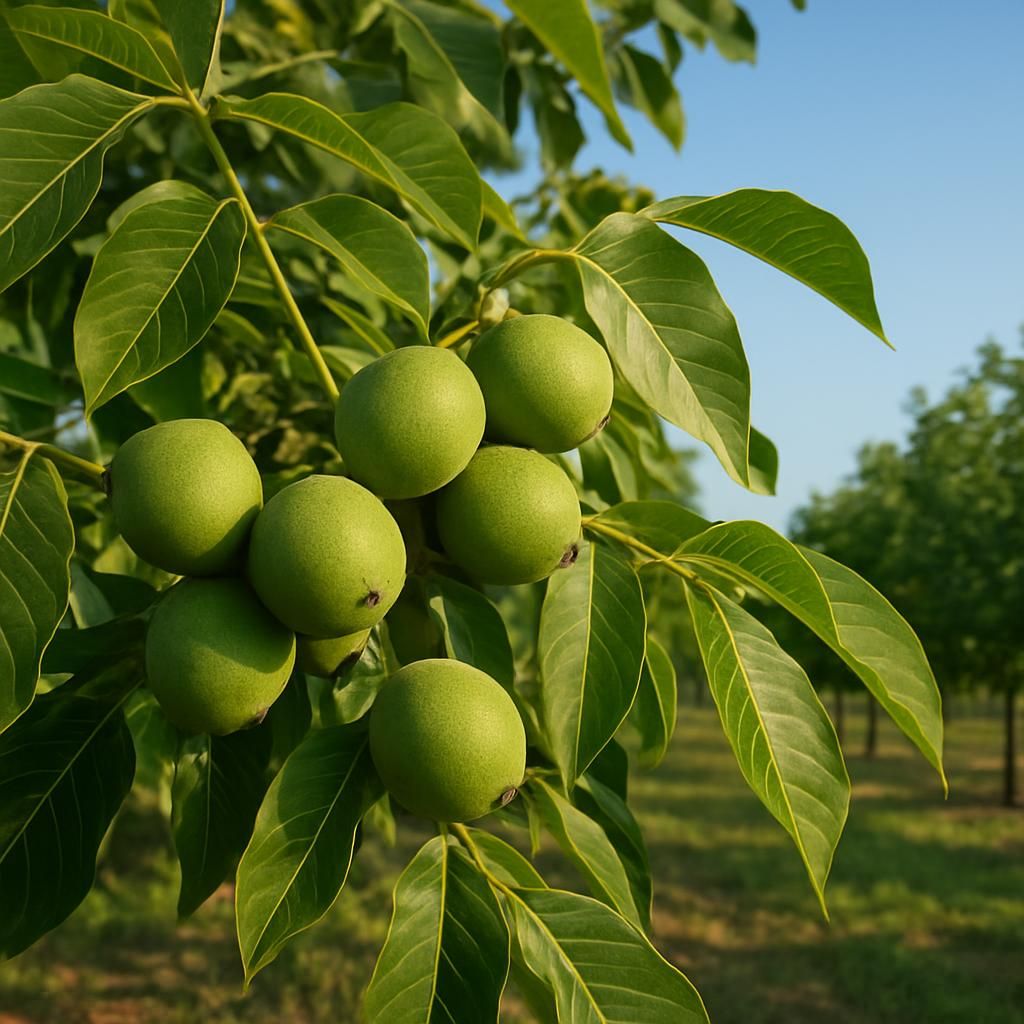
Introduction to Walnut (English - Payne)
The Payne English walnut is a leading early-season cultivar of Walnut valued by commercial orchards for its precocity, high kernel fill, and reliable production in Mediterranean and temperate climates. Developed in California, the variety matures nuts weeks earlier than standard seedlings, allowing growers to capture premium early-market prices while avoiding late-season rains that can trigger Walnut blight. Payne trees exhibit strong apical dominance, moderate vigor, and excellent lateral bearing, making them ideal for high-density plantings. With proper management, mature orchards can produce 4–6 tons per hectare of in-shell nuts with kernel recoveries exceeding 50 percent.
Botanical Profile of Walnut (English - Payne)
Juglans regia 'Payne' belongs to the Juglandaceae family and is a deciduous, monoecious tree reaching 15–20 m at maturity. The cultivar produces compound leaves 25–40 cm long with 5–9 leaflets and develops a deep taproot system supplemented by extensive lateral roots. Male catkins appear in early spring before female flowers; Payne is protandrous, releasing pollen 7–10 days before pistillate receptivity, so compatible pollenizers such as Chandler Walnut are recommended. The nuts are round to slightly elongated, thin-shelled, and average 12–14 g with light-colored kernels of superior flavor.
Soil, pH, and Climate Requirements for Walnut (English - Payne)
Walnut (English - Payne) performs best on deep, well-drained loams with good water-holding capacity. The following table summarizes optimal conditions:
| Parameter | Ideal Range | Notes |
|---|---|---|
| Soil Texture | Loam to sandy loam | Avoid heavy clays and shallow soils |
| Soil pH | 6.0–7.5 | Tolerates up to 8.0 with micronutrient management |
| Soil Depth | >1.5 m | Critical for taproot development |
| Drainage | Excellent | Raised berms or tile drainage on marginal sites |
| Temperature Range | -10 °C to 38 °C | Frost-sensitive during bloom; heat units accelerate kernel fill |
| Chill Requirement | 700–1,000 hours below 7 °C | Ensures uniform bud break |
| Annual Rainfall | 600–900 mm or equivalent irrigation | Supplemental irrigation required in summer |
| Elevation | 0–1,200 m | Higher elevations delay bloom and reduce blight risk |
Step-by-Step Planting & Propagation
- Site Preparation: Conduct soil tests and amend with lime or sulfur to reach target pH. Rip soil to 60–90 cm depth and incorporate 20–30 t/ha well-rotted manure.
- Rootstock Selection: Use Paradox or Northern California black walnut rootstocks for vigor and soil-borne disease resistance.
- Propagation: Graft scions of Payne onto one-year-old rootstocks in late winter using whip-and-tongue or cleft grafts. Bench grafting success exceeds 85 % when done under controlled humidity.
- Planting Window: Plant bare-root trees from December to February in mild-winter regions or March–April after last frost in colder zones.
- Spacing: High-density systems use 6 × 6 m (277 trees/ha); traditional orchards space 10 × 10 m.
- Planting Technique: Dig holes twice the root-ball width, position graft union 5 cm above grade, backfill, and irrigate immediately to settle soil.
Care & Maintenance regimes for Walnut (English - Payne)
Consistent water, balanced nutrition, and timely pruning are essential for sustained productivity. The table below outlines seasonal schedules:
| Season | Water (mm/week) | Fertilizer (kg/tree N-P-K) | Pruning Action |
|---|---|---|---|
| Winter | 0 | Apply 0.5 kg 15-15-15 + boron | Dormant pruning: remove dead wood, open canopy |
| Spring | 25–35 | Split 1.0 kg N at bud break & bloom | Tip prune new shoots to encourage laterals |
| Summer | 40–50 | 0.5 kg N + micronutrients | Summer prune watersprouts and crossing limbs |
| Autumn | 15–20 | 0.25 kg K to improve kernel fill | Light hedging to control height |
Mulch with 10–15 cm of wood chips in the tree row to conserve moisture and suppress weeds. Monitor leaf nutrient levels annually and adjust programs accordingly.
Pests, Diseases & Organic Management
Key threats include Walnut blight caused by Xanthomonas arboricola pv. juglandis, Walnut husk fly, Walnut aphid, and Codling moth. Implement an integrated program:
- Sanitation: Remove and destroy fallen leaves and mummified nuts to reduce overwintering inoculum.
- Monitoring: Deploy yellow sticky traps for husk fly and pheromone traps for codling moth starting at 400 degree-days.
- Organic Sprays: Apply copper hydroxide plus mancozeb at 25 % and 75 % bloom for blight; use spinosad or granulosis virus for codling moth at first egg hatch.
- Biological Control: Release Trichogramma wasps against codling moth and encourage predatory mites to suppress Walnut aphid.
- Cultural: Maintain orchard floor vegetation to support beneficial insects and reduce dust that favors mite outbreaks.
Harvesting, Curing & Optimal Storage
Payne nuts reach physiological maturity when the hull splits and kernels reach 8–10 % moisture. Shake or pole-pick in late August to early September. Immediately sweep nuts into windrows and dry to 8 % moisture using forced-air dryers at 32–35 °C for 24–48 hours. Cool nuts to ambient temperature before storage. Store in-shell at 0–5 °C and 60–65 % RH for up to 12 months with <2 % kernel deterioration. Shelled kernels packed under nitrogen flush retain quality for 6–9 months at –18 °C.
Companion Planting for Walnut (English - Payne)
Juglone produced by walnut roots inhibits many garden crops, but compatible companions thrive in the orchard understory. Clover and Hairy vetch fix nitrogen and tolerate juglone while improving soil structure. Marigold and Nasturtium repel aphids and attract beneficial insects. Deep-rooted Comfrey (new) and Yarrow accumulate minerals and can be cut for mulch. Avoid planting Tomato, Potato, or Alfalfa (new) within 15 m of mature trees.