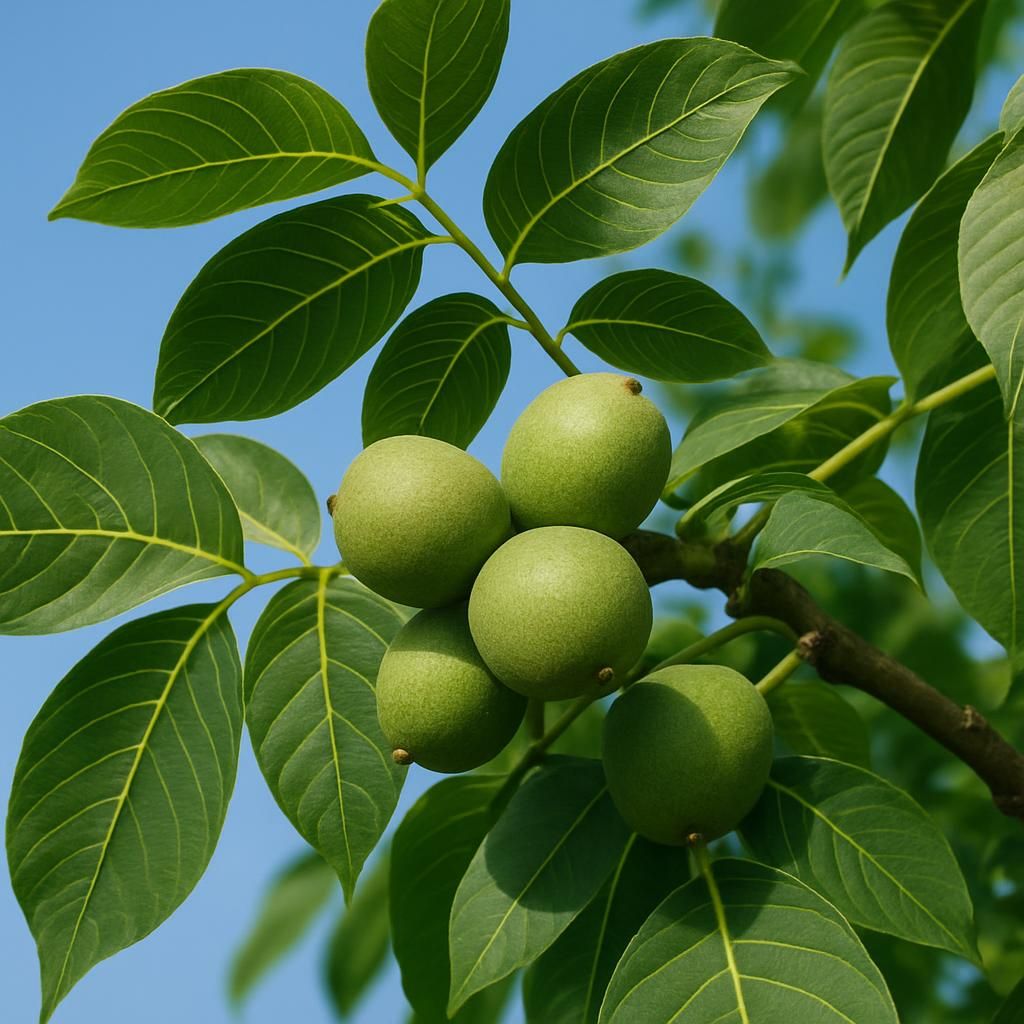
Introduction to Walnut (English - Hartley)
English Walnut (Hartley) is a premium late-leafing cultivar of Walnut valued for its large, light-colored kernels and thin shells that crack easily. Developed in California, the variety combines high productivity with resistance to late spring frosts because leaves emerge later than many other cultivars. Mature Hartley trees reach 40–60 feet with a broad canopy, making them suitable for both commercial orchards and spacious home landscapes. The nuts mature in mid-to-late September in most temperate zones and store exceptionally well when properly cured.
Botanical Profile of Walnut (English - Hartley)
Juglans regia 'Hartley' belongs to the Juglandaceae family. Trees are deciduous with compound leaves composed of 5–9 leaflets. Male catkins appear in spring before leaves fully expand; female flowers develop on new growth. The fruit is a drupe with a thick green husk that splits at maturity to reveal the hard shell. Hartley is self-fertile but benefits from cross-pollination with compatible cultivars such as Chandler Walnut or Franquette for maximum yields. The tree exhibits moderate vigor and produces heavy crops on lateral buds, a trait that distinguishes it from terminal-bearing varieties.
Soil, pH, and Climate Requirements for Walnut (English - Hartley)
Hartley walnuts demand deep, fertile, well-drained soils. Avoid heavy clays or sites with a high water table. The following table summarizes ideal conditions:
| Parameter | Ideal Range | Notes |
|---|---|---|
| Soil Type | Loam to sandy loam | Minimum 4–6 ft rooting depth |
| Soil pH | 6.0–7.5 | Slightly acidic to neutral |
| Annual Rainfall | 25–40 inches | Supplemental irrigation required in dry areas |
| USDA Hardiness Zones | 5–9 | Protect young trees from early frosts |
| Optimum Temperature | 75–85 °F (growing season) | Late-leafing reduces spring frost risk |
| Chill Hours | 700–1,000 hours below 45 °F | Ensures uniform bud break |
Step-by-Step Planting & Propagation
- Site Selection: Choose full sun with protection from strong winds. Space trees 30–40 ft apart in rows 40 ft wide.
- Soil Preparation: Perform a deep-ripping or backhoe planting hole 3 ft wide by 3 ft deep. Incorporate aged compost and rock phosphate.
- Planting Time: Install bare-root trees in late winter while dormant; container trees can be planted in spring or fall.
- Planting Depth: Set the graft union 2–3 inches above soil level. Backfill and water thoroughly.
- Initial Irrigation: Provide 10–15 gallons per tree immediately after planting and maintain consistent moisture for the first two seasons.
- Staking: Use two sturdy stakes and flexible ties to support the trunk for the first three years.
Care & Maintenance regimes for Walnut (English - Hartley)
Consistent irrigation, balanced nutrition, and annual pruning are essential for sustained productivity. The schedule below outlines key tasks:
| Season | Watering Schedule | Fertilizer Application | Pruning Activity |
|---|---|---|---|
| Spring | 1–1.5 inches/week; increase during bloom | 1 lb N per tree (split); boron foliar if needed | Remove frost-damaged twigs; shape scaffold branches |
| Summer | 1.5–2 inches/week; monitor ET | 0.5 lb N in June; zinc sulfate if deficient | Tip-prune new growth to encourage lateral fruiting |
| Fall | Reduce to harden off; deep soak before dormancy | Apply compost or well-rotted manure | Remove dead or crossing wood |
| Winter | Minimal; only if soil is dry | Soil test and adjust pH if below 6.0 | Dormant pruning to open canopy |
Mulch with 4–6 inches of wood chips in a 6-ft radius to conserve moisture and suppress weeds. Avoid nitrogen excess after July to prevent delayed hardening.
Pests, Diseases & Organic Management
Key threats include Walnut blight caused by Xanthomonas arboricola pv. juglandis, Walnut husk fly, Walnut aphid, and Codling moth. Implement an integrated approach:
- Monitor with pheromone traps for husk fly and codling moth starting in May.
- Apply copper-based sprays at bud swell and 7–10 days later for blight control.
- Release beneficial insects such as lacewings and parasitic wasps for aphid suppression.
- Remove and destroy fallen husks to break the husk-fly life cycle.
- Maintain orchard sanitation by pruning out infected wood and avoiding overhead irrigation.
Harvesting, Curing & Optimal Storage
Harvest when the husk begins to split and the kernel reaches 8–10% moisture. Shake or hand-pick daily to minimize quality loss. Remove husks immediately and wash nuts in clean water. Dry at 95–105 °F with good airflow for 3–5 days until kernels rattle inside shells. Store cured nuts at 32–40 °F and 60–65% relative humidity for up to 12 months. Vacuum-sealed packages extend shelf life beyond two years.
Companion Planting for Walnut (English - Hartley)
Walnuts release juglone, a natural allelochemical that inhibits many plants. Compatible companions that tolerate juglone include Comfrey (not listed but tolerant), certain clover species, and Nasturtium. Understory options limited to juglone-resistant species such as Elderberry (American) or select Raspberry cultivars. Avoid planting tomatoes, peppers, potatoes, and most brassicas within 50 feet of mature trees. Use deep-rooted cover crops like alfalfa in alleyways to improve soil structure without competing directly with walnut roots.