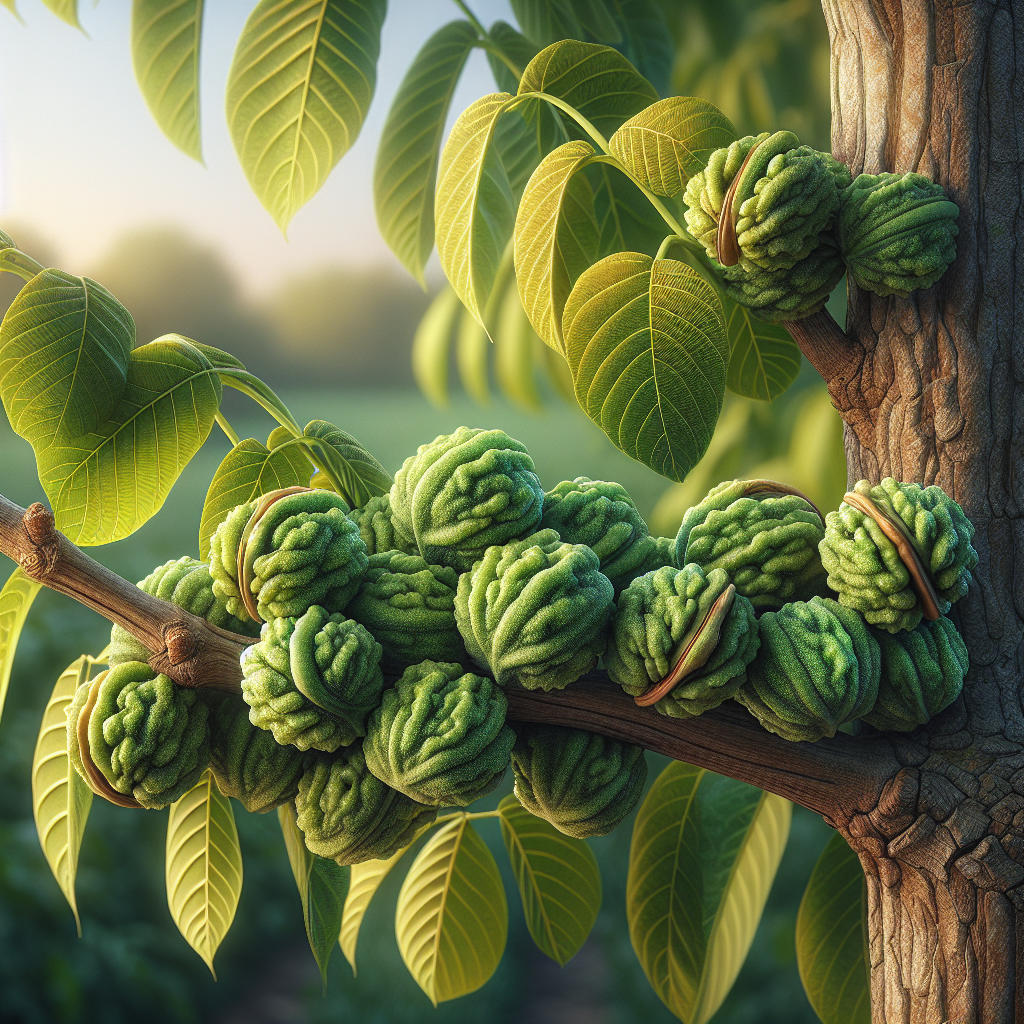
Introduction to Walnut (Franquette)
A traditional French cultivar, Franquette has long been valued in European and North American walnut districts for its dependable nut quality, upright growth, and notably late budbreak. That late leafing habit is one of its greatest commercial strengths because it helps the tree avoid injury from late spring frosts that can devastate earlier varieties. Franquette is usually classified within the English or Persian walnut species, even though its management differs significantly from many modern high-density orchard cultivars.
Compared with newer, highly lateral-bearing walnuts, Franquette is often less precocious and may take longer to reach full production, but it compensates with longevity, strong structure, and adaptability in cooler walnut regions. Nuts are typically medium to somewhat elongated, with shells that are fairly strong and kernels of good flavor and acceptable color when harvested and dried properly. In many regions it has also been used as a pollinizer for other walnut cultivars because of its pollen timing and extended bloom period; for broader species context, see English walnut.
This is not a casual backyard tree if your goal is serious nut production. A mature Franquette walnut becomes large, casts dense shade, produces juglone from roots and husks, and requires real planning around spacing, irrigation, pruning, and harvest logistics. But for growers in the right climate, it remains one of the most historically important and reliable late-season walnuts.
Botanical Profile of Walnut (Franquette)
Franquette belongs to Juglans regia, a deciduous tree species native to a broad region stretching from the Balkans through Central Asia. The cultivar itself originated in France and became especially associated with alpine-influenced walnut districts where spring frost was a recurring risk. Trees are vigorous and typically develop an upright to semi-upright framework in youth before broadening with age.
Leaves are alternate, pinnately compound, aromatic when crushed, and composed of 5 to 9 leaflets, occasionally more under vigorous conditions. Like other walnuts, the tree is monoecious: male flowers are borne in pendulous catkins produced on previous season wood, while female flowers develop near the tips of new shoots. Pollination is wind-driven, not insect-dependent, so orchard layout and bloom overlap matter more than pollinator abundance.
Franquette is known for late leafing and comparatively late female bloom. In frost-prone valleys, this can be the difference between a full crop and a total loss. It is also generally considered terminal-bearing to partly lateral-bearing, which means nut production is concentrated more toward shoot ends than in highly lateral cultivars. That trait affects both pruning style and yield expectations. Trees often enter significant bearing later than very precocious commercial selections, but they can remain productive for decades.
The nuts are usually oval to elongated with a reasonably well-sealed shell. Kernel extraction is moderate to good depending on growing conditions and harvest timing. Shell strength can be an advantage in areas with bird pressure or rough handling, though shell thickness is not as thin as some premium hand-cracking types. Hulls split at maturity, revealing the shell beneath; prompt pickup after hull split is essential to preserve kernel color and avoid mold or staining.
On seedling root systems, mature height may easily exceed 12 to 18 meters, and sometimes more in fertile deep soils. Canopy spread can reach 10 to 15 meters or beyond if unmanaged. That size alone explains why orchard spacing and long-term light management are so important.
Soil, pH, and Climate Requirements for Walnut (Franquette)
Franquette performs best in deep, fertile, well-drained loam to sandy loam soils with high rooting depth and good internal aeration. Ideal effective soil depth is at least 1.5 to 2 meters. Walnuts are not forgiving of compacted subsoil, hardpans, or seasonally perched water tables. If roots hit an anaerobic layer, tree vigor declines, disease pressure rises, and nut fill suffers.
The preferred soil pH is generally 6.5 to 7.5. Trees can tolerate slightly more alkaline conditions, but once pH rises much above about 7.8, micronutrient issues become more common, especially zinc, iron, and manganese deficiencies. In overly acidic soils below pH 6.0, calcium availability and root performance often decline, and lime may be needed before planting. Base saturation and calcium-magnesium balance matter because walnut root systems perform best in structurally stable soils with good aggregation.
Drainage is critical. After irrigation or rainfall, the top 30 to 45 cm of soil should drain back to field capacity within roughly 24 to 48 hours, not remain saturated for days. If you dig a test pit and observe gray mottling, sulfur odor, or standing water after rain, the site is risky. Walnut roots need oxygen, and chronic saturation invites Phytophthora crown and root rots.
Climate-wise, Franquette is best adapted to temperate regions with distinct winter chilling and warm, not excessively humid, growing seasons. It generally needs substantial winter chill for uniform budbreak, often estimated in the range of 700 to 1,000+ chill hours depending on model and region. At the same time, it benefits from late spring conditions that are not frost-prone at female bloom. Its late leaf-out makes it especially useful where early-budding walnuts would be damaged.
Summer heat should be adequate for kernel fill and wood maturation, but extreme heat combined with drought stress can cause sunburn, shriveled kernels, poor nut fill, and reduced return bloom. Optimal growing season temperatures are usually in the broad range of 24 to 32°C during active growth, with less stress when nights cool moderately. Persistent hot winds during nut fill increase evapotranspiration sharply and may require more frequent irrigation.
Rainfall requirements vary with soil type and tree age, but mature walnut production is water-intensive. As a rough benchmark, a full-size mature orchard in a warm dry climate may use 900 to 1,300 mm of water annually from rain plus irrigation, sometimes more. What matters is not just the total but the timing: moisture stress from leaf expansion through kernel development reduces shoot growth, nut size, and next year's flower initiation.
Walnuts also require air drainage. Avoid frost pockets, valley bottoms with cold-air pooling, and exposed ridge crests with desiccating wind. A gentle slope with deep soil and good cold-air movement is often ideal. Site selection is so important that it is worth reviewing broader fertility strategy before planting; see soil health tips.
Step-by-Step Planting & Propagation
Commercial Franquette trees are almost always established as grafted nursery stock rather than grown true from seed. Seedling-grown trees are genetically variable and will not reliably reproduce the cultivar's nut quality, bloom timing, or growth habit. Purchase certified disease-free grafted trees from a reputable nursery, ideally with rootstock suited to your soil and nematode or disease profile.
Choose the orchard layout first. Standard spacing for vigorous Franquette on large root systems is often 10 x 10 meters, 10 x 12 meters, or wider depending on soil vigor and mechanization. In lower-vigor sites, slightly tighter spacing may work, but overcrowding becomes costly later because walnut canopies shade heavily and reduce interior fruiting wood.
Prepare the site 6 to 12 months before planting. Deep-rip compacted layers when soil moisture is right for shattering, not smearing. Correct pH, phosphorus, potassium, calcium, and organic matter before planting because deep incorporation is difficult once trees are in. Remove perennial weeds thoroughly.
Plant during dormancy. Bare-root trees are usually planted in late winter to very early spring, after severe freezing risk declines but before bud swell. Container trees can be planted more flexibly, but dormant-season establishment is still preferred in temperate climates.
Handle roots carefully. Never allow bare roots to dry in sun or wind. Keep them moist and shaded until planting. Prune only broken root ends; do not excessively shorten healthy roots.
Dig a planting hole wide, not unnecessarily deep. The goal is to spread roots naturally at the same depth they grew in the nursery. Planting too deep is a common cause of slow decline. The graft union should remain safely above soil level.
Backfill with native soil. Avoid creating a compost-rich pocket that discourages roots from extending outward. Water in thoroughly to settle soil and eliminate air pockets.
Install protection immediately. Tree guards help reduce sunscald, rodent damage, and herbicide injury. In windy districts, stake young trees for the first season, but do not tie so tightly that the trunk cannot flex.
Head the tree at planting if training demands it. Many growers head at about 1.2 to 1.5 meters to establish scaffold branches, though exact height depends on harvest equipment, shaking plans, and desired trunk clearance.
Propagation beyond nursery production is usually done by grafting or budding onto seedling or clonal rootstocks. Bench grafting, whip-and-tongue grafting, and patch budding are used by professionals, but walnut is not the easiest species for amateur propagation because callusing conditions and sap flow timing are exacting. For orchard establishment, buying finished trees is generally more reliable than attempting home propagation.
Care & Maintenance regimes for Walnut (Franquette)
Young Franquette trees need a strong structural training program. In the first 3 to 5 years, focus on developing a dominant trunk and well-spaced scaffold limbs with wide crotch angles. Remove or spread narrow-angle branches early; ignoring them creates future breakage points under crop load or wind. Because Franquette tends toward upright growth, limb spreading or selective pruning is often needed to open the canopy.
Pruning should be moderate and purposeful. Heavy winter pruning can stimulate excessive vegetative vigor and delay bearing. Mature trees benefit more from light structural correction, deadwood removal, clearance for machinery, and periodic thinning to maintain light penetration. In walnut, light distribution within the canopy strongly affects spur health and long-term productivity.
Irrigation management must be precise. Young trees should have evenly moist but not saturated root zones. In practical terms, maintain soil moisture in the top 45 to 60 cm near about 60 to 80% of field capacity during active establishment. If soil forms a weak ball in the hand and crumbles with light pressure, moisture is often acceptable; if it is powdery at rooting depth, you are too dry. Mature trees should be irrigated deeply enough to wet the main feeder-root zone, often to 90 cm or deeper depending on soil. Frequent shallow watering encourages weak surface rooting and increases drought sensitivity.
Overwatering signs in Franquette include pale leaves despite adequate fertility, reduced shoot extension, leaf yellowing from the interior outward, soft or sour-smelling soil, algae or moss around emitters, and eventually dieback from root dysfunction. Underwatering signs include dull or slightly cupped leaves during heat, premature leaflet yellowing, poor nut fill, shriveled kernels, sunburned hulls, and reduced return bloom the following season. The most critical periods for avoiding stress are spring leaf expansion, shoot elongation, nut sizing, and kernel fill.
Mulch can be useful in young orchards if kept 10 to 15 cm away from the trunk to avoid crown rot and rodent shelter. Organic mulches moderate soil temperature and reduce evaporation, but they should not create a persistently wet crown zone.
Fertilization should be based on leaf analysis and soil tests, not guesswork. Nitrogen is usually the main annual driver of canopy growth and cropping, but excess nitrogen produces rank shoots, delayed hardening, higher blight susceptibility, and poorer nut quality. Young non-bearing trees may need split nitrogen applications in spring and early summer to build frame. Bearing trees typically receive nitrogen timed from budbreak through early summer, avoiding late-season applications that encourage soft growth before winter.
Walnuts commonly respond to zinc, especially in high-pH soils. Deficiency appears as small leaves, shortened internodes, rosetting, and pale interveinal tissue. Boron is also important for flowering and nut set, but the line between deficiency and toxicity is narrow, so tissue-guided correction is essential.
Weed control around the root zone is particularly important during establishment. Grass competition can severely reduce early growth by stealing water and nitrogen. Maintain a clean strip under trees for the first years or use suppressive living covers at a safe distance from the trunk.
Pests, Diseases & Organic Management
Walnut blight, caused by Xanthomonas arboricola pv. juglandis, is among the most economically important diseases in wet spring climates. It infects young shoots, leaves, and nuts, causing black lesions, nut drop, and shell/kernel damage. Franquette's late leafing can help it avoid some early infection windows, but prolonged rain during bloom and early nut development still creates risk. Organic management depends on sanitation, open canopies, avoiding excess nitrogen, and carefully timed copper-based sprays where permitted.
Anthracnose can cause leaf spotting and premature defoliation, especially in humid regions. Good airflow, destruction of infected leaf litter where practical, and balanced fertility reduce severity. Phytophthora crown and root rot is primarily a site and irrigation management issue: poor drainage is the real problem, and no spray can compensate for waterlogged soil.
Codling moth may attack walnuts, especially where apples, pears, or other hosts are nearby. Larvae can bore into developing nuts, reducing marketability. Mating disruption, sanitation, and monitoring with pheromone traps are core tools in lower-input orchards. Husk fly is another major pest in some regions; larvae feed in the husk, causing blackening, staining, and difficult hull removal. Yellow sticky traps, sanitation, and timely organic bait sprays can help suppress populations.
Aphids, especially Walnut aphid and dusky-veined Walnut aphid, remove sap and lead to honeydew and sooty mold. Heavy infestations reduce photosynthetic efficiency. Conserving beneficial insects is important, which is one reason broad-spectrum insecticides often backfire. Groundcover diversity and companion insectary plants such as Yarrow and Thyme can support natural enemies in orchard margins.
Birds and squirrels can become serious preharvest pests. Clean orchard floors, prompt harvest, trunk guards in young blocks, and exclusion where feasible are more effective than reactive control after damage begins.
Organic management works best as a system: resistant or appropriate cultivar choice, proper site selection, balanced nutrition, irrigation discipline, orchard floor hygiene, canopy airflow, and monitoring. Waiting until severe symptoms appear usually means yield and quality have already been lost.
Harvesting, Curing & Optimal Storage
Franquette is generally a later-maturing walnut, another trait that suits cooler regions but requires a long enough frost-free season for full kernel development. Harvest begins when hulls split naturally and nuts can be dislodged with moderate shaking. Do not rely on shell color alone; hull split and kernel maturity are better indicators.
For best quality, harvest promptly once a significant portion of the crop reaches maturity. Nuts left on wet soil stain easily, absorb moisture, and become vulnerable to mold. Commercial orchards shake trees mechanically and sweep or pick up nuts quickly. Small growers can hand-pole branches onto clean tarps, but avoid damaging spurs or bark.
Immediately after collection, remove hulls. Delayed hulling darkens shells and can stain kernels. Wash only if necessary, and dry the nuts promptly with moving air. Ideal curing conditions are warm, dry, and well ventilated. Target final kernel moisture is usually about 8% for in-shell storage, sometimes slightly lower for shelled kernels intended for longer keeping. If you do not have a moisture meter, a practical indicator is that kernels become crisp rather than rubbery, and the packing tissue between kernel halves dries fully.
Do not cure at excessive heat. Temperatures much above about 38 to 43°C can impair flavor, darken kernels, and reduce shelf life. Slow, even drying with good airflow is better than hot, rapid drying.
Store in-shell walnuts in cool, dry, dark conditions. Near 0 to 5°C with low relative humidity is excellent for extended storage. Shelled kernels are much more prone to rancidity because of their exposed oils, so they should be refrigerated or frozen in airtight packaging. Keep walnuts away from strong odors; kernels absorb them readily.
Quality losses during storage usually come from excess moisture, heat, oxygen, and time. Signs of poor storage include bitter or paint-like rancid flavors, darkened kernels, shriveling, and moldy odor. High-quality Franquette kernels reward careful postharvest handling with excellent flavor and better marketability.
Companion Planting for Walnut (Franquette)
Because walnut roots and husks contain juglone and because mature trees cast heavy shade, companion planting around Franquette must be approached strategically. The goal is usually not to crowd the root zone with sensitive crops, but to establish tolerant, functional plants in orchard alleys, borders, or the outer dripline. Avoid planting highly juglone-sensitive vegetables directly beneath mature canopies.
The best companions are often support species rather than cash crops. Clover is one of the most useful choices for orchard lanes because it suppresses erosion, supports beneficial insects, adds some biologically fixed nitrogen to the system, and tolerates mowing. Yarrow works well in insectary strips and orchard edges, attracting predatory and parasitic beneficials while tolerating relatively dry soils once established. Thyme can function as a low-growing aromatic groundcover in drier margins with excellent pollinator value. Nasturtium is more suitable in younger orchards or outer edges where light is still adequate, helping attract beneficial insects and acting as a trap plant for some pests.
Keep companion plants at least 1 to 1.5 meters away from young trunks so they do not compete excessively for water and nutrients. In mature orchards, place permanent insectary strips in sunny alley zones rather than in the darkest area under the canopy. If irrigation is drip-based, do not assume companion species are being watered appropriately; many understory failures happen because emitters are positioned for trees, not for cover plants.
Avoid deep tillage once the orchard is established, since walnut roots are extensive and easily damaged. Instead, use mowed living covers and spot mulching. The right companion system in a Franquette orchard improves soil structure, predator habitat, and trafficability without undermining tree vigor.