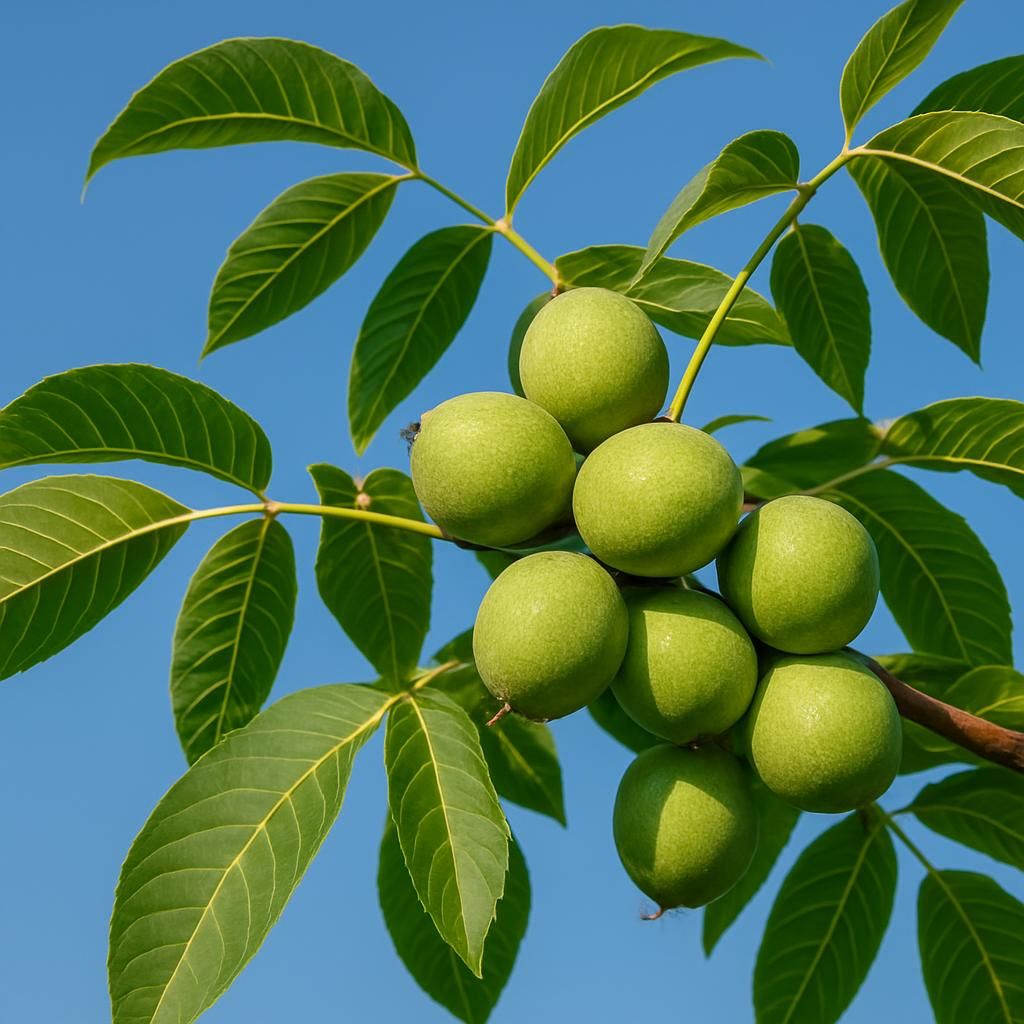
Introduction to Walnut (English - Chandler)
The Chandler cultivar of English walnut (Juglans regia) was released by the University of California in 1979 and quickly became the dominant commercial variety in California’s Central Valley. Growers favor Chandler for its large, light-colored kernels that average 53–55 % of nut weight, late leaf-out that avoids spring frosts, and moderate resistance to walnut blight. With proper management, mature orchards can produce 4–6 metric tons of in-shell nuts per hectare, making it one of the most profitable temperate nut crops.
Chandler trees are moderately vigorous, reaching 15–20 m at maturity when grown on Paradox or own-rooted seedling rootstocks. The cultivar is self-fertile but benefits from cross-pollination with varieties such as Serr or Hartley. Because of its late bloom, Chandler is also suited to higher-elevation sites where early cultivars suffer frost damage.
Botanical Profile of Walnut (English - Chandler)
English walnut belongs to the Juglandaceae family. Chandler produces compound leaves 25–40 cm long with 7–9 leaflets. Male catkins emerge in April–May; female flowers appear two weeks later on the same shoot. The fruit is a drupe with a green husk that splits at maturity to release a hard shell containing the edible kernel. Chandler’s kernel color is consistently light amber, commanding premium prices in both domestic and export markets.
Soil, pH, and Climate Requirements for Walnut (English - Chandler)
Chandler walnuts perform best on deep, well-drained loams with at least 1.5 m of rooting depth. Heavy clays or shallow hardpans restrict root development and increase susceptibility to Phytophthora root rot. The following table summarizes ideal conditions:
| Parameter | Ideal Range | Notes |
|---|---|---|
| Soil Texture | Loam to sandy loam | Avoid compacted or saline soils |
| Soil pH | 6.0–7.5 | Below 5.5 requires lime; above 8.0 may cause micronutrient deficiencies |
| Organic Matter | 2–4 % | Incorporate compost before planting |
| Annual Rainfall | 600–900 mm | Supplemental irrigation essential in drier regions |
| Growing Season Temp | 15–32 °C daytime | Heat units above 32 °C can reduce kernel fill |
| Chill Requirement | 700–1,000 hours below 7 °C | Ensures uniform bud break |
| Frost-Free Period | 180–220 days | Late leafing reduces spring frost risk |
Step-by-Step Planting & Propagation
- Site Selection: Choose south- or southwest-facing slopes with full sun and good air drainage.
- Soil Testing: Collect samples to 1.5 m depth; correct pH and nutrient imbalances 6–12 months before planting.
- Rootstock Choice: Paradox hybrid (Juglans hindsii × regia) offers vigor and tolerance to saline soils; own-rooted Chandler is used on non-saline sites.
- Tree Spacing: 7 m × 7 m (200 trees/ha) for moderate-density orchards; 10 m × 10 m for low-density, long-term plantings.
- Planting Window: Late winter to early spring when soil temperature exceeds 10 °C.
- Hole Preparation: Dig 60 cm wide × 60 cm deep holes; backfill with native soil amended with 20 % well-aged compost.
- Irrigation at Planting: Apply 20–30 L per tree immediately after planting and maintain consistent moisture for the first two growing seasons.
Care & Maintenance regimes for Walnut (English - Chandler)
Consistent water, balanced nutrition, and timely pruning are critical for high-quality Chandler production. The table below outlines seasonal schedules:
| Season | Irrigation (mm/week) | Fertilizer (kg N/tree) | Pruning Focus |
|---|---|---|---|
| Spring | 25–35 | 0.5–0.75 | Remove frost-damaged shoots |
| Summer | 35–45 | 0.75–1.0 | Tip-prune vigorous shoots for light penetration |
| Autumn | 15–25 | 0 | Remove dead/diseased wood |
| Winter | Dormant only | 0.25 (if leaf analysis indicates) | Structural pruning; open center |
Mulch 10–15 cm deep within the dripline to conserve moisture and suppress weeds. Monitor leaf nutrient levels annually; target leaf N of 2.3–2.8 %, K 1.5–2.0 %, and Zn 25–50 ppm.
Pests, Diseases & Organic Management
Major pests include Walnut husk fly, Walnut aphid, and Codling moth. Walnut blight caused by Xanthomonas arboricola pv. juglandis remains the primary disease. Organic strategies include:
- Sanitation: Remove and destroy fallen husks and mummies each winter.
- Monitoring: Use yellow sticky traps for husk fly and degree-day models for codling moth.
- Biological Control: Release Trichogramma wasps against codling moth eggs; encourage lacewings for aphid suppression.
- Approved Sprays: Copper-based bactericides at 20 % and 80 % leaf emergence for blight; spinosad or granulosis virus for codling moth.
- Cultural Practices: Maintain orchard floor vegetation to reduce dust that favors mites.
Harvesting, Curing & Optimal Storage
Chandler walnuts reach physiological maturity when the husk begins to split and kernel moisture drops below 10 %. In California’s Central Valley this typically occurs mid-September to early October. Shake or hand-pick nuts and remove husks within 24 hours to prevent shell staining. Dry nuts to 8 % moisture using forced-air dryers at 32–35 °C. Store in-shell at 0–5 °C and 60–65 % RH for up to 12 months with minimal quality loss. Shelled kernels packaged under nitrogen flush retain light color for 6–9 months at –18 °C.
Companion Planting for Walnut (English - Chandler)
Walnuts produce juglone, a natural allelochemical that inhibits many garden plants. Compatible companions include Clover as a living mulch and nitrogen source, and Thyme or Yarrow planted outside the dripline to attract beneficial insects. Avoid planting Tomato, Potato, or Blueberry within 15 m of mature Chandler trees.
For additional insights on soil health and orchard resilience, see The Hidden Power of Mulching: 8 Organic Strategies to Transform Small Farm Soil.