Introduction to Walnut (Serr)
Developed for commercial walnut production, Serr is an English walnut cultivar selected for strong productivity, relatively early bearing, and attractive in-shell and kernel quality. It is especially important in intensive orcharding systems where early return on investment matters, because Serr tends to come into production earlier than many traditional seedling walnuts. Growers often value it for large nuts, good kernel fill under proper moisture management, and a growth habit that can be trained efficiently in modern orchard layouts.
Serr belongs to the Persian or English walnut species, Juglans regia, the same species behind many premium dessert walnuts. Historically, English walnuts spread from Central Asia and Persia westward through trade routes into Europe, and later into California and other temperate orchard belts. Modern cultivars like Serr represent decades of breeding and selection for shell seal, kernel color, yield, and adaptation. In many walnut districts, Serr has been used both as a commercial cultivar and as a pollinizer companion in mixed plantings, although orchard design must always be based on local bloom overlap data.
What makes Serr distinct is its tendency toward lateral fruiting, meaning a meaningful percentage of side buds can produce nuts instead of relying only on terminal shoots. That trait can dramatically improve yield potential, but it also means the tree can overcrop if fertilization, pruning, and irrigation are poorly balanced. In practical terms, Serr rewards attentive orchard management and punishes neglect more quickly than low-vigor, low-bearing genotypes.
Botanical Profile of Walnut (Serr)
This cultivar is a deciduous broadleaf nut tree in the Juglandaceae family. Mature orchard trees can reach 9-15 meters in height if unpruned, though commercial systems usually maintain a more manageable canopy through structural training and selective thinning cuts. The canopy is naturally upright to spreading depending on rootstock, spacing, and pruning regime.
Leaves are alternate, pinnately compound, aromatic when crushed, and usually composed of 5-9 smooth-edged leaflets. Budbreak occurs in spring after winter dormancy, followed by rapid shoot extension. Male flowers appear as pendulous catkins borne on older wood, while female flowers are typically terminal or lateral on current season shoots. Because bloom timing can vary slightly by region and year, Serr orchards should never be planted without considering compatible pollen sources and local climatic records.
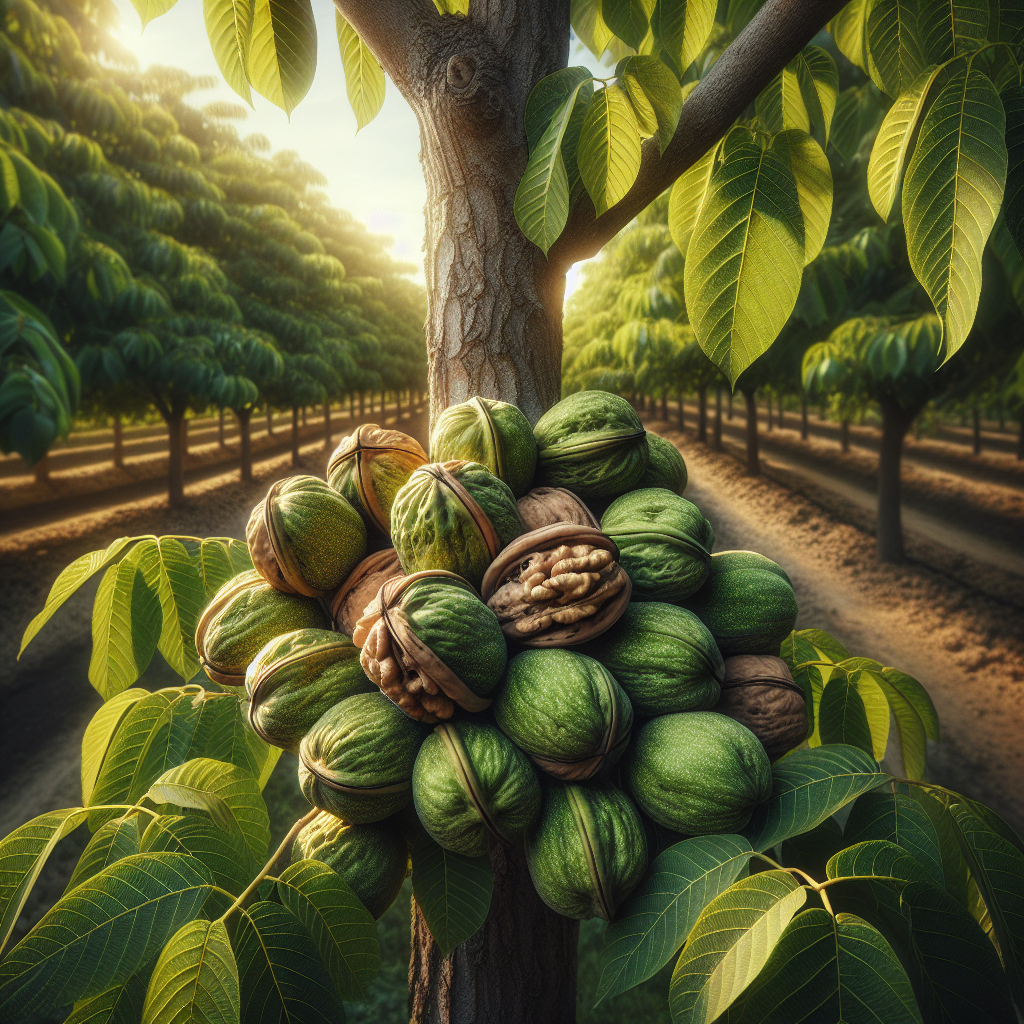
The fruit is technically a drupe-like nut enclosed in a green husk. As the nut matures, the husk splits and exposes the corrugated shell. High-quality Serr nuts are known for relatively large size and good kernel recovery when water and nutrient supply remain even during shell hardening and kernel fill. Uneven moisture at these stages can increase shrivel, poor fill, dark kernels, or shell defects.
Like other walnuts, Serr produces juglone and related allelopathic compounds, especially in roots, leaves, and husks. This natural chemistry can suppress sensitive understory plants. That is why walnut orchard floor design matters more than with many fruit trees. Growers familiar with English Walnut culture will recognize the same species-level management principles, but Serr often demands tighter crop load and vigor balancing.
Soil, pH, and Climate Requirements for Walnut (Serr)
This cultivar performs best in deep, fertile, well-aerated loam to sandy loam soils with excellent internal drainage. Ideal effective rooting depth is at least 1.5-2 meters. Walnut roots are intolerant of prolonged saturation; if water stands within the upper 60 centimeters for more than 24-48 hours during active growth, root stress, crown decline, and Phytophthora risk rise sharply. Heavy clay is not automatically disqualifying, but only if it has been deeply ripped, amended where appropriate, and fitted with drainage solutions.
Target soil pH is 6.5-7.5. Serr can survive slightly outside that range, but performance drops when pH becomes too acidic or too alkaline. Below about pH 6.2, calcium availability may decline and micronutrient balance can shift unfavorably. Above roughly pH 7.8, zinc and iron deficiencies become common, especially on calcareous soils. In high-pH orchards, young leaves may emerge pale yellow with green veins, indicating iron chlorosis, or show small, narrow, weakly expanded leaflets from zinc deficiency.
Walnuts need a temperate climate with sufficient winter chill to break dormancy evenly. Serr generally suits warm temperate to Mediterranean regions with cool winters and warm, dry summers. A chilling requirement in the broad range typical for Juglans regia should be expected, and exact suitability depends on local adaptation data. Spring frost is one of the main site-selection hazards. Because walnut budbreak can be early enough to expose flowers and tender shoots, low pockets where cold air collects should be avoided. A site with good air drainage on gentle slope is often superior to a flat basin.
Summer heat is beneficial for nut maturation, but excessive heat above about 38-40°C, especially when paired with hot winds and low humidity, can scorch hull tissue, sunburn exposed scaffolds, and impair kernel development if irrigation lags. Serr particularly benefits from stable soil moisture during late spring through late summer. Aim to keep moisture in the active root zone near field capacity without waterlogging; for many orchard soils this means irrigating before the top 30-45 centimeters become excessively dry. In practical terms, soil should feel cool and slightly cohesive at root depth, not powdery, and never sour-smelling or sticky-saturated.
Annual rainfall alone is rarely enough for commercial production unless it is well distributed and soils store moisture deeply. Drip or micro-sprinkler irrigation is preferred for precision. Wind exposure also matters: strong, persistent winds can interfere with pollination, increase evapotranspiration, and break vigorous new shoots.
Step-by-Step Planting & Propagation
Commercial Serr walnuts are almost always established as grafted trees on suitable rootstocks rather than grown from seed. Seed propagation does not produce true-to-type offspring, and seedling variability in nut quality, vigor, and bearing habit is too high for reliable orchard performance. Buy certified, disease-free nursery stock with a well-healed graft union, strong central leader, and no spiral roots.
- Choose the site carefully. Select full sun, excellent air drainage, deep soil, and access to irrigation. Avoid compacted subsoil, saline spots, and areas with a history of standing winter water.
- Test soil before planting. Perform a full soil analysis for pH, organic matter, cation balance, salinity, boron, sodium, zinc, and chloride. Walnut is sensitive to salinity; high sodium adsorption or chloride accumulation can reduce vigor and cause leaf marginal burn.
- Prepare the subsoil. Deep rip planting rows if compaction exists, ideally when soil moisture is right for shattering rather than smearing. Correct drainage before planting, not after decline appears.
- Lay out spacing. Typical orchard spacing ranges from about 7 x 7 meters to 10 x 10 meters depending on rootstock vigor, training system, soil fertility, and equipment width. Serr’s productive habit can support moderately intensive spacing, but overcrowding later causes light loss and disease pressure.
- Plant during dormancy. Late winter to early spring planting is ideal in most temperate regions, once the ground is workable but before budbreak. In mild-winter areas, dormant-season planting allows roots to establish before summer heat.
- Dig proper planting holes. Dig only as deep as the root system and 2-3 times as wide. Never bury the graft union. Plant with the graft several centimeters above finished soil grade.
- Backfill with native soil. Avoid over-amending the planting hole with rich compost pockets, which can create textural discontinuities and poor root exploration. Water in thoroughly to settle soil.
- Head and train. If using a central leader system, head the tree at the desired scaffold initiation height, commonly around 1.2-1.5 meters depending on machinery clearance and training style. Remove broken roots or damaged shoots at planting.
- Install protection. Use tree guards against sunburn, rodents, rabbits, and herbicide drift. White trunk paint diluted for orchard use can reduce southwest injury on young bark.
- Mulch cautiously. Organic mulch can moderate moisture and temperature, but keep it 15-20 centimeters away from the trunk to prevent collar rot and vole habitat.
Topworking established walnut trees to Serr is possible by grafting or budding, but this requires skilled technique, timing, and sanitation. For new orchards, nursery-grafted trees are far more reliable.
Care & Maintenance regimes for Walnut (Serr)
Irrigation is the single most important annual management variable after site selection. Young trees need frequent, moderate watering to establish a wide root system; mature trees need deep, measured irrigation based on evapotranspiration, canopy size, and soil texture. During establishment, keep the root ball and adjacent soil uniformly moist, not saturated. In sandy soils, this may mean watering 2-4 times weekly during hot weather; in loam, once or twice may suffice. The critical point is to avoid cycling between drought stress and flooding.
Signs of underwatering in Serr include dull gray-green foliage, leaflet edge curling during midday that does not recover by evening, short shoot growth, nut drop, and poor kernel fill later in the season. Signs of overwatering include persistently soft soil, yellowing leaves despite adequate fertility, reduced shoot extension, sour odor in the root zone, algae or moss near emitters, and increased root disease incidence.
Nutrient management should be based on annual leaf analysis and preseason soil data. Nitrogen drives canopy development and yield, but excess nitrogen makes trees too vegetative, delays hardening, and can worsen blight susceptibility. Young non-bearing trees need enough nitrogen to build structure, while bearing Serr trees require balanced feeding timed to demand peaks. Split applications through spring and early summer are usually safer than one heavy dose. Zinc is often the most important micronutrient in walnut orchards; foliar sprays may be required where soils tie it up. Boron must be managed carefully: deficiency reduces flower fertility and nut set, but excess quickly becomes toxic.
Pruning strategy depends on tree age. In years 1-4, focus on framework: establish a strong trunk, well-spaced scaffolds with wide crotch angles, and even canopy architecture. Remove narrow, competing leaders and weak crotches early before they become structural failures. Once bearing begins, pruning becomes more conservative. The main goals are light penetration, removal of dead or diseased wood, suppression of crossing branches, and moderation of excessive height. Serr’s lateral bearing means over-pruning can remove productive wood, but neglect can create dense shade and small kernels. The ideal canopy allows dappled light into the interior without exposing scaffolds to severe sunburn.
Orchard floor management should control weed competition while preserving soil structure. The strip under the tree row is usually kept relatively weed-free, especially in the first 3-5 years. Young walnut trees compete poorly with aggressive grasses for nitrogen and moisture. Between rows, living covers can improve infiltration and trafficability. Good choices include Clover, which can contribute nitrogen biologically if managed correctly, and seasonal covers such as Thyme or Yarrow in appropriate low-competition zones. For broader soil stewardship principles, see soil health strategies.
Sunburn protection is often underappreciated. Exposed trunks and upper scaffolds of young walnuts can suffer bark injury from intense western sun, especially after heavy pruning. Whitewash trunk paint and maintain enough leaf cover to shade major limbs.
Pests, Diseases & Organic Management
Walnut blight, caused by Xanthomonas arboricola pv. juglandis, is one of the most serious diseases in humid spring conditions. It infects young shoots, leaves, flowers, and nuts, producing black lesions, nut spotting, poor set, and reduced kernel quality. Serr growers in rainy or dew-prone districts must pay close attention to bloom-period risk. Organic management relies on sanitation, airy canopies, resistant site choice, and carefully timed copper-based sprays where permitted. Overuse of copper can injure tissue and accumulate in soil, so timing matters more than quantity.
Codling moth can infest walnuts similarly to pome fruit, with larvae entering nuts and ruining kernels. Pheromone traps should be used to monitor flight, and mating disruption is highly effective in larger, coordinated orchards. Timed releases of Trichogramma wasps, use of granulosis virus in integrated systems, and sanitation of dropped nuts can all help reduce pressure.
Walnut husk fly is another major pest in many regions. Maggots feed in the husk, causing blackened hulls, staining, difficult hulling, and lower market quality. Yellow sticky traps with ammonium attractants help monitor populations. Early detection is critical because late-season damage can escalate rapidly.
Aphids, especially Walnut aphid and dusky-veined Walnut aphid, remove sap and can lead to honeydew and sooty mold. Encourage natural enemies such as lacewings, lady beetles, and parasitic wasps. Avoid unnecessary broad-spectrum sprays that collapse beneficial insect populations.
Crown gall, caused by Agrobacterium, enters through wounds and can stunt young trees severely. Buy clean nursery stock and avoid injuring trunks or roots during planting and cultivation. Root and crown rots caused by Phytophthora are usually irrigation and drainage problems first, pathogen problems second. If trunks are constantly wetted or soils stay saturated, losses can be severe.
Organic management begins with prevention: site drainage, balanced nutrition, canopy airflow, sanitation, monitoring traps, beneficial insect habitat, and removing mummified or infested nuts. In serious orchards, weekly scouting during bloom and nut development is standard, not optional.
Harvesting, Curing & Optimal Storage
Harvest timing is based on hull split, kernel maturity, and intended market. Serr nuts are typically ready when a significant percentage of hulls begin to split naturally and the packing tissue between kernel and shell has turned brown rather than white. Harvesting too early reduces kernel fill, flavor, and oil development. Waiting too long increases sun exposure, insect damage, mold risk, and dark hull staining.
For small-scale growers, nuts can be pole-shaken or hand-harvested once they begin dropping. Commercial orchards use mechanical shakers and sweepers. Nuts should be picked up promptly; leaving them on damp soil encourages mold, shell staining, and insect entry.
After harvest, remove husks as quickly as possible. Hull residues stain shells and hands dark brown because of phenolic compounds. Wash nuts if needed, but do not leave them wet. Dry immediately in a well-ventilated, shaded area or forced-air drying setup. The goal is to reduce kernel moisture to around 8% for safe storage. In practice, properly dried nuts feel lighter, kernels snap rather than bend, and the internal shell surfaces are dry, not clammy.
Avoid drying at excessively high temperatures, which can darken kernels and degrade flavor. Gentle airflow with moderate warmth is better than intense heat. Once cured, store in-shell walnuts in cool, dry, dark conditions. Ideal long-term storage is near 0-4°C with low relative humidity and protection from rodents. Shelled kernels are far more perishable because walnut oil oxidizes readily; vacuum sealing and refrigeration or freezing greatly extend quality.
Rancidity is the main storage failure. If kernels smell paint-like, bitter, or stale, the oils have oxidized. High temperature, oxygen, and light accelerate this process.
Companion Planting for Walnut (Serr)
Because walnut roots and leaf litter contain juglone, companion planting around Serr must be more selective than around most orchard trees. The best companions are not heavy feeders placed directly against the trunk, but tolerant support plants used in orchard alleys, margins, or carefully managed understory zones outside the most concentrated root competition area.
Clover is one of the most practical companions for walnut orchards. It functions as a living cover, improves soil aggregation, protects against erosion, supports pollinators when allowed to flower in controlled strips, and can contribute nitrogen through symbiotic fixation. It should still be kept from directly crowding young tree trunks, especially in the first years.
Thyme works well in dry orchard margins and beneficial insect strips because it remains relatively low, attracts pollinators, and does not create the same vigorous moisture competition as tall grasses. It is especially useful where irrigation is localized and alleyways are not heavily cultivated.
Yarrow is another useful support plant in diversified walnut systems. It attracts predatory insects and parasitoids, improves habitat complexity, and tolerates relatively lean soils once established. It is more suited to border strips and designed insectary zones than dense planting within the immediate root zone.
If you want to trial companions, start conservatively. Keep a vegetation-free ring around young trunks, monitor tree growth, and expand only after confirming that cover plants are not reducing shoot extension, leaf nutrient status, or summer soil moisture. With walnuts, the right companion system is one that supports soil biology and beneficial insects without competing with the tree during critical nut fill.