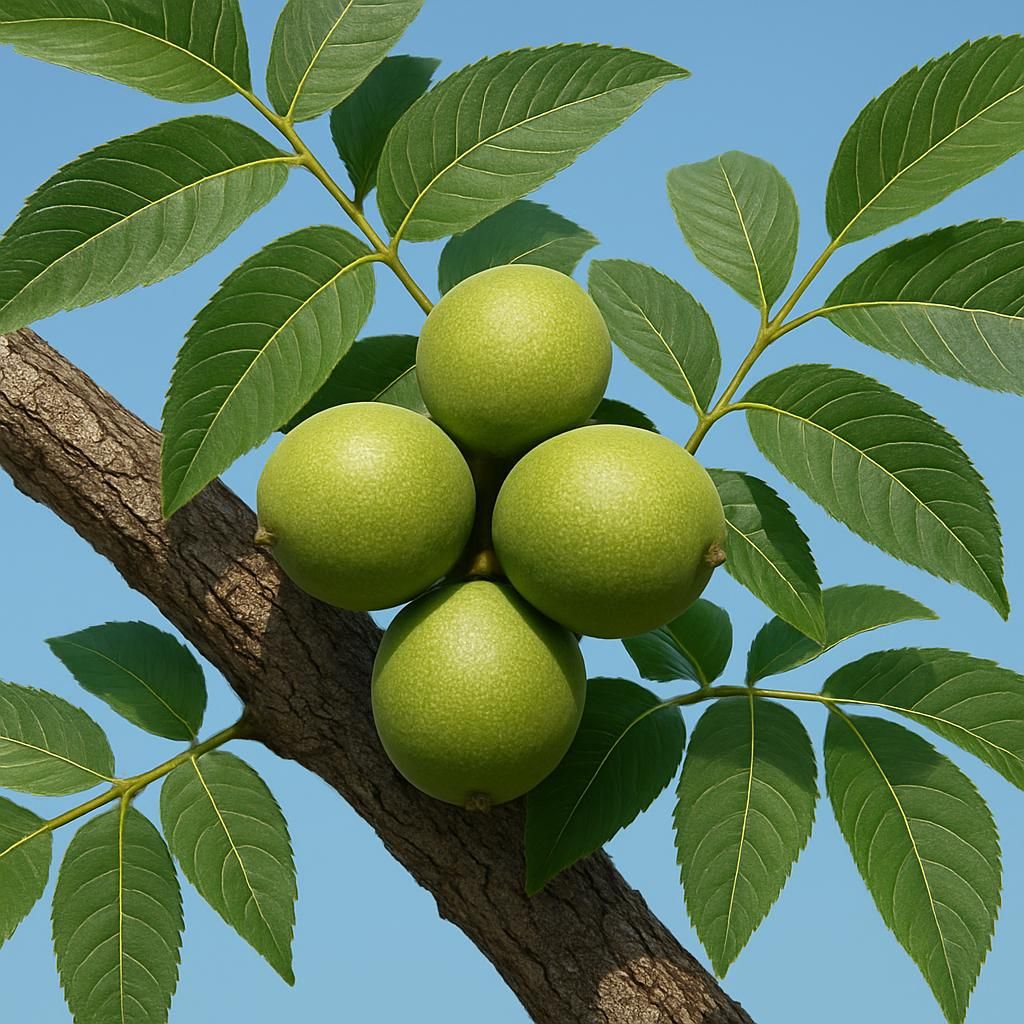
Introduction to Walnut (Black - Sparrow)
Black walnut (Juglans nigra) is a cornerstone species in North American agroforestry, valued for both its nutrient-dense nuts and premium dark heartwood. The 'Sparrow' cultivar stands out among selections for its exceptionally thin shells, high kernel percentage, and strong resistance to common diseases. Developed through university breeding programs, Sparrow combines productivity with manageable tree size, making it suitable for both small orchards and larger timber-nut systems. Growers appreciate its relatively early bearing and consistent yields when provided with proper site conditions and management.
Botanical Profile of Walnut (Black - Sparrow)
The Sparrow black walnut forms a broad, oval crown reaching 50–70 feet at maturity with a straight central leader ideal for timber. Leaves are pinnately compound, 12–24 inches long, with 15–23 lanceolate leaflets that release the characteristic aromatic juglone compound. Male catkins appear in spring followed by inconspicuous female flowers; pollination is wind-driven and benefits from nearby compatible pollinizers. Nuts develop inside a thick green husk that splits at maturity, revealing a round, thin-shelled nut containing a rich, oily kernel. The tree exhibits moderate vigor and a lifespan exceeding 100 years under favorable conditions.
Soil, pH, and Climate Requirements for Walnut (Black - Sparrow) (MUST INCLUDE A MARKDOWN TABLE OF IDEAL CONDITIONS)
Black walnuts demand deep, fertile, well-drained soils with high organic matter. They perform poorly on compacted or waterlogged sites. The following table summarizes optimal growing parameters:
| Parameter | Ideal Range | Notes |
|---|---|---|
| Soil Type | Loam to sandy loam | Avoid heavy clay without amendment |
| Soil Depth | Minimum 4 ft to bedrock | Critical for taproot development |
| Soil pH | 6.0–7.0 | Slightly acidic to neutral |
| Drainage | Excellent | Raised beds or tile drainage on marginal sites |
| USDA Hardiness Zones | 5–9 | Tolerates -20 °F once established |
| Annual Rainfall | 30–45 inches | Supplemental irrigation in drier regions |
| Temperature Range | 60–85 °F growing season | Late spring frosts can damage catkins |
Site selection should prioritize south- or west-facing slopes with good air drainage to reduce frost risk.
Step-by-Step Planting & Propagation
- Obtain one-year-old, bare-root or container-grown Sparrow seedlings from reputable nurseries.
- Choose a planting window of early spring before bud break or late fall after leaf drop.
- Dig holes 2–3 times wider than the root ball and equal in depth; backfill with native soil amended with well-rotted compost.
- Space trees 30–40 ft apart in orchard rows 40–50 ft wide to allow equipment access and sunlight penetration.
- Plant at the same depth as the nursery line, tamp soil firmly, and water thoroughly.
- Apply a 3–4 inch layer of organic mulch in a 3 ft radius, keeping mulch 6 inches from the trunk.
- Stake young trees in windy locations and install tree guards against rodent damage.
Grafting onto seedling rootstock is the standard method for maintaining Sparrow characteristics; whip-and-tongue or cleft grafts performed in late winter yield high success rates.
Care & Maintenance regimes for Walnut (Black - Sparrow) (MUST INCLUDE A MARKDOWN TABLE OF WATER, FERTILIZER, AND PRUNING SCHEDULES)
Consistent moisture during the first three seasons is essential for root establishment. Mature trees require approximately 1 inch of water per week during nut fill. Fertilization should be based on annual leaf or soil analysis. The schedule below outlines recommended practices:
| Season | Watering | Fertilizer (per tree) | Pruning |
|---|---|---|---|
| Spring | 1–1.5 in/week if rainfall low | 1 lb 10-10-10 or equivalent NPK at bud break | Remove dead/diseased wood; shape central leader |
| Summer | Maintain even moisture | Side-dress 0.5 lb nitrogen mid-June if needed | Minimal; tip-prune watersprouts |
| Fall | Reduce to harden off | Apply compost or aged manure (5–10 lb) | Light structural pruning after leaf drop |
| Winter | Dormant; protect roots | None | Major structural pruning on dormant trees |
Monitor leaf color and terminal growth annually to adjust nutrient programs.
Pests, Diseases & Organic Management
Key challenges include Walnut blight caused by Xanthomonas arboricola pv. juglandis and Walnut husk fly. Regular sanitation—removing fallen husks and mummified nuts—significantly reduces inoculum. Copper-based sprays applied at bud swell and petal fall provide organic control of blight. Walnut aphid populations can be managed with insecticidal soaps or horticultural oils during early infestation. Codling moth is best controlled with pheromone disruption or timely applications of spinosad. Maintain habitat for beneficial insects by planting flowering understory species. Mulching and avoiding overhead irrigation help prevent soil-borne pathogens such as Phytophthora root rot.
Harvesting, Curing & Optimal Storage
Nuts are ready when the husk begins to split and the kernel reaches 20–25% moisture. Shake or hand-pick in September–October depending on latitude. Remove husks immediately using a corn sheller or manual huller to prevent staining and off-flavors. Wash nuts in clean water and air-dry on screens with good airflow for 2–3 weeks until kernels reach 8% moisture. Store in-shell at 32–40 °F with 60–70% relative humidity; properly cured nuts maintain quality for 12–18 months. For longer storage, vacuum-seal kernels at 0 °F.
Companion Planting for Walnut (Black - Sparrow)
Juglone produced by black walnut roots inhibits many garden crops. Compatible companions include Tomato varieties selected for tolerance, Garlic, and Onion that tolerate juglone. Deep-rooted Comfrey and Clover improve soil structure and fix nitrogen without competing heavily. Avoid planting Potato, Apple, and Tomato directly under the canopy. Establishing a diverse understory of insectary plants such as Yarrow and Nasturtium supports beneficial arthropods and enhances overall orchard resilience.
For additional insights on building resilient small-farm systems, see The Truth About Weather Patterns and Small Farm Resilience.