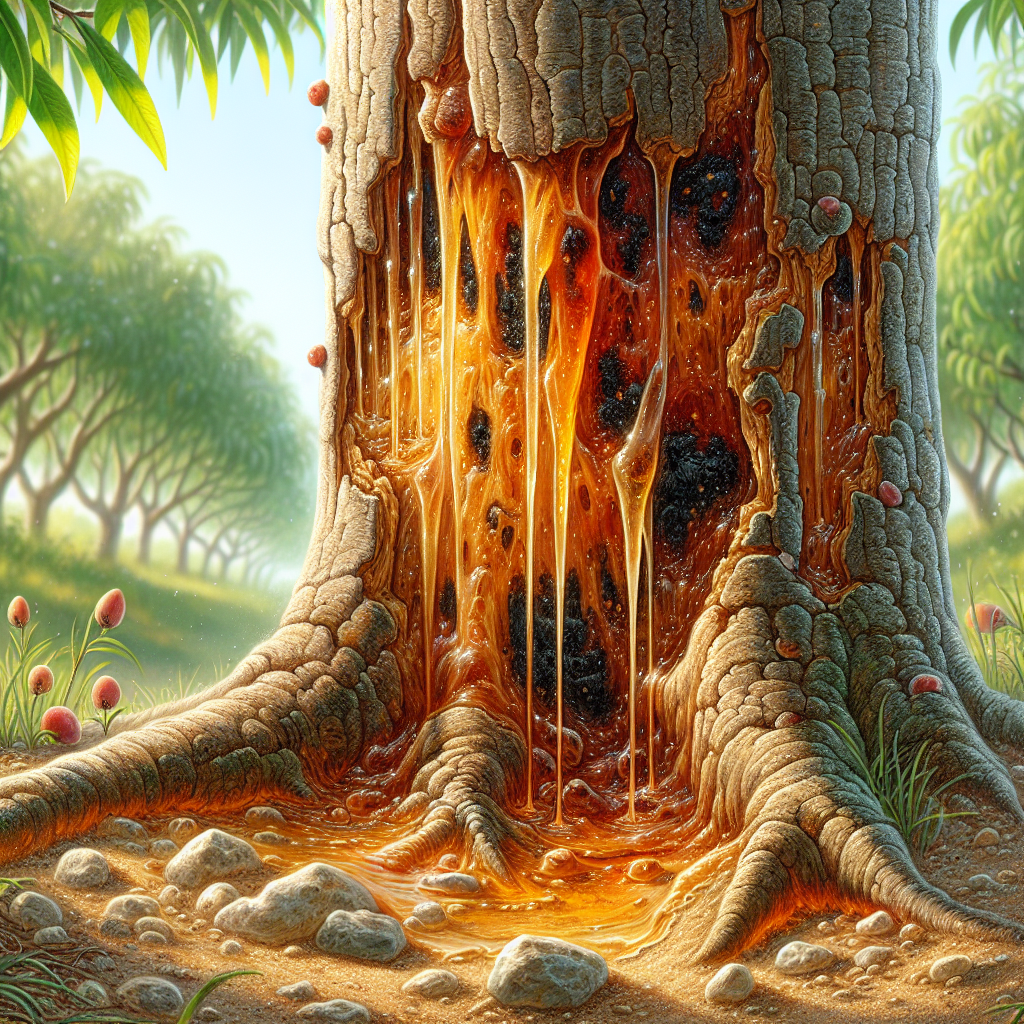
Introduction to trunk gummosis
Trunk gummosis, often simply called gummosis, represents one of the most serious threats to fruit orchards worldwide, particularly in stone fruit and citrus production. This disease manifests as a sticky, amber-colored gum exuding from cracks and lesions on tree trunks and scaffolds, signaling severe underlying infection by oomycete pathogens like Phytophthora. Unlike mechanical injuries, gummosis indicates active fungal invasion that disrupts nutrient and water transport, leading to canopy dieback, reduced yields, and tree mortality if unmanaged.
Primarily affecting crops in humid, poorly drained regions, trunk gummosis costs growers millions annually through lost productivity and removal expenses. Stone fruits such as peach, plum, cherry, and apricot are highly susceptible, alongside citrus like orange and lemon. The pathogen enters through wounds or natural openings, colonizing the cambium layer and producing toxins that provoke the tree's gummy defense response. While chemical controls exist, integrated organic strategies emphasizing soil health and cultural practices offer sustainable long-term solutions. This guide provides definitive diagnostics, lifecycle insights, and proven management protocols to protect your orchard investment.
Identifying Symptoms & Damage
Recognizing trunk gummosis early is critical for containment. The hallmark symptom is the profuse oozing of gum—a translucent, viscous sap that darkens to brown upon air exposure—from bark fissures on the lower trunk, often 6-24 inches above soil level. This gum hardens into crusty patches, attracting pests like ants and sap beetles that exacerbate damage.
Inspect for sunken, discolored bark lesions with irregular margins, frequently water-soaked initially. Peel back affected bark to reveal necrotic, reddish-brown cambium and dark streaking in the sapwood. Advanced stages show extensive cankers encircling the trunk (girdling), causing wilting leaves, yellowing foliage, and sparse canopy. Trees may exhibit stunted growth, small fruits, premature leaf drop, and branch dieback starting from the top.
Differentiate from non-pathogenic gummosis (stress-induced) by lesion depth and pathogen confirmation via lab culture or PCR testing. Mechanical damage from mowers or rodents lacks consistent gum flow and fungal growth. In avocado groves, combine with root rot symptoms for accurate diagnosis. Yield losses can reach 50-80% in severe epidemics, underscoring vigilant scouting.
Lifecycle and Progression of trunk gummosis
Trunk gummosis follows a polycyclic lifecycle driven by Phytophthora spp., soilborne oomycetes that produce zoospores for splash dispersal during rains. Overwintering as thick-walled oospores or chlamydospores in soil or infected tissue, pathogens activate in saturated conditions, germinating to infect roots and crowns. Zoospores swim to trunk wounds, encyst, and penetrate within hours.
Lesion expansion occurs rapidly in spring and fall, coinciding with bud break and leaf fall when trees are vulnerable. Gum production peaks 2-4 weeks post-infection as a phenolic response, sealing wounds but trapping mycelia. Cankers enlarge 1-3 inches monthly under optimal conditions (15-25°C, high moisture), girdling trunks by summer. Sporangia release new zoospores, perpetuating cycles up to 5-10 times yearly.
Progression varies by host: peaches decline in 1-2 years, while mature mango trees resist longer. Secondary invaders like Botrytis accelerate decay. Understanding this cycle informs timing for cultural interventions and phosphite applications. For deeper insights into related trunk issues, see our Why Misidentifying Plants Costs Small Farms Thousands - And How AI Camera Diagnosis Fixes It Fast.
Environmental Triggers & Risk Factors
Phytophthora thrives in heavy, compacted soils with poor drainage, where waterlogging persists >48 hours. Flooded orchards, over-irrigation, and low-lying sites amplify risk, as oxygen depletion stresses roots, facilitating infection. Cool, wet weather (10-20°C) during active growth maximizes zoospore motility.
Wounds from cultivation, rodent activity (rodents), or frost cracks serve as entry points. Shallow planting exposes root collars, while excessive nitrogen promotes succulent tissue. Susceptible rootstocks like Nemaguard peach heighten vulnerability versus resistant Lovell. Overcrowded canopies trap humidity, and mulch piled against trunks creates moist microclimates.
Climate change intensifies outbreaks via erratic rains. Acidic soils (pH<6) favor pathogen survival. Integrated site assessment—soil tests, elevation mapping—mitigates 70% of risks pre-planting.
Organic Control & Treatment Plans
Organic management hinges on exclusion, sanitation, and biological enhancements. Remove and destroy infected trees promptly to curb spore spread; do not compost. Excavate 12-18 inches of soil around trunks to expose lesions, then scrape cankers to healthy tissue, applying copper fungicide (e.g., Bordeaux mixture) post-rain.
Soil solarization in summer kills surface propagules: cover moist soil with clear plastic for 4-6 weeks. Boost tree vigor with compost teas rich in Trichoderma and mycorrhizae, applied drench-style thrice yearly. Phosphorous acid (mono- and di-potassium salts) at 2-4 quarts/acre mobilizes defenses; time sprays for pre-rain periods.
Aerate compacted zones with deep tines, install drainage ditches, and plant cover crops like mustard for biofumigation. Mulch 4-6 inches deep, keeping 6 inches from trunk. Introduce beneficial nematodes (Steinernema feltiae) against soil pests aiding Phytophthora. Monitor with bait traps (almond leaves floated in water samples). Rotate resistant varieties and avoid wounding during wet seasons. Success rates exceed 80% with consistent execution.
Preventing trunk gummosis in the Future
Prevention outperforms cure through site selection and best practices. Plant on raised beds or mounds (18-24 inches) in well-drained loams (pH 6.5-7.5). Choose resistant rootstocks: Controller 5 for peach, Trojan for plum. Space trees 15-20 feet to enhance airflow.
Implement drip irrigation below canopy, scheduling to soil moisture at 20% capacity. Prune annually to open centers, removing water sprouts. Test soil pre-planting for Phytophthora via bioassay. Apply lime-suppressed mulches and gypsum to amend heavy clays. Scout monthly, flagging suspect trees.
Foster microbiome health with cover crops (clover) and vermicompost. Quarantine new stock. Long-term, integrate predictive tools for irrigation timing. See Soil Health Mastery: 5 Proven Strategies for Small Farms to Build Fertile Ground Without Breaking the Bank for soil resilience tips.
Crops Most Affected by trunk gummosis
Stone fruits dominate vulnerability: peaches (80% infection rates in epidemics), apricots, plums, and cherries suffer rapid girdling. Citrus like oranges, lemons, and grapefruits show trunk lesions alongside root rot. Avocados (Hass avocado) face crown infections yielding 30-50% losses. Almonds and walnuts exhibit cankers, while apples and pears are occasional hosts. Tropicals including mango and papaya report sporadic outbreaks. Avoid planting susceptibles in high-risk zones; opt for intercropping with repellents like marigold.