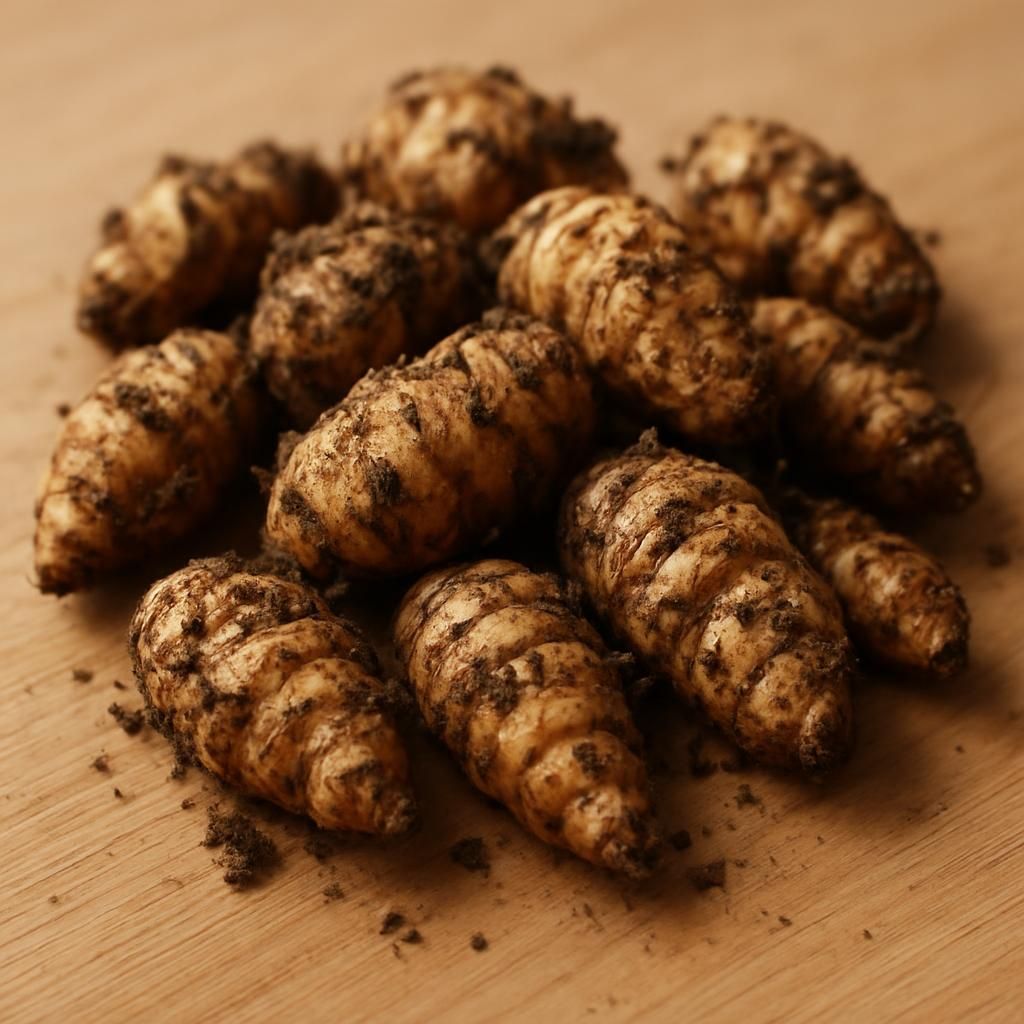
Introduction to Tiger Nut (Chufa)
Tiger nut (Cyperus esculentus), commonly called chufa, is an ancient tuber crop that has been cultivated for thousands of years across the Mediterranean, West Africa, and parts of the Americas. Despite its name, it is not a nut but the underground tuber of a perennial sedge. The small, wrinkled tubers have a sweet, nutty flavor and are eaten fresh, roasted, or processed into horchata de chufa, a traditional Spanish beverage. Modern interest has grown due to its exceptional nutritional profile—high in resistant starch, oleic acid, magnesium, and iron—making it suitable for gluten-free, paleo, and diabetic-friendly diets.
Beyond human consumption, tiger nut is valued in sustainable agriculture as a low-input crop that tolerates drought, suppresses weeds through allelopathy, and improves soil tilth with its fibrous root system. Commercial production occurs in Spain, Nigeria, Egypt, and increasingly in the southern United States. Small-scale growers appreciate its ability to produce 8–12 tons of tubers per hectare under optimal conditions with minimal irrigation once established.
Botanical Profile of Tiger Nut (Chufa)
Tiger nut belongs to the Cyperaceae family and grows as a clump-forming perennial sedge reaching 30–90 cm in height. It produces triangular stems (culms) with narrow, grass-like leaves and an extensive network of rhizomes that terminate in edible tubers. The tubers are typically 1–3 cm long, covered in a thin, fibrous skin that ranges from light tan to dark brown. Each plant can produce 50–200 tubers depending on cultivar, soil fertility, and growing season length. Flowers appear in umbrella-like clusters but are rarely fertile; most propagation occurs vegetatively through tubers or rhizome fragments.
The plant exhibits C4 photosynthesis, conferring high water-use efficiency and heat tolerance. Tubers remain dormant during winter and resume growth when soil temperatures exceed 15 °C. Two primary botanical varieties exist: the cultivated form (var. sativus) selected for larger, sweeter tubers and the wild form (var. esculentus) with smaller, more fibrous tubers used mainly for forage or soil improvement.
Soil, pH, and Climate Requirements for Tiger Nut (Chufa)
Tiger nut performs best in light, well-drained sandy or sandy-loam soils that allow easy harvesting of the tubers. Heavy clay soils increase rot risk and make mechanical harvesting difficult. The crop is moderately salt-tolerant and thrives in soils with low to moderate fertility, although organic matter improves tuber size and yield.
| Parameter | Ideal Range | Notes |
|---|---|---|
| Soil Type | Sandy loam to loamy sand | Excellent drainage essential |
| Soil pH | 5.5 – 7.5 | Slightly acidic to neutral optimal |
| Temperature (growth) | 20 – 32 °C | Minimum 15 °C soil temperature for sprouting |
| Frost Tolerance | None below 0 °C | Plant after last frost; tubers survive mild freezes |
| Annual Rainfall | 400 – 800 mm | Supplemental irrigation in drier regions |
| Day Length | 12 – 14 hours | Long days promote vegetative growth |
Step-by-Step Planting & Propagation
Site Selection and Preparation: Choose a sunny location with at least 6–8 hours of direct sunlight. Perform a soil test and incorporate 2–4 cm of well-rotted compost if organic matter is below 2 %. Avoid fields with a history of root rot or heavy nematode pressure.
Tuber Selection: Use certified disease-free tubers 1.5–2.5 cm in diameter. Soak tubers in water for 12–24 hours to break dormancy, then pre-sprout in moist sand at 20–25 °C for 5–7 days until shoots emerge.
Planting Time: In temperate zones, plant when soil temperature at 10 cm depth reaches 18 °C, typically 2–3 weeks after the last frost. In subtropical regions, planting can occur from March through June.
Spacing and Depth: Plant tubers 5–8 cm deep and 20–30 cm apart in rows spaced 60–75 cm. For higher density production, use 15 cm in-row spacing with 50 cm between rows.
Irrigation at Planting: Provide light irrigation immediately after planting to settle soil around tubers. Maintain consistent moisture until shoots emerge, then reduce frequency.
Care & Maintenance regimes for Tiger Nut (Chufa)
Tiger nut is relatively low-maintenance once established. Focus on weed control during the first 6–8 weeks and supplemental irrigation during tuber bulking. The crop benefits from light hilling when shoots reach 20 cm to encourage additional tuber formation.
| Growth Stage | Water Schedule | Fertilizer Schedule | Pruning / Other Tasks |
|---|---|---|---|
| Establishment (0–6 weeks) | 25–30 mm/week; keep top 10 cm moist | 20-10-10 NPK at 40 kg N/ha at planting | Weed by hand; avoid herbicides |
| Vegetative (6–12 weeks) | 20 mm/week; allow top 5 cm to dry | Side-dress 15 kg N/ha at 8 weeks | Hill soil around plants at 20 cm height |
| Tuber Bulking (12–18 weeks) | 15 mm/week; reduce 2 weeks before harvest | No additional fertilizer; maintain K levels | Monitor for pests; cease irrigation |
| Post-harvest | None required | None | Remove debris; prepare field for rotation |
Pests, Diseases & Organic Management
Tiger nut faces relatively few serious pest pressures compared with other root crops. Primary concerns include root-knot nematodes, cutworms, and occasional infestations of aphids on foliage. Fungal issues such as Pythium and Rhizoctonia can cause tuber rot in poorly drained soils.
Organic management strategies include crop rotation with corn or sorghum for at least three years, solarization of beds before planting, and application of neem-based products for sucking insects. Beneficial nematodes (Steinernema feltiae) effectively control cutworm larvae. Maintaining soil organic matter above 3 % and avoiding over-irrigation are the most effective preventative measures against soil-borne pathogens.
Harvesting, Curing & Optimal Storage
Tiger nut reaches maturity 120–150 days after planting when foliage begins to yellow and tubers develop a firm, wrinkled skin. In small plots, use a garden fork to gently lift plants, shaking soil from the root mass. Commercial operations employ modified potato harvesters or specialized tiger-nut diggers.
Immediately after harvest, wash tubers in clean water and spread them in a single layer under shade or in a forced-air dryer at 30–35 °C for 3–5 days until moisture content drops below 12 %. Properly cured tubers store for 6–12 months in cool (10–15 °C), dry conditions with good ventilation. For longer storage, vacuum-seal or freeze at −18 °C.
Companion Planting for Tiger Nut (Chufa)
Tiger nut pairs well with tall, upright crops that provide light shade during peak summer heat. Compatible companions include corn, sunflower, and okra. The sedge’s allelopathic properties help suppress weeds beneath these taller plants. Avoid planting near potato or onion because of shared nematode and fungal susceptibilities. Interplanting with legumes such as cowpea or peanut can improve soil nitrogen while the deep-rooted tiger nut accesses subsoil moisture, creating a mutually beneficial microclimate.
For more on building resilient cropping systems, see Summer Companion Planting: 10 Organic Pairings to Boost Small Farm Resilience.