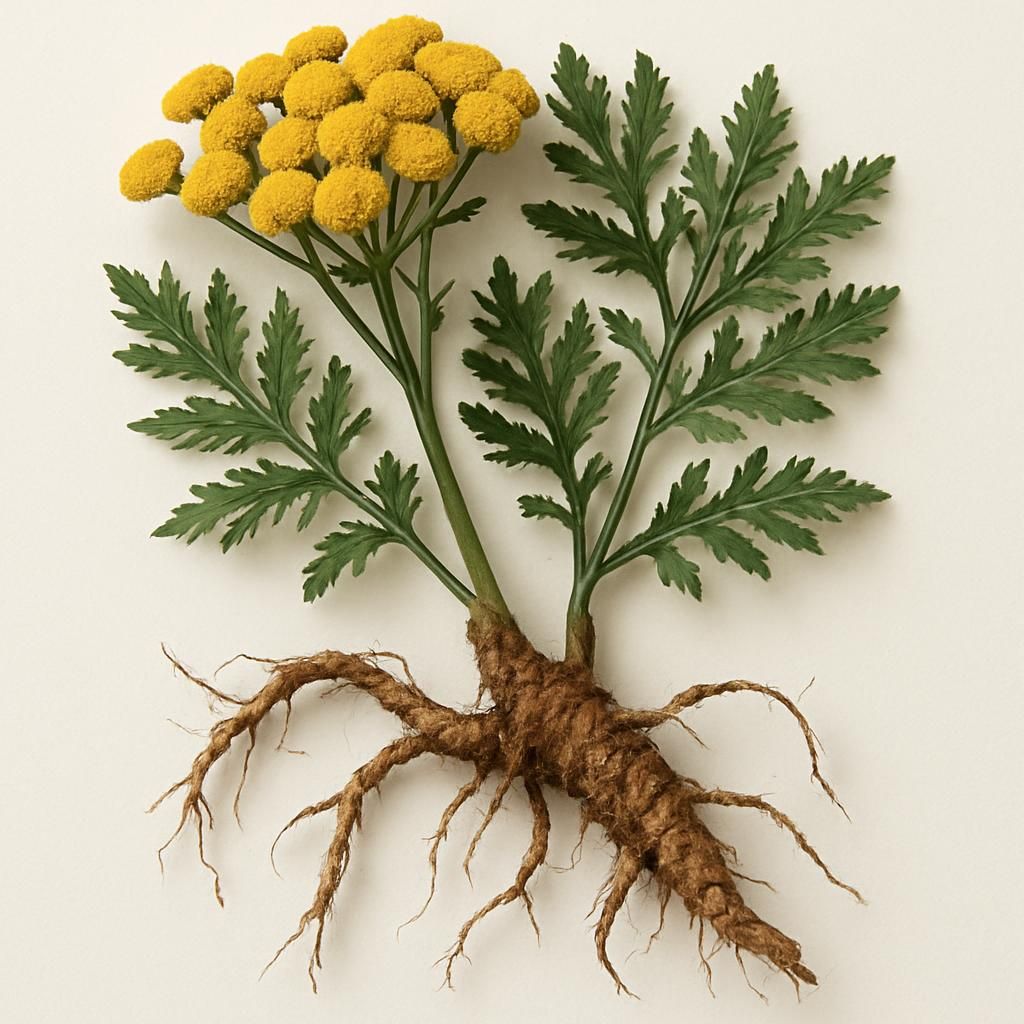
Introduction to Tansy Root
Tansy Root (Tanacetum vulgare var. radices) is a robust perennial herb prized for its intensely aromatic roots and insect-repelling foliage. Native to temperate Eurasia, it has been cultivated for centuries as a natural pesticide companion and a source of essential oils used in traditional medicine. Modern growers value Tansy Root for its resilience, low maintenance requirements, and ability to thrive in marginal soils where many other crops struggle.
The plant produces clusters of fern-like leaves and clusters of button-like yellow flowers in summer, while its thick, fibrous roots are harvested in autumn for drying or distillation. Tansy Root’s natural thujone content makes it an effective deterrent against many common garden pests, reducing the need for synthetic interventions. With proper site selection and organic management, a single planting can remain productive for 4–6 years before requiring renewal.
Botanical Profile of Tansy Root
Tansy Root belongs to the Asteraceae family and grows as a clump-forming herbaceous perennial reaching 60–120 cm in height. The plant develops a deep taproot system supplemented by lateral rhizomes that allow moderate spreading. Leaves are dark green, deeply dissected, and emit a strong camphor-like aroma when crushed. Flower heads are dense, flat-topped corymbs of golden-yellow disc florets without ray petals.
The roots are the primary economic part, consisting of woody, branched structures 8–20 cm long and 1–3 cm thick with a bitter, aromatic flavor. Essential oil content ranges from 0.8–2.5% depending on soil fertility and harvest timing, with thujone, camphor, and borneol as dominant constituents. Unlike common Tansy, the root variety has been selectively bred for larger rhizomes and lower seed viability, reducing its potential to become invasive.
Soil, pH, and Climate Requirements for Tansy Root
Tansy Root performs best in well-drained loamy or sandy loam soils with moderate fertility. Heavy clay soils should be amended with organic matter or raised beds to prevent waterlogging, which can cause root rot. The plant tolerates a wide pH range but produces optimal root biomass between 6.0 and 7.2.
| Parameter | Ideal Range | Notes |
|---|---|---|
| Soil Type | Sandy loam to loam | Well-drained; avoid compacted clays |
| Soil pH | 6.0–7.2 | Slightly acidic to neutral |
| Organic Matter | 3–5% | Incorporate compost or aged manure |
| Temperature Range | 15–28 °C daytime | Hardy to -20 °C; prefers cool summers |
| Annual Rainfall | 500–900 mm | Supplemental irrigation in dry periods |
| Sun Exposure | Full sun to partial shade | Minimum 6 hours direct light |
| Elevation | 0–1500 m | Performs well in temperate highlands |
The crop is winter-hardy across USDA zones 4–8 and benefits from a period of vernalization to stimulate vigorous spring regrowth. In hotter climates, afternoon shade and consistent moisture help maintain leaf quality and prevent premature flowering.
Step-by-Step Planting & Propagation
Tansy Root is most reliably propagated by root division rather than seed due to variable germination and lower thujone content in seed-grown plants. Begin site preparation in early autumn or late winter by clearing weeds and incorporating 5–8 cm of well-rotted compost. Divide established clumps in early spring when new shoots emerge, selecting sections with at least two buds and 8–10 cm of root.
Plant divisions 30 cm apart in rows spaced 60–75 cm, setting the crown just below soil level. Firm the soil gently and water thoroughly to eliminate air pockets. For larger plantings, pre-sprout root cuttings in moist sand for 10–14 days before transplanting to accelerate establishment. Mulch with 5 cm of straw or shredded leaves immediately after planting to suppress weeds and conserve moisture.
Care & Maintenance regimes for Tansy Root
Established Tansy Root requires minimal intervention beyond seasonal mulching and occasional division. Weed control is critical during the first growing season; thereafter the dense foliage canopy naturally suppresses most annual weeds. Remove flower heads promptly if seed production is undesirable, redirecting energy into root development.
| Task | Frequency | Details |
|---|---|---|
| Watering | Weekly during establishment; bi-weekly thereafter | Maintain even moisture; avoid waterlogging |
| Fertilizer | Early spring and post-harvest | Apply 2–3 cm compost tea or balanced organic fertilizer (NPK 5-5-5) |
| Pruning | Early spring and after flowering | Cut back to 10 cm; divide every 3–4 years |
| Mulching | Renew twice yearly | 5 cm organic mulch to retain moisture and suppress weeds |
| Division | Every 3–4 years | Split clumps in early spring to maintain vigor |
Monitor soil fertility annually with a basic test; Tansy Root rarely shows deficiency symptoms but benefits from light potassium supplementation in sandy soils to enhance root oil content.
Pests, Diseases & Organic Management
Tansy Root’s natural thujone content provides strong resistance to many common pests, yet aphids, Spider Mites, and root-knot nematodes can occasionally appear under stress. Regular inspection of leaf undersides and prompt removal of infested foliage usually prevents outbreaks. Companion planting with Nasturtium or Marigold further reduces aphid pressure through natural repellency.
Fungal issues such as Powdery Mildew or Botrytis may develop in humid conditions with poor airflow. Improve circulation by spacing plants adequately and removing lower leaves at the first sign of infection. Organic copper or sulfur sprays applied preventively during wet springs offer effective control without residue concerns. Avoid overhead irrigation to minimize leaf wetness duration.
Harvesting, Curing & Optimal Storage
Harvest Tansy Root in late autumn after the first hard frost when foliage begins to senesce. Carefully lift entire clumps with a garden fork, shaking off excess soil. Separate usable roots from the crown, retaining 2–3 buds per division for replanting. Rinse roots gently in cool water and trim damaged sections.
Cure by spreading roots in a single layer in a shaded, well-ventilated area at 15–20 °C for 7–10 days until the surface is dry to the touch. For long-term storage, cut roots into 5 cm pieces and dry in a dehydrator at 35 °C until brittle. Store in airtight glass jars away from light and heat; properly cured roots retain potency for up to two years. Essential oil extraction should occur within six months of harvest for maximum thujone yield.
Companion Planting for Tansy Root
Tansy Root serves as an excellent companion due to its pest-repellent properties. Plant near Tomato rows to deter Aphids and Whiteflies, or intersperse with Cucumber beds to reduce Cucumber Beetles. Its aromatic foliage also masks the scent of brassicas, protecting Cabbage and Kale from Cabbage Loopers.
Avoid planting near Fava Bean or Peas as Tansy Root can inhibit legume nodulation through allelopathic root exudates. Instead, pair with Yarrow or Thyme to create a diverse insectary border that supports beneficial predators. These strategic pairings enhance overall garden biodiversity while minimizing the need for external inputs.