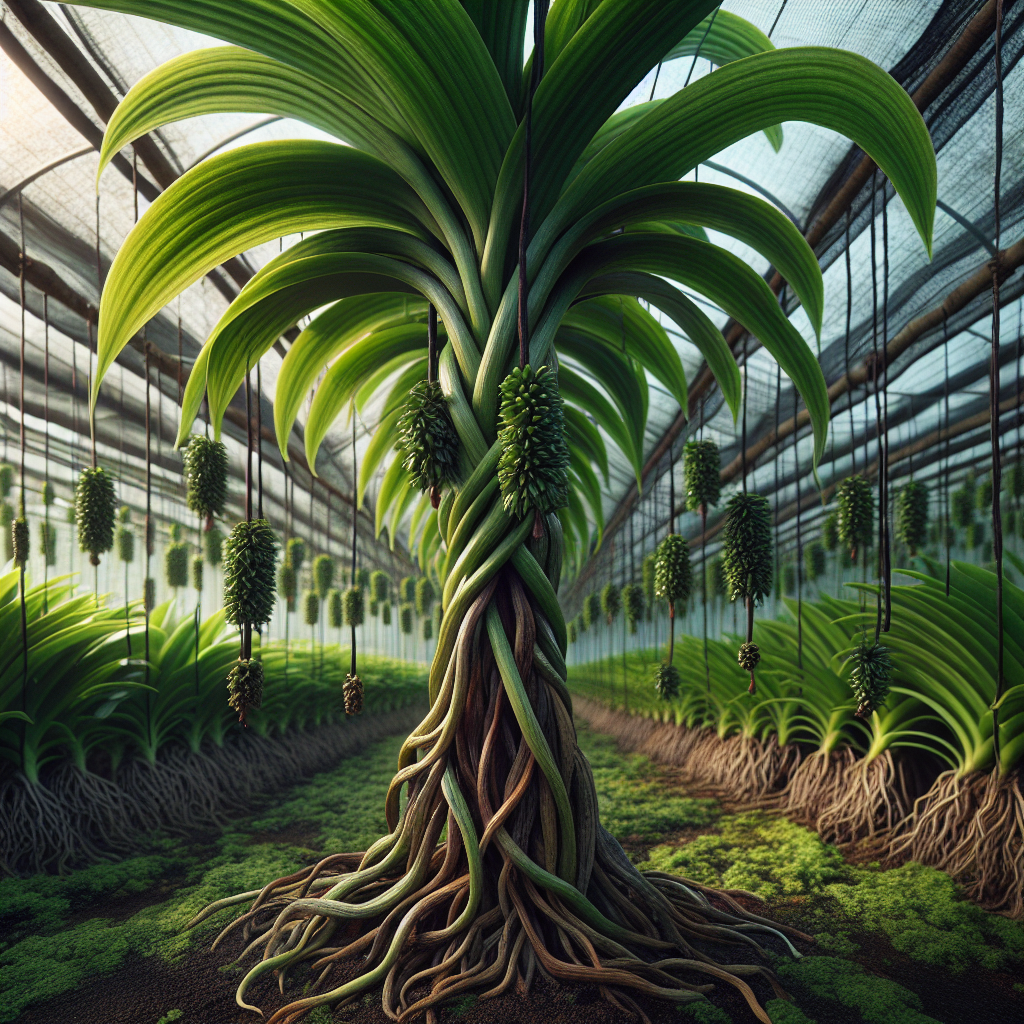
Introduction to Tahitian Vanilla
A distinct vanilla type long associated with French Polynesia, this crop is prized for a perfume-like bouquet often described as floral, cherry-like, spicy, and slightly licorice or anise scented. Unlike the more common Bourbon vanilla, Tahitian vanilla typically produces plumper beans with a higher proportion of aromatic compounds such as p-anisyl derivatives, giving it exceptional value in perfumery, pastry, and premium extract production.
Although it is commercially grouped as “vanilla,” it is botanically and agronomically specialized. Most authorities identify it as Vanilla × tahitensis, a hybrid lineage closely related to Vanilla planifolia and Vanilla odorata. That parentage helps explain its softer, fruitier aroma and somewhat different bean morphology. Growers considering this crop should understand that success depends less on brute fertility and more on microclimate management, vine architecture, pollination timing, and disciplined postharvest handling. For background on the broader crop group, see Vanilla.
Botanical Profile of Tahitian Vanilla
This species-group is a perennial, monopodial climbing orchid that produces long, fleshy, segmented vines. Each node can form a leaf, an aerial root, and eventually an inflorescence under mature, favorable conditions. Leaves are thick, succulent, and elliptic to oblong, usually medium to deep green when light levels are appropriate. Pale or yellow-green foliage often signals excessive light, while very dark, lush foliage with weak flowering can indicate too much shade or excessive nitrogen.
Aerial roots are not just anchoring organs; they are physiologically important for water uptake and gas exchange in humid tropical settings. Healthy roots should look firm, silvery to greenish, and actively gripping supports. Blackened, mushy, or shriveled roots usually indicate rot, prolonged saturation, salt injury, or desiccation stress.
Flowering generally begins once vines are physiologically mature, often 2 to 3 years after planting from well-grown cuttings, though less vigorous plantings may take longer. Inflorescences arise from leaf axils on mature sections of vine. Flowers are ephemeral, commonly opening in the morning and remaining receptive for only a few hours. In most production systems outside the plant’s native pollinator range, hand pollination is essential.
Pods, commonly called beans, develop over several months after successful pollination. Tahitian vanilla beans are often shorter and thicker than standard Bourbon types, with a supple, oily feel when properly cured. Their sensory profile is the principal commercial distinction: less aggressively vanillic, more floral and fruity, and often preferred for cold desserts, creams, and fragrance applications.
Soil, pH, and Climate Requirements for Tahitian Vanilla
This orchid does not behave like a conventional row crop rooted in dense mineral soil. In nature and in well-designed production, it performs best in a highly aerated, organic-rich rooting environment with fast drainage and constant but moderate moisture. The ideal medium is loose, fibrous, and biologically active, often made from decomposed leaf mold, composted bark, coconut husk fiber, coarse compost, and a small proportion of friable loam. Heavy clay is unsuitable unless extensively amended and mounded.
Aim for a root-zone pH of 6.0 to 7.0, with 6.2 to 6.8 often giving the best balance of nutrient availability and microbial activity. At pH below about 5.5, root stress and micronutrient imbalance become more likely. Above 7.2, iron, manganese, and zinc deficiencies can appear, especially under alkaline irrigation water. If using container or shade-house systems, test both media and irrigation water quarterly because pH drift is common in organic substrates.
Temperature is the most decisive climate variable. Optimal daytime temperatures are roughly 24 to 32°C (75 to 90°F), with night temperatures ideally 18 to 24°C (64 to 75°F). Growth slows noticeably below 18°C, and chilling injury can occur under prolonged exposure below about 10 to 12°C. Frost is usually fatal. In marginal climates, protected cultivation under a humid shade structure or tropical greenhouse is the only reliable strategy.
Relative humidity should generally remain between 70% and 85%. Below 60%, vines can wrinkle, aerial roots desiccate, and flower drop increases. Sustained humidity above 90% with poor airflow, however, sharply raises disease pressure, especially stem and Root rots. The goal is humid air with continuous gentle movement, not stagnant dampness.
Light should be bright but filtered, typically 40% to 60% shade. Think of the dappled understory of a tropical orchard rather than full sun. Leaves exposed to excessive midday radiation will bleach, scorch, or develop yellow patches. Insufficient light causes long internodes, delayed flowering, and fewer inflorescences. Shade cloth, agroforestry canopies, or training on living support trees are all valid approaches.
Rainfall or irrigation should supply steady moisture without waterlogging. Annual rainfall of 1500 to 3000 mm is suitable if drainage is excellent and there are slight drier intervals to support floral induction. Constant saturation is one of the most common causes of failure. The root zone should feel evenly moist, like a wrung-out sponge, not dripping wet. If substrate squeezed by hand releases free water, it is too wet. If it feels dusty, brittle, or hydrophobic, it is too dry.
Step-by-Step Planting & Propagation
Commercial propagation is almost always by stem cuttings because seed-grown orchids are variable, slow, and technically difficult. Select disease-free, vigorous mother vines with thick internodes and no sign of stem lesions, mite scarring, or nutrient disorder. The best cuttings are usually 60 to 120 cm long with at least 8 to 15 nodes. Longer cuttings often establish and flower earlier because they retain more carbohydrate reserves.
Prepare the site before planting. Install support systems first, because disturbing vines later can damage roots. Supports may be living trees, rough wooden posts, or trellised frames. Living supports are traditional, but they must cast filtered shade rather than dense darkness. Suitable companion support plants include Gliricidia, Coconut, and Cacao where climate permits.
Build a raised, well-drained rooting zone. Form mounds or beds 15 to 30 cm above surrounding grade if the site has any tendency to puddle. Mix in mature compost, leaf litter, chopped coconut husk, or aged bark to create a porous organic base.
Cure the cuttings briefly. After cutting, allow the basal end to dry in shade for 1 to 3 days so wounds callus slightly. This reduces immediate rot risk. Do not leave them so long that they shrivel.
Position the basal nodes shallowly. Lay 2 to 4 nodes along the surface of the prepared medium and lightly cover them with loose organic matter. Avoid deep burial; buried succulent tissue rots easily. The remaining vine should lean against or be gently tied to the support.
Orient for climbing and looping. As vines grow upward to about 1.5 to 2 m, loop them downward or around the support. This practice is central to vanilla management because drooping or bent mature vine sections tend to flower more readily than endlessly ascending shoots.
Water lightly but consistently during establishment. For the first 6 to 8 weeks, keep the medium uniformly moist but never saturated. A useful target is that the top few centimeters remain slightly damp most days while free drainage occurs within minutes of irrigation.
Delay heavy feeding. Newly planted cuttings have limited active roots. Start with diluted liquid organic feed only after new root attachment and fresh leaf growth appear, usually 4 to 8 weeks after planting.
Mulch generously. Apply 5 to 10 cm of coarse organic mulch around, but not smothering, the basal rooting zone. This moderates temperature, preserves moisture, and slowly feeds the fungal-rich biology orchids appreciate.
If planting in protected structures, spacing of 1.5 to 2.5 m between support points is common, depending on training style. In field systems with living supports, density must balance airflow and labor access. Overcrowding is a classic mistake: it drives up humidity around stems, complicates pollination, and encourages disease.
Care & Maintenance regimes for Tahitian Vanilla
Water management should be precise. During active vegetative growth, irrigate whenever the upper 2 to 4 cm of the organic root zone begins to lose surface moisture but before the underlying medium dries. In practical terms, this may mean light irrigation 2 to 4 times weekly in humid tropics, or daily mist-supported irrigation in dry protected environments. Mature vines tolerate brief drying better than saturation. Overwatering symptoms include soft yellowing leaves, stem blackening near the base, sour-smelling media, and roots that turn brown and collapse. Underwatering appears as wrinkled leaves, slowed extension growth, dry root tips, and failure of tender buds to expand.
Nutrition should be moderate, frequent, and biologically gentle. This is not a crop that rewards aggressive fertilization. Use well-decomposed compost, vermicast, fish hydrolysate, seaweed extract, or balanced soluble feeds at low concentration. A practical feeding program is a diluted balanced feed every 2 to 4 weeks during active growth, supplemented with compost topdressing 2 to 3 times per year. Excess nitrogen causes lush vine growth with poor flowering and softer tissues more susceptible to rot. If internodes become abnormally long and leaves very soft and dark green, reduce nitrogen and slightly increase light.
Calcium and magnesium are often overlooked. In organic media, periodic additions of gypsum or dolomitic inputs may be useful if tests show deficiency, but avoid sudden pH swings. Micronutrient shortages, especially iron and zinc, are more common under alkaline water or exhausted media. Foliar micronutrient correction can be effective when root uptake is impaired.
Training and pruning are central to productivity. Let vines climb until they reach a manageable height, then bend, loop, or drape them back down. This creates accessible flowering wood and reduces labor at pollination and harvest. Remove dead, diseased, or heavily tangled sections promptly. Do not over-prune healthy mature vine mass, since carbohydrate reserves support flowering and pod fill.
Hand pollination is usually done early in the day when flowers are fresh. A thin splinter, grass stem, or specialized pick is used to lift the rostellum and press anther and stigma together. Skilled workers can pollinate many flowers quickly, but restraint matters. Over-pollination weakens the vine and leads to undersized beans. On robust vines, growers commonly pollinate only a limited number of flowers per inflorescence and only a sustainable number of inflorescences per plant. If beans are desired at premium quality rather than maximum count, thinning is wise.
Seasonal moisture manipulation can help induce flowering in some environments. Once vines are mature, a slight reduction in irrigation for several weeks, without severe stress, may encourage reproductive development, especially when combined with good light and mature drooping vines. The key word is slight: the vines should not wrinkle or abort tissue.
Sanitation should be routine. Sterilize tools, avoid dragging cut vines through wet media, and remove fallen diseased tissue immediately. Vanilla systems can remain productive for years, but only if canopy hygiene and airflow are consistently maintained. General soil stewardship also improves resilience; see soil health strategies.
Pests, Diseases & Organic Management
The biggest risks are usually diseases linked to moisture imbalance and poor hygiene rather than insect outbreaks alone. Stem rot, Root rot, and Fusarium-type wilt problems are especially serious in poorly drained systems. Early signs include yellowing from the lower vine upward, black or brown lesions at nodes, internal browning, and tissue collapse. Once advanced, infected vine sections often need removal well above visible symptoms.
Organic management begins with prevention: fast drainage, clean planting material, moderate shade, and airflow. Never allow mulch to bury succulent stems completely. Keep irrigation water off stems late in the day if nights are cool or stagnant. If rot is detected, cut back to healthy tissue with sterilized tools, destroy infected material, and dust wounds with allowed biofungicidal or desiccating materials where permitted locally.
Anthracnose and other fungal spotting diseases can affect leaves and pods in humid, poorly ventilated conditions. Pod spotting is particularly damaging because marketability depends on bean appearance. Space vines so that pollination and harvest crews can move without tearing tissue or transferring inoculum.
Common pests include Mealybugs, Scale insects, Spider mites in drier structures, Snails and Slugs on young tissue, and occasionally Caterpillars or Grasshoppers. Mealybugs and scale often cluster at nodes and under leaf bases, sucking sap and producing honeydew that supports sooty mold. Control them by pruning congested growth, washing colonies off with water where feasible, encouraging beneficial insects, and applying horticultural soap or neem-based products carefully. Avoid spraying open flowers.
Spider mites become problematic when humidity drops and dust accumulates. Symptoms include stippling, dull leaves, and fine webbing. Raise humidity moderately, improve wash-down hygiene, and use biological controls or compatible miticidal soaps. Snails and Slugs can scar tender roots and shoots; hand collection, habitat reduction, and baiting with approved products are effective.
Nematodes can impair root function in soils with previous host history. Using raised organic substrates and clean propagation material reduces risk substantially. Where vanilla is grown under living supports, maintain a biologically active mulch layer to encourage natural antagonists and improve root vigor.
Harvesting, Curing & Optimal Storage
Harvest timing determines whether flavor potential is captured or wasted. Beans should remain on the vine until physiologically mature, typically when the distal end begins to yellow slightly or the pod shows the first sign of color change from deep green toward pale green-yellow. Harvesting too early produces thin aroma, poor curing response, and lower weight. Waiting too long risks splitting, pest damage, and uneven curing.
Pick beans carefully by hand, keeping them unbruised and shaded. Do not heap them in hot sun or sealed containers, as field heat accelerates deterioration. Sort immediately to remove damaged or diseased pods.
Curing is the true transformation stage. Fresh vanilla beans have little of the final aroma consumers expect. Through killing, sweating, drying, and conditioning, enzymatic reactions generate the characteristic bouquet. Tahitian types are often cured slightly differently from Bourbon types because their beans are plumper and their flavor objective emphasizes floral complexity rather than only vanillin concentration.
A typical curing sequence includes:
- Killing: stopping vegetative life while preserving enzymatic activity. This may be done with hot water, sun-wilting, or controlled heat depending on tradition and scale.
- Sweating: keeping beans warm and humid so enzymatic breakdown and aroma development proceed. Beans are wrapped or boxed to maintain internal warmth.
- Drying: gradually reducing moisture to prevent mold while retaining suppleness. Dry too fast and beans harden outside while remaining wet within; dry too slowly and molds proliferate.
- Conditioning: storing semi-dry beans in closed boxes or lined containers for weeks to months so aroma harmonizes.
Finished moisture content is often targeted around 25% to 35%, depending on market style. Beans should be flexible, glossy to slightly oily, dark brown, and strongly aromatic without surface mold. If bent gently, a well-cured bean should flex rather than crack. White crystals on true vanilla may sometimes be prized vanillin bloom in some types, but mold is fuzzy, irregular, and musty; they are not the same.
For storage, keep cured beans in airtight or near-airtight containers at cool room temperature, ideally around 15 to 20°C, away from light. Do not refrigerate if condensation risk is high. Periodically inspect for mold or overdrying. If beans become too dry, they lose suppleness and extractability; if too moist, they spoil. Vacuum sealing can work for short- to medium-term storage if beans were properly cured first.
Companion Planting for Tahitian Vanilla
Companion planting for this crop is less about classic vegetable guilds and more about creating a functional tropical understory system. The best companions provide filtered shade, structural support, mulch biomass, humidity buffering, and diversified income without overwhelming the orchid.
Cacao is one of the most natural agroforestry partners because it thrives in similar warm, humid, partially shaded conditions and contributes canopy layering. Coconut can function in wider tropical systems by moderating light and wind at the upper story, though spacing must be generous so the vanilla root zone does not become overly dry from competition. Banana is particularly useful in young plantings because it establishes quickly, creates temporary shade, and contributes organic residue, but it must be thinned to maintain airflow. Nitrogen-fixing support trees such as Gliricidia are valuable where available because they provide pruning biomass and manageable trellis structure.
Avoid aggressive climbers, dense groundcovers that trap excessive moisture around the base, and allelopathic or highly competitive species. The ideal companion system leaves the vanilla rooting zone cool and mulched, the canopy bright but filtered, and worker access open for pollination and harvest. In practice, the best design is one where every companion serves at least one of four functions: support, shade, biomass, or microclimate stabilization.