Introduction to Sweet Potato (Stokes Purple)
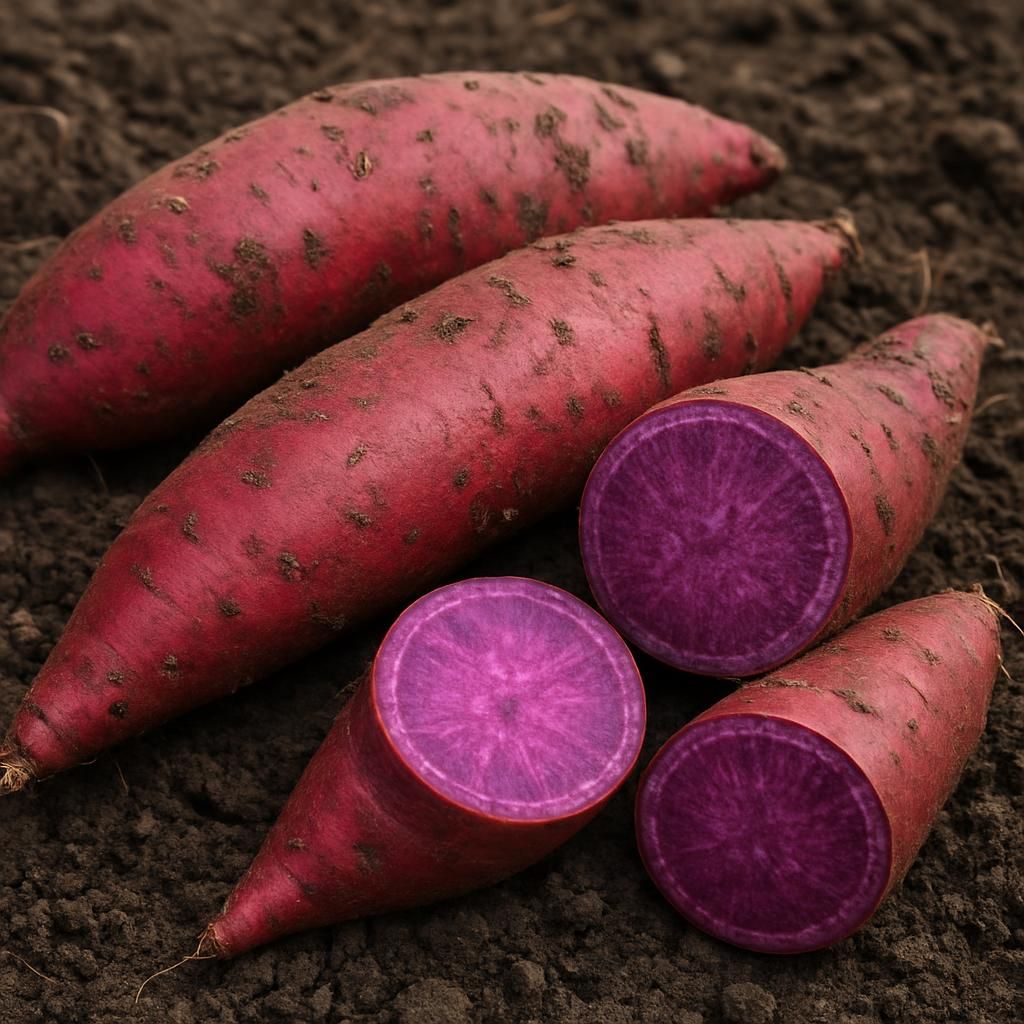
Stokes Purple sweet potato stands out among specialty varieties for its striking violet-purple flesh, which retains vibrant color even after cooking. Developed for both culinary excellence and superior field performance, this cultivar delivers reliable yields of medium-to-large, uniform tubers with smooth, deep-red skin. Its elevated levels of antioxidants make it a favorite for health-focused markets and value-added processing.
Growers appreciate Stokes Purple for its vigorous vine growth, tolerance to heat stress, and resistance to several common soil-borne pathogens. Whether cultivated in raised beds, traditional hills, or large-scale commercial fields, this variety rewards attentive management with exceptional storage life and market appeal.
Botanical Profile of Sweet Potato (Stokes Purple)
Sweet potato belongs to the Convolvulaceae family and is botanically unrelated to the common Potato. The plant produces long, trailing vines that root at nodes and generate adventitious roots which swell into storage tubers. Stokes Purple exhibits vigorous, semi-erect vines reaching 1.5–2.5 m in length with dark green, cordate leaves that provide excellent canopy coverage.
Tubers develop 10–20 cm below the soil surface and feature smooth, reddish-purple skin enclosing intensely purple flesh rich in anthocyanins. The variety flowers sporadically under long-day conditions, producing pale lavender blooms, though commercial production relies entirely on vegetative propagation via slips.
Soil, pH, and Climate Requirements for Sweet Potato (Stokes Purple)
Stokes Purple performs best in well-drained, sandy loam or loamy sand soils with good aeration. Heavy clay soils should be amended with organic matter or grown in raised beds to prevent waterlogging and tuber rot.
| Parameter | Ideal Range | Notes |
|---|---|---|
| Soil Type | Sandy loam to loamy sand | Excellent drainage essential |
| Soil pH | 5.8 – 6.5 | Avoid alkaline soils; lime only if below 5.5 |
| Temperature (Day) | 24 – 32 °C | Optimal tuber bulking occurs above 21 °C |
| Temperature (Night) | 15 – 21 °C | Chilling below 10 °C slows growth |
| Frost Tolerance | None | Plant after last frost when soil ≥18 °C |
| Rainfall / Irrigation | 25–40 mm per week | Consistent moisture during establishment |
| Growing Season | 120–150 frost-free days | Longer seasons increase average tuber size |
Step-by-Step Planting & Propagation
- Source certified disease-free slips or produce your own by sprouting disease-free mother tubers in a warm (24–27 °C), humid environment.
- Prepare slips by cutting 15–20 cm sections with 4–6 leaves once roots reach 3–5 cm.
- Harden slips outdoors for 3–5 days before transplanting.
- Form raised beds or hills 20–30 cm high spaced 1.0–1.2 m apart; plant slips 30–38 cm apart within rows.
- Bury the lower two nodes of each slip, leaving 2–3 leaves above soil; water thoroughly immediately after planting.
- Apply a thin layer of straw mulch to suppress weeds and conserve moisture.
Care & Maintenance regimes for Sweet Potato (Stokes Purple)
Consistent care throughout the season maximizes both yield and tuber quality. Focus on balanced nutrition, timely irrigation, and weed suppression without damaging shallow feeder roots.
| Growth Stage | Water Schedule | Fertilizer Schedule | Pruning / Canopy Management |
|---|---|---|---|
| Establishment (0–4 wks) | 25 mm every 3 days if no rain | 5-10-10 at 200 kg/ha banded 10 cm from slips | Remove any flowers to direct energy to roots |
| Vegetative (4–10 wks) | 25–30 mm per week, maintain even moisture | Side-dress 20 kg N/ha at 6 weeks | Trim vines only if exceeding row boundaries |
| Tuber Bulking (10–16 wks) | 30–40 mm per week during peak heat | Optional light K boost (0-0-20) at 12 weeks | Minimal pruning; maintain 80–90 % canopy cover |
| Late Season (16+ wks) | Reduce to 15–20 mm/week 2 wks pre-harvest | Cease nitrogen applications | Remove senescing leaves to improve airflow |
Pests, Diseases & Organic Management
Stokes Purple shows good resistance to several soil-borne issues, yet remains susceptible to certain above-ground and below-ground threats. Implement integrated pest management with an emphasis on cultural and biological controls.
Common above-ground pests include Aphids, Spider mites, and Whiteflies. Scout weekly and release beneficial insects such as lady beetles or lacewings at first detection. Root-knot Nematodes can be suppressed through crop rotation with Sorghum or Marigold and solarization of beds before planting.
Fungal diseases such as Southern blight and Rhizoctonia are best managed by improving drainage, avoiding overhead irrigation, and removing crop debris at season end. Fusarium wilt is rarely an issue in well-drained soils when using certified slips.
Harvesting, Curing & Optimal Storage
Harvest when vines begin to yellow, typically 120–150 days after planting. Use a garden fork to gently lift tubers, taking care not to bruise or cut the skin. Immediately move harvested roots to a shaded area.
Cure tubers at 29–32 °C and 85–90 % relative humidity for 5–7 days to heal minor wounds and convert starches to sugars. After curing, store at 13–15 °C with 85–90 % humidity; avoid refrigeration. Properly cured Stokes Purple tubers maintain quality for 4–6 months.
Companion Planting for Sweet Potato (Stokes Purple)
Pair Stokes Purple with nitrogen-fixing legumes such as Cowpeas or Clover to improve soil fertility. Aromatic herbs including Thyme and Rosemary help deter insect pests while occupying minimal space. Avoid planting near Fennel or Walnut trees, which can inhibit sweet potato growth through allelopathy.
For additional organic strategies that support small-farm resilience, see The Hidden Power of Mulching: 8 Organic Strategies to Transform Small Farm Soil.