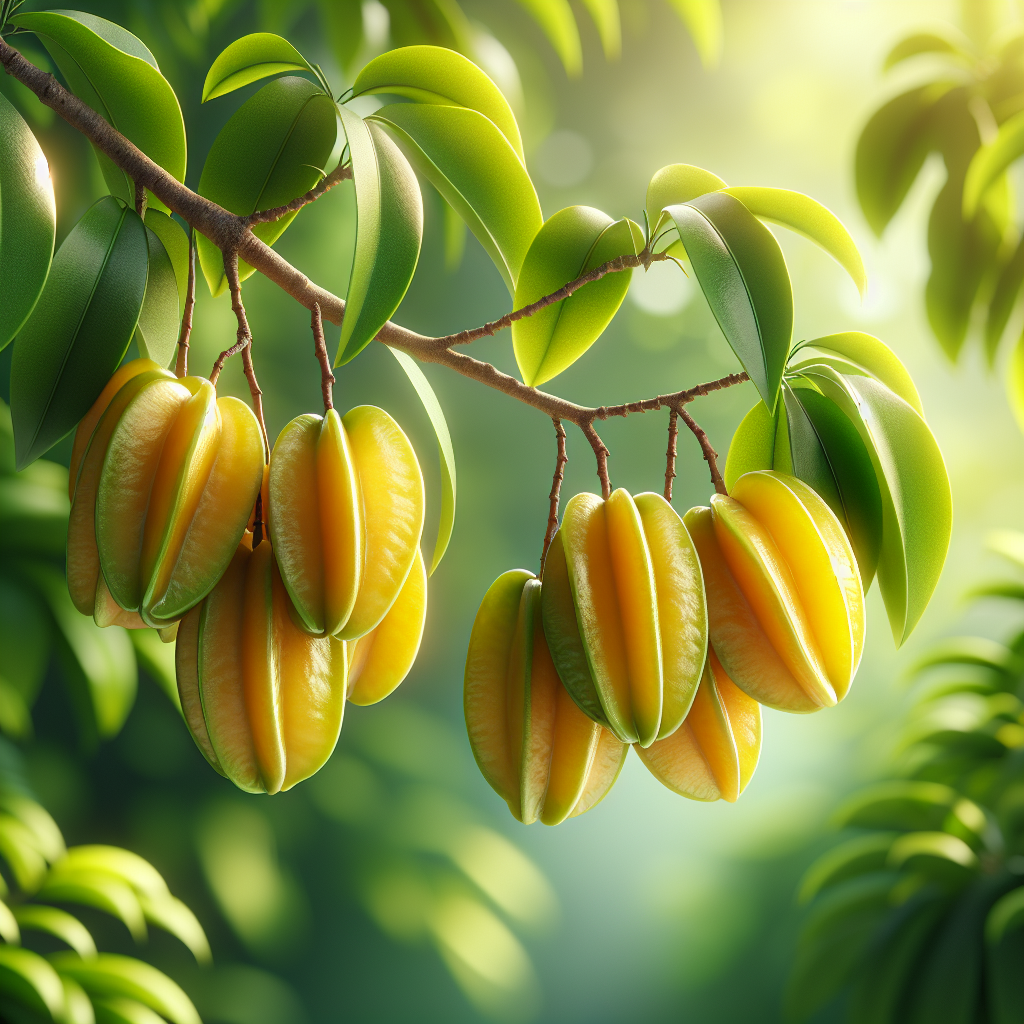
Introduction to Starfruit (B-10)
Starfruit (B-10), known scientifically as Averrhoa carambola 'B-10', represents a superior dwarf cultivar selected for its compact growth habit, heavy fruit production, and superior flavor profile. Originating from selective breeding programs in Southeast Asia, the B-10 variety stands out due to its reduced height (typically 8-12 feet at maturity), making it perfect for high-density planting in small farms, orchards, or even container cultivation in subtropical regions. Each waxy, golden-yellow fruit slices into perfect five-pointed stars, boasting a crisp texture, balanced sweet-tart taste, and notably low oxalic acid levels compared to wild types, reducing the risk of kidney stone concerns for consumers.
This variety thrives in USDA zones 10-11, producing 100-200 fruits per tree annually under optimal conditions, with harvests spanning 6-8 months. Growers appreciate B-10 for its disease resistance and adaptability to container growing, enabling profitable yields on limited land. Whether you're a commercial orchardist scaling production or a smallholder diversifying tropical crops, mastering Starfruit (B-10) cultivation unlocks a niche market for exotic, vitamin C-rich fruits. For insights into similar tropical delights, explore the Dragon Fruit (crop) wiki page.
Botanical Profile of Starfruit (B-10)
Starfruit (B-10) belongs to the Oxalidaceae family, a small evergreen tree with a bushy, rounded canopy reaching 8-12 feet tall and 10-15 feet wide. Its smooth, glossy green leaves are pinnate, composed of 5-11 leaflets that fold together at night (nyctinasty), a unique adaptation signaling stress or low light. The tree produces small, fragrant pink-to-purple flowers in clusters along branches, blooming nearly year-round in tropical climates.
Fruits are oblong, 4-8 inches long, with thin, waxy skin that transitions from green to sunny yellow at maturity. Internally, the flesh is juicy and translucent with minimal to no seeds in B-10, surrounded by 5-12 prominent ribs forming the iconic star shape when sliced. Nutritionally, each 100g fruit delivers 91% water, 6-7g carbs, 2.8g fiber, 35mg vitamin C (39% DV), and traces of B vitamins, potassium, and antioxidants like quercetin. B-10's dwarf stature results from a natural mutation promoting basal branching, ideal for mechanical harvesting and wind-resistant orchards. Root systems are shallow but extensive, extending 2-3 times the canopy width, necessitating mulching for moisture retention.
Pollination is primarily entomophilous, with bees and hoverflies as key vectors; self-fertile flowers ensure consistent yields without cross-pollination needs. Phenologically, B-10 flowers 2-4 weeks after vegetative flush, with fruit set maturing in 90-120 days. This profile positions B-10 as a resilient, high-value crop outperforming standard carambola in yield per hectare (up to 20 tons).
Soil, pH, and Climate Requirements for Starfruit (B-10)
Starfruit (B-10) demands well-drained, fertile soils rich in organic matter, thriving in sandy loam or loamy soils with 2-3% organic content. Avoid heavy clays prone to waterlogging, which induce root rot. Optimal pH ranges 5.5-6.5; test soil annually and amend with dolomite lime for acidity below 5.5 or sulfur for alkalinity above 7.0. Incorporate 4-6 inches of compost pre-planting to enhance microbial activity and cation exchange capacity.
Climatically, B-10 flourishes in tropical to subtropical zones with average temperatures 68-86°F (20-30°C), tolerating brief dips to 50°F but suffering damage below 32°F. High humidity (60-80%) promotes flowering, but rainfall exceeding 60 inches/year requires raised beds or drainage tiles. Full sun (6-8 hours daily) is essential; partial shade reduces yields by 30-40%. Windbreaks using guava hedges protect shallow roots. Irrigation: Drip systems delivering 20-40 gallons/tree/week during dry spells maintain soil moisture at 60-70% field capacity. For heatwave resilience, see Why Summer Heatwaves Are Silently Killing Small Farm Yields - And 7 Organic Strategies to Fight Back. Salinity tolerance is moderate (EC <2.0 dS/m); leach soils if brackish.
Step-by-Step Planting & Propagation
Propagation: B-10 is best propagated via air-layering or marcotting for true-to-type plants, achieving 90% success. Select 1-2 year-old pencil-thick branches; girdle 1-inch wide, apply rooting hormone (IBA 5000ppm), wrap in moist sphagnum moss and plastic for 6-8 weeks until roots form. Seed propagation yields variable offspring and takes 5-7 years to fruit.
Site Preparation: Clear land, plow to 18 inches, incorporate 10-15 tons/ha compost and 200g superphosphate/tree pit. Space trees 12-15 feet apart (hedgerow) or 15-20 feet (orchard) for 200-300 trees/ha.
Planting: Dig 2x2x2 ft pits; plant air-layers at same depth as nursery, firm soil, stake. Best timing: early rainy season. Water deeply post-planting; apply 5-10 lbs organic mulch.
Establishment Care: Irrigate weekly first year; fertilize monthly with 1:1:1 NPK + micronutrients. Prune to single trunk, thin crowded shoots. Expect first fruit in 12-18 months.
Care & Maintenance regimes for Starfruit (B-10)
Irrigation: Consistent moisture without saturation; deficit irrigation post-fruit-set boosts sugar content by 15%. Use tensiometers targeting -20 to -40 kPa.
Fertilization: Annual program: 1-2 lbs N, 0.5-1 lb P, 1-1.5 lbs K/tree, split 4-6 applications. Foliar sprays of micronutrients (Zn, Fe, Mn) every 3 months prevent deficiencies. Organic option: compost tea + fish emulsion.
Pruning: Annual post-harvest: remove deadwood, water sprouts, thin canopy for light penetration (20-30% removal). Dwarf habit minimizes ladder needs.
Weed Control: Mulch with 4-6 inches straw/coco coir; mow alleys. Cover crops like clover suppress weeds.
Training: Espalier or open center for high-density (400 trees/ha). Monitor growth; tip prune young trees for bushiness.
Pests, Diseases & Organic Management
Pests: Aphids cluster on new growth—blast with water, release ladybugs. Mealybugs on branches: neem oil 2% weekly. Fruit flies puncture skins—bagging fruits or protein baits. Scale insects: horticultural oil dormant sprays.
Diseases: Phytophthora root rot in wet soils—improve drainage, use phosphonate drenches. Anthracnose causes fruit spots—copper fungicide + sanitation. Powdery mildew: sulfur sprays, prune for airflow.
Organic IPM: Scout weekly; introduce predatory mites/beetles. Companion plant marigold for nematodes. Reflective mulches deter whiteflies. For broader strategies, check Why 90% of Small Farms Fail at Pest Management - And 8 Organic Fixes That Actually Work.
Harvesting, Curing & Optimal Storage
Harvest when 80% yellow, thumb-pressure yields slightly (specific gravity 1.0-1.05). Clip with 1-inch stem using secateurs; yield peaks years 3-7. Handle gently to avoid bruising.
Curing: Room temp (68-77°F) 3-5 days completes ripening, enhances sweetness (Brix 12-16).
Storage: 50-59°F, 85-90% RH, lasts 3-4 weeks. Waxing or modified atmosphere bags extend to 6 weeks. Market fresh, juiced, or dried; avoid ethylene producers like banana. Postharvest losses <5% with proper ventilation.
Companion Planting for Starfruit (B-10)
Pair B-10 with nitrogen-fixers like pigeon pea for soil enrichment, or Thai basil to repel aphids. Underplant with pineapple or ginger for weed suppression and microclimate cooling. Avoid water-hungry mango nearby. Nasturtium traps pests; yarrow attracts pollinators. Benefits: 20% yield boost, reduced inputs.