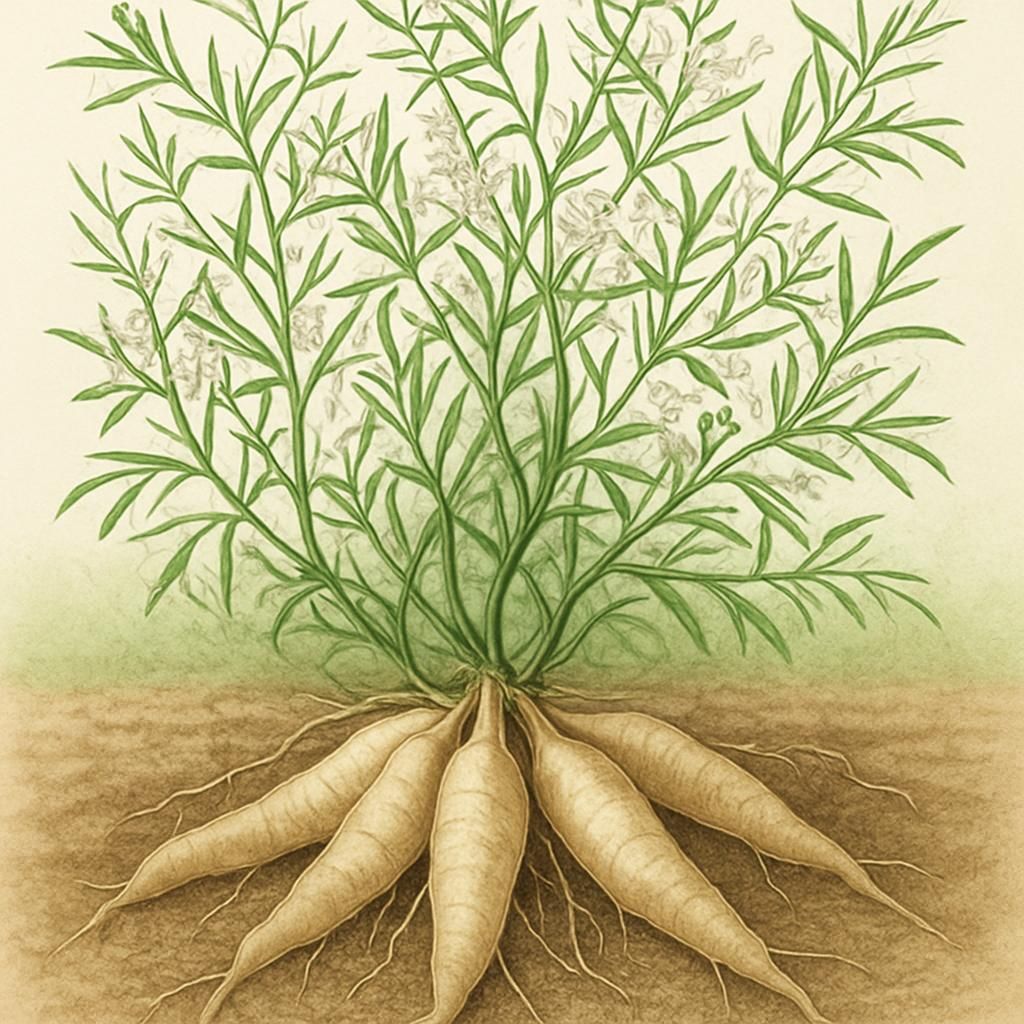
Introduction to Shatavari Root
Shatavari Root (Asparagus racemosus) is a climbing perennial belonging to the Asparagaceae family. Native to India, Nepal, and parts of Southeast Asia, the plant produces clusters of fleshy, spindle-shaped roots that are harvested, dried, and processed for medicinal and nutraceutical use. Commercial cultivation has expanded because of rising global demand for adaptogenic herbs and stable pricing for dried root material.
Botanical Profile of Shatavari Root
Asparagus racemosus is a dioecious vine that can reach 1–2 meters in height when supported. It develops needle-like cladodes instead of true leaves and bears small, fragrant white flowers followed by globular berries. The root system consists of fasciculated tubers 10–30 cm long that store starches and saponins. Unlike Asparagus, Shatavari produces thinner, more numerous roots suited for medicinal extraction rather than culinary spears.
Soil, pH, and Climate Requirements for Shatavari Root (MUST INCLUDE A MARKDOWN TABLE OF IDEAL CONDITIONS)
Shatavari performs best on sandy loam to loam soils with excellent drainage. Heavy clay or waterlogged conditions cause tuber rot and reduce saponin content. The crop tolerates a wide temperature range but is sensitive to frost during establishment.
| Parameter | Ideal Range | Notes |
|---|---|---|
| Soil Type | Sandy loam to loam | Avoid compacted or saline soils |
| Soil pH | 6.0–7.5 | Slightly acidic to neutral; liming if below 5.8 |
| Temperature (day) | 25–35 °C | Optimal growth; slows below 15 °C |
| Temperature (night) | 15–22 °C | Frost below 5 °C damages young shoots |
| Annual Rainfall | 600–1200 mm | Supplemental irrigation needed in dry spells |
| Altitude | 0–1500 m | Higher elevations may require shade nets |
Step-by-Step Planting & Propagation
- Site selection: Choose a south-facing slope or raised beds with full sun and wind protection.
- Soil preparation: Incorporate 20–25 t ha⁻¹ well-rotted FYM or compost and 50 kg ha⁻¹ rock phosphate. Form 30 cm raised beds 1 m apart.
- Propagation material: Use disease-free, 8–10 month old root divisions or tissue-culture plantlets. Each division should have 2–3 active buds.
- Planting time: Spring (March–April) in subtropical zones or early monsoon in tropical regions.
- Spacing: 60 cm × 45 cm for commercial density of ~37,000 plants ha⁻¹.
- Planting depth: Place divisions 8–10 cm deep; water immediately after planting.
- Initial irrigation: Light daily watering for 10–14 days to ensure establishment.
Care & Maintenance regimes for Shatavari Root (MUST INCLUDE A MARKDOWN TABLE OF WATER, FERTILIZER, AND PRUNING SCHEDULES)
Once established, Shatavari is moderately drought tolerant but responds well to scheduled irrigation and balanced nutrition. Support vines with 1.5 m trellises to improve air circulation and root quality.
| Growth Stage | Irrigation Schedule | Fertilizer (NPK kg ha⁻¹) | Pruning / Training |
|---|---|---|---|
| Establishment (0–3 mo) | 3–4 L plant⁻¹ every 3 days | 40-20-20 at 30 & 60 DAP | Remove weak shoots; train on trellis |
| Vegetative (3–12 mo) | 25–30 mm weekly or rainfall equivalent | 60-30-40 split into 3 applications | Pinch tips at 1.2 m; remove diseased cladodes |
| Mature (>12 mo) | 15–20 mm every 7–10 days | 30-15-30 annually in split doses | Annual winter cutback to 30 cm |
Mulch with 5–7 cm of straw or leaf litter to conserve moisture and suppress weeds. Avoid over-fertilization, which promotes excessive vegetative growth at the expense of root saponins.
Pests, Diseases & Organic Management
Common pests include Aphids, Spider mites, and Thrips. Root-knot nematodes can reduce tuber quality in sandy soils. Major diseases are Root rot caused by Pythium and Phytophthora species and Leaf spot diseases.
Organic control begins with cultural practices: crop rotation with Garlic or Onion, solarization of beds, and use of neem cake at 250 kg ha⁻¹. Beneficial insects such as lady beetles and predatory mites are released at first sign of aphids or mites. Copper-based fungicides and Trichoderma harzianum drenches provide effective control of soil-borne pathogens.
Harvesting, Curing & Optimal Storage
Roots reach harvestable size after 24–36 months. Dig carefully with a spade or mechanical lifter when foliage begins to yellow. Wash tubers immediately, trim fibrous roots, and sort by diameter. Sun-dry or use forced-air dryers at 40–45 °C until moisture content reaches 8–10 %. Store in jute bags lined with polythene at 15 °C and <60 % RH. Properly cured roots maintain saponin levels for up to 24 months.
Companion Planting for Shatavari Root
Shatavari benefits from nitrogen-fixing companions such as Pigeon pea and Sesame that improve soil fertility without competing for light. Aromatic herbs like Thai Basil and Rosemary deter aphids and thrips. Intercropping with Marigold reduces nematode populations through root exudates. Avoid planting near Potato or Tomato to prevent shared soil pathogens.