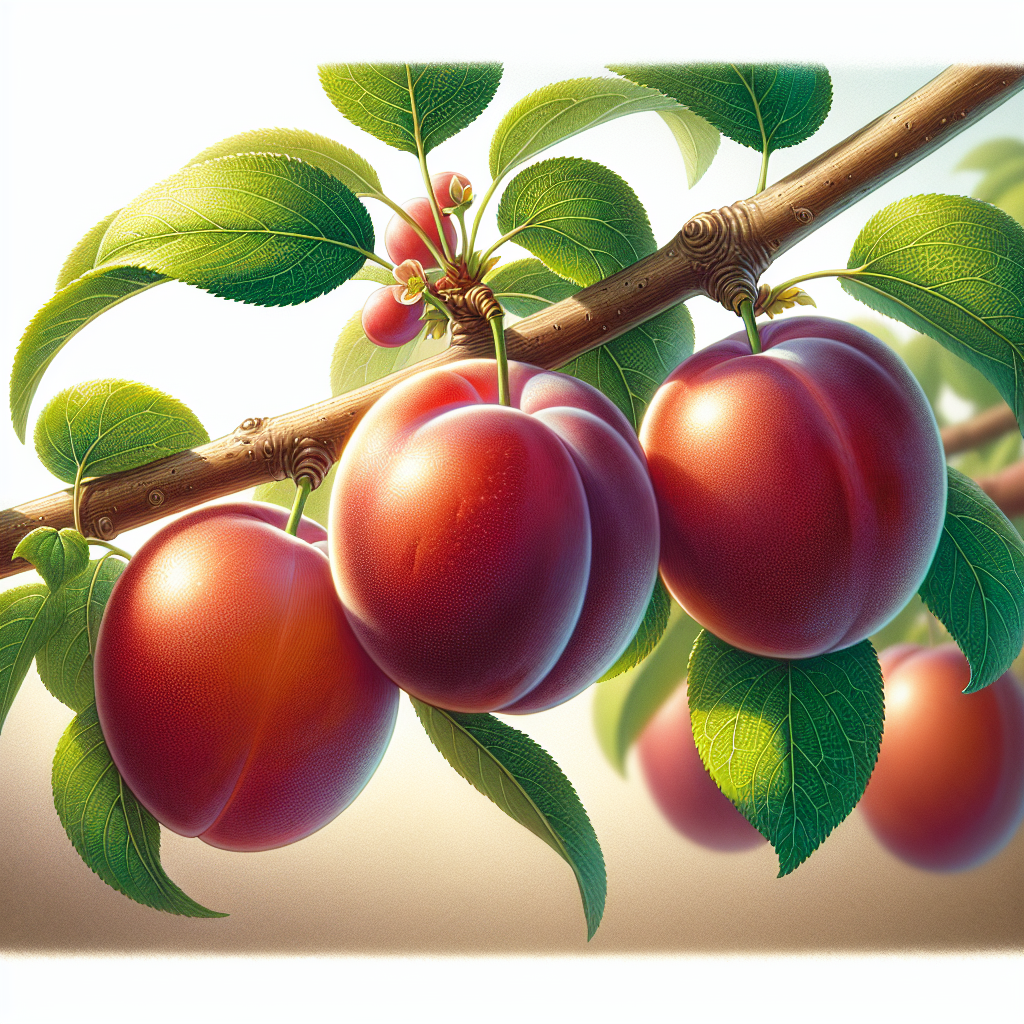
Introduction to Santa Rosa Plum
Developed in California by Luther Burbank in the early 20th century, this cultivar became one of the defining Japanese-type plums in commercial and home orchards. Despite the name “Japanese plum,” it belongs to a group of Asian-origin plums that were extensively improved in the United States, especially in Mediterranean and mild-temperate climates. Santa Rosa stands out for its complex flavor balance: fully mature fruit combines high sugars with a lively acid edge, making it markedly more aromatic than many modern shipping plums.
The tree is valued for more than fruit quality. It produces abundant spring blossom, has attractive foliage, and can serve as a productive dual-purpose landscape tree when properly pruned. It is also an important pollination partner for some other plum cultivars, though its exact fruit set performance varies by climate, bloom overlap, and pollinizer availability. For broader species background, see our Plum guide.
In orchard terms, Santa Rosa is best described as moderately vigorous, precocious, and capable of heavy cropping if winter chill, pollination, thinning, and irrigation are managed correctly. Left unmanaged, however, it can overcrop, produce small fruit, suffer limb breakage, and show increased susceptibility to Brown rot or sunburn in stressful seasons. The definitive approach with this variety is to balance vegetative growth and fruit load from the first year onward.
Botanical Profile of Santa Rosa Plum
This cultivar belongs to Prunus salicina, though many Japanese-type plums grown today have hybrid ancestry involving other Prunus species. Santa Rosa usually forms a rounded to upright-spreading canopy with medium to strong vigor, depending on rootstock, soil fertility, irrigation, and pruning style. On common semi-vigorous rootstocks, mature trees often reach 12-20 feet tall and wide if unpruned, but can be maintained at 8-12 feet in backyard systems through annual summer and dormant pruning.
Leaves are simple, alternate, finely serrated, and medium green. Flowers are typically white, five-petaled, and appear before or with early leaf emergence. Bloom is often profuse, which is visually striking but agronomically risky if late frosts are common. Fruit is round to slightly heart-shaped, medium to large, with dark red to purplish-red skin and a waxy bloom. Flesh is yellow near the skin in some fruit but often stained deep red toward the center when fully mature. The texture is juicy and melting rather than crisp.
Santa Rosa is widely considered partially self-fertile, but yields are usually better and more consistent with a compatible pollinizer nearby. In many regions, another Japanese plum with overlapping bloom improves fruit set, especially in springs with cool, windy, or rainy flowering weather that limits bee activity. Fruit ripening is typically midseason, though the exact harvest window may shift by 2-4 weeks depending on latitude, winter chill accumulation, rootstock, and heat units during fruit development.
Chill requirement is usually described in the low-to-moderate range, commonly around 300-500 chill hours below 45°F (7°C), though field performance depends on the quality of chill accumulation rather than a simple numeric total. In marginal low-chill zones, erratic bloom and weak leaf-out can occur; in extremely cold winter zones, flower buds and scaffolds may be damaged. This makes the variety well suited to many temperate and Mediterranean fruit belts, but less ideal for very warm subtropical districts with unreliable chill or extremely cold continental climates.
Soil, pH, and Climate Requirements for Santa Rosa Plum
Best performance comes in deep, well-drained loam or sandy loam with moderate water-holding capacity and good aeration. Santa Rosa dislikes chronically wet feet. If the soil remains saturated for more than 24-48 hours during the growing season, fine feeder roots begin to suffocate, increasing the risk of root rot, Bacterial canker stress, weak shoot growth, yellowing leaves, and poor fruit sizing. On heavy clay, planting on berms or raised rows 12-18 inches high is often the difference between long-term success and decline.
Ideal soil pH is 6.0-6.8, though the tree can tolerate roughly 5.8-7.2 if drainage and nutrition are good. Below pH 5.5, aluminum and manganese availability may rise to harmful levels while calcium and magnesium become less available. Above pH 7.3, iron chlorosis is more likely, especially on calcareous soils; symptoms include interveinal yellowing on young leaves while veins remain green. If soil is alkaline, incorporate compost cautiously, use chelated iron when necessary, and avoid overliming.
Before planting, a professional soil test should assess pH, cation exchange capacity, salinity, organic matter, phosphorus, potassium, calcium, magnesium, and micronutrients. Santa Rosa performs best when soil organic matter is around 3-5% in mineral orchard soils. Excessive nitrogen-rich organic amendments right in the planting hole can encourage lush but weak growth and may create a bathtub effect in poorly drained soils, so amend broadly across the row or drip zone instead of creating one rich pocket.
Climatically, the tree prefers warm summers, cool winters, and relatively dry conditions around bloom and harvest. It tolerates summer heat well if soil moisture is even, but fruits can crack or shrivel when irrigation swings from drought to saturation. Prolonged spring rain increases blossom blight and Brown rot pressure. Late spring frosts below about 28°F (-2°C) during full bloom can reduce crop potential significantly. Site selection is therefore critical: plant on gentle slopes or slightly elevated ground where cold air drains away, not in low frost pockets.
Sun exposure should be full, with at least 8 hours of direct light daily. Shading reduces flower bud initiation, weakens color development, and increases disease pressure by slowing canopy drying. Wind protection is beneficial, but avoid tight enclosed spaces that trap humidity. The ideal orchard microclimate is airy, bright, and frost-draining.
For growers interested in broader fertility planning and orchard floor improvement, soil health strategies can be adapted well to plum systems.
Step-by-Step Planting & Propagation
Purchase a certified disease-free grafted tree from a reputable nursery. Do not start this cultivar from seed if the goal is true-to-type fruit; seedlings are genetically variable and usually inferior for predictable production. Commercial and serious backyard growers typically buy one-year bare-root whips in winter or container-grown trees in spring. Rootstock choice matters: some promote vigor and anchorage, others improve adaptation to wet soils, nematodes, or calcareous ground.
- Choose the site carefully. Select full sun, excellent drainage, and enough room for mature spread. Standard spacing is often 15-20 feet between trees and 18-20 feet between rows, though backyard systems using summer pruning may keep trees at 10-12 feet.
- Prepare the ground 2-6 weeks before planting. Remove perennial weeds in at least a 3-4 foot diameter circle. If drainage is marginal, form a mound or raised bed.
- Dig a hole only as deep as the root system and 2-3 times as wide. The finished root flare should sit at or slightly above final soil level. Planting too deep is a common cause of decline.
- For bare-root trees, soak roots in clean water for 1-4 hours before planting. Trim only broken roots. Spread roots naturally in the hole.
- Backfill with native soil unless the site is extremely poor. Firm gently to remove large air pockets without compacting. Water thoroughly to settle soil.
- Keep the graft union several inches above the soil line to prevent scion rooting.
- Head the tree at planting, usually 24-36 inches above ground for open-center training, unless the nursery tree already has well-placed scaffolds.
- Apply 2-4 inches of mulch over the root zone, keeping it 4-6 inches away from the trunk to reduce crown rot and vole damage.
The preferred training system for Santa Rosa is open center, especially in home orchards and small-scale plantings. During the first dormant season, select 3-4 scaffold branches spaced vertically by 4-6 inches and distributed around the trunk like spokes. Remove narrow crotch angles because they split under crop load. In years 2-4, develop secondary scaffolds while keeping the center open for light penetration.
Propagation is normally by budding or grafting onto compatible rootstocks during nursery production. T-budding in late summer is common. Bench grafting can also be successful. Skilled growers sometimes topwork established plum rootstocks or related Prunus trees with Santa Rosa scion wood, but sanitation is essential to avoid transmitting canker, viruses, or other graft-transmissible problems.
Care & Maintenance regimes for Santa Rosa Plum
Irrigation should be deep and regular, never shallow and erratic. Young trees need consistently moist but not waterlogged soil through their first 1-2 growing seasons. As a practical target, maintain moisture in the upper 12-18 inches of soil where new feeder roots are active. In sandy soils this may mean watering 2-3 times weekly during hot weather; in loam, once or twice weekly may suffice; in clay, less frequent but deeper irrigation is usually better. Mature trees generally need the equivalent of about 1-2 inches of water per week from rainfall plus irrigation during active growth, with peak demand from fruit expansion through harvest.
A good rule is to irrigate when the top 2-3 inches of soil have dried but deeper soil is still slightly cool and faintly moist. Signs of underwatering include dull or curled leaves, reduced shoot extension, small fruit, premature fruit drop, and hard dry soil under the mulch. Signs of overwatering include persistently wet soil, yellowing leaves, limp lush growth, sour-smelling soil, algal growth, and dieback of fine twigs due to root stress.
Fertilization should be based on leaf analysis and soil testing, but general guidance is to avoid overfeeding nitrogen. Excess nitrogen produces rank vegetative growth, delayed fruit maturity, reduced color, softer fruit, and increased aphid and disease pressure. In young nonbearing trees, modest spring nitrogen is useful to establish canopy structure. In bearing trees, many growers apply nitrogen in late winter to early spring, with adjustments based on vigor. If annual shoot growth on mature bearing wood exceeds roughly 18-24 inches, nitrogen may already be too high. If growth is under 8-10 inches and leaves are pale, the tree may need more fertility or improved irrigation.
Typical deficiencies show characteristic patterns. Nitrogen deficiency causes general paling and weak growth. Potassium deficiency may appear as marginal leaf scorch and poor fruit size. Zinc deficiency can cause small leaves and shortened internodes. Boron deficiency may reduce fruit set and deform fruit, but overapplication of boron is dangerous because the margin between deficiency and toxicity is narrow.
Pruning is central to fruit quality. Santa Rosa fruits on one-year wood and on short-lived spurs, so annual renewal is important. During dormancy, remove dead, diseased, crossing, shaded, and overly upright shoots. Thin crowded fruiting wood so sunlight reaches the interior canopy. Summer pruning after harvest is especially useful in vigorous trees because it controls size without stimulating as much regrowth as heavy winter cuts. Maintain scaffold angles of roughly 45-60 degrees for strength.
Fruit thinning is not optional in heavy crop years. Thin when fruit is marble-sized to about 1 inch across, ideally within 30-45 days after bloom. Leave fruit about 4-6 inches apart along branches, depending on branch strength and leaf area. Proper thinning improves fruit size, sugar accumulation, color, and return bloom while reducing Brown rot and limb breakage.
Pollination management matters. Even if a tree sets some fruit alone, nearby compatible Japanese plums often improve yield. Maintain bee activity by avoiding insecticide sprays during bloom and by ensuring nearby forage. Orchard floor flowering strips can help, especially with Clover, if managed so they do not compete excessively for water in dry climates.
Pests, Diseases & Organic Management
Major pests vary by region, but plum aphids, scale insects, mites, peach twig borer, plum curculio, oriental fruit moth, and fruit flies can all affect production. Aphids cluster on tender shoots, causing leaf curling and sticky honeydew. Organic control begins with vigor balance: overfertilized trees attract more aphids. Encourage natural enemies and, if needed, use insecticidal soap or horticultural oil on exposed populations, making sure coverage reaches leaf undersides.
scale insects appear as immobile bumps on bark and twigs, weakening branches over time. Dormant oil sprays before bud break are one of the most effective organic-compatible interventions. mites often explode in hot, dusty orchards, causing stippling and bronzing. Reduce dust, avoid unnecessary broad-spectrum insecticides, and monitor with a hand lens before treating.
plum curculio in eastern North America causes crescent-shaped egg-laying scars and internal feeding that leads to drop or wormy fruit. Organic management relies on sanitation, perimeter monitoring, trunk traps in some systems, and tightly timed sprays of approved products where allowed. Brown paper bagging of fruit can work in small plantings but is labor-intensive.
Brown rot is among the most serious diseases of Santa Rosa, especially in wet bloom periods and humid preharvest weather. Blossoms may blight, twigs may canker, and fruit develops tan-gray spore masses before mummifying. Control depends on sanitation and canopy drying: remove mummies, prune for airflow, thin fruit, avoid overhead irrigation, and harvest promptly as fruit ripens. Bacterial canker is another major issue, especially where trees are stressed by wet soils, winter injury, or aggressive pruning. Symptoms include gum exudation, sunken bark lesions, bud death, and sudden limb flagging. Prevention is better than cure: plant in well-drained soil, avoid excessive nitrogen, protect trunks from sunscald, and prune in dry weather.
Shot hole disease causes small reddish lesions that drop out of leaves, leaving a perforated appearance. Severe infection weakens trees and marks fruit. Copper-based dormant sprays are sometimes used in organic programs, but timing is critical because copper injury is possible. Always follow local extension recommendations and label restrictions.
Integrated organic management should emphasize five principles: resistant site selection, sanitation, balanced nutrition, canopy airflow, and monitoring. Rake and destroy infected leaves and mummified fruit, remove diseased twigs below visible symptoms, sterilize pruning tools when cutting cankered wood, and keep weeds down around the trunk to reduce humidity and rodent cover. Support beneficial insects with nearby insectary plants such as Yarrow and Thyme, positioned where they do not interfere with mowing or irrigation.
Harvesting, Curing & Optimal Storage
Santa Rosa is best harvested based on maturity indicators rather than calendar date alone. Skin should develop full varietal color, the fruit should give slightly under gentle pressure, and flavor should shift from sharply acidic to balanced sweet-tart. Background color changes are subtle in dark-skinned plums, so taste testing and repeated picking rounds are often more reliable than visual assessment alone.
For fresh local use, harvest when fruit is tree-ripe but still firm enough to handle without bruising. For short transport or a few days of storage, pick slightly earlier when color is advanced but flesh is not yet fully soft. Overripe fruit loses shipping quality quickly, bruises easily, and becomes highly vulnerable to Brown rot.
Use a gentle upward twist and keep the stem attached when possible. Avoid pulling hard, which tears skin and shortens shelf life. Pick into shallow containers no more than 1-2 layers deep if fruit is very ripe. Never harvest wet fruit for storage; surface moisture encourages decay.
Unlike garlic, onions, or winter squash, plums are not “cured” in the traditional dry-down sense. Postharvest handling instead focuses on rapid field heat removal and careful ripening management. Cool fruit as quickly as possible to around 32-34°F (0-1°C) with high relative humidity, ideally 90-95%. Under these conditions, Santa Rosa may hold for about 2-4 weeks depending on maturity at harvest and disease pressure, though flavor is best when not stored too long.
At room temperature, fruit will soften rapidly within a few days. If picked slightly firm, allow ripening at 65-75°F (18-24°C) out of direct sun until the flesh yields gently and aroma becomes pronounced. Refrigerate fully ripe fruit and use promptly. Remove damaged, bird-pecked, or cracked fruit immediately from storage lots because decay spreads quickly.
For processing, Santa Rosa is excellent for jam, chutney, sauces, drying, and fresh desserts because the flesh has strong color and a distinctive aromatic profile. Fruit with cosmetic defects but sound flesh can be diverted quickly to value-added use.
Companion Planting for Santa Rosa Plum
Companion planting in plum orchards works best when it supports pollinators, beneficial predators, soil protection, and weed suppression without competing too strongly with the tree’s feeder roots. The most useful companions are usually low-growing, shallow-rooted, or strip-managed plants rather than aggressive perennials right against the trunk.
Clover is one of the most practical orchard companions because it fixes nitrogen, protects soil from erosion, supports pollinators, and improves soil structure when mowed and left as mulch. In low-rainfall systems, keep it out of a weed-free strip 2-4 feet around young trunks so it does not compete for water. Thyme works well in border zones and dry orchard edges, attracting beneficial insects while tolerating lean soils and reflective heat. Yarrow is especially valuable for predatory insects and parasitoids, and its deep roots can help improve soil aggregation over time.
Avoid dense, tall, moisture-holding companions directly under the canopy in humid climates because they can increase disease pressure by slowing airflow and creating splash dispersal of fungal spores. Also avoid aggressive grasses right up to the trunk of young trees, since grass competition can dramatically reduce establishment and early growth.
The best layout is usually zoned: a mulch ring immediately around the trunk, a managed weed-free irrigation strip in the tree row, and a companion strip or alley planting beyond that. This design gives Santa Rosa the low-competition root zone it needs while still capturing the ecological advantages of companion species.