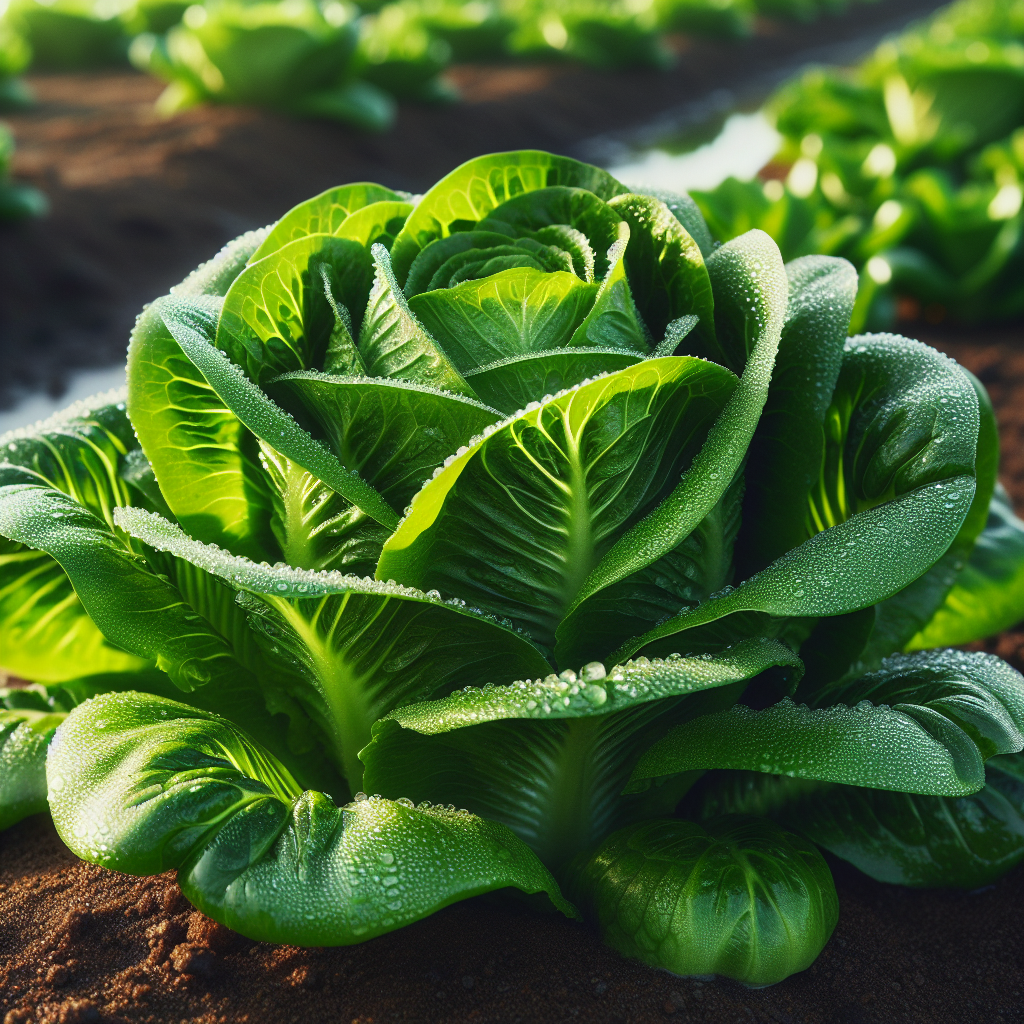
Introduction to Romaine Lettuce (Parris Island)
Romaine Lettuce (Parris Island), also known as Parris Island Cos, stands out as one of the most reliable romaine varieties for gardeners seeking consistent performance under varying conditions. Introduced in 1951 by the South Carolina Agricultural Experiment Station and named after the nearby Parris Island Marine Corps base, this heirloom cultivar was selectively bred from older cos types to excel in the humid Southeast U.S. Its defining traits include tall, upright heads reaching 10-12 inches in height and 6-8 inches wide, with thick, crisp, dark green outer leaves that fold naturally into a loose heart. Unlike softer butter lettuces, Parris Island offers a robust texture and mild, nutty flavor that intensifies slightly with maturity, making it a staple for fresh salads, grilling, and Mediterranean dishes.
This variety's historical significance lies in its breeding for heat tolerance and disease resistance, addressing common failures in traditional romaines during warm spells. It matures in 65-75 days from transplant, slower than some looseleaf types but faster than many full-sized cos varieties. Gardeners appreciate its bolt resistance—up to 10-15 days longer than standard romaines in temperatures approaching 80°F (27°C)—allowing extended harvests without bitterness. In commercial settings, Parris Island yields 20-30% more marketable heads per row foot due to its vigorous growth and minimal waste from Tipburn or ribbing. For small farms, its adaptability to succession planting supports multiple cuts, boosting productivity in limited spaces.
Botanical Profile of Romaine Lettuce (Parris Island)
Belonging to the Asteraceae family, Romaine Lettuce (Parris Island) is a cultivar of Lactuca sativa var. longifolia, distinguished by its upright, columnar habit rather than the rosette form of leaf lettuces or the spherical heads of crisphead types. Botanically, it exhibits oblong to lanceolate leaves with entire or slightly undulate margins, a savoyed texture on inner leaves, and prominent midribs that provide structural integrity. The plant's basal rosette develops into a 12-18 inch tall stalk under stress, but optimal conditions keep it compact at 10-12 inches. Leaves measure 8-12 inches long, with a waxy cuticle that reduces water loss, contributing to its semi-heat tolerance.
Chromosomally diploid (2n=18), Parris Island inherits vigor from its cos lineage, showing hybrid-like uniformity despite open-pollinated status. Flowering, if induced by heat or long days, produces tall (up to 5 feet) bolting stems with yellow ligulate florets, though commercial growers rogue early bolters. Root systems are fibrous and shallow, concentrating in the top 6-8 inches of soil, with fine laterals extending 12-18 inches laterally for efficient nutrient uptake. This shallow rooting demands consistent moisture and loose soil to prevent stunting. Compared to Iceberg Lettuce, Parris Island has higher chlorophyll content (darker green) and more ascorbic acid, enhancing nutritional value with 15-20 IU vitamin A per 100g serving.
Soil, pH, and Climate Requirements for Romaine Lettuce (Parris Island)
Parris Island thrives in fertile, well-drained loams or silt loams with 2-4% organic matter, avoiding heavy clays that compact roots. Ideal soil texture is sandy loam (50-70% sand, 20-30% silt, 10-20% clay) for aeration and moisture retention without waterlogging. Incorporate 2-4 inches of aged compost pre-planting to achieve 25-35 lbs/1000 sq ft nitrogen equivalent. pH range is 6.2-6.8; below 6.0, molybdenum deficiency causes whiptail (strappy leaves), while above 7.2, calcium uptake falters, leading to Tipburn—brown necrotic edges on inner leaves.
Climate-wise, optimal daytime temps are 60-70°F (15-21°C) with nights above 45°F (7°C). It tolerates up to 80°F (27°C) day/70°F (21°C) night for 10-14 days without bolting, outperforming Paris White Cos by 20%. Frost tolerance extends to 28°F (-2°C) for mature plants, but seedlings suffer below 40°F (4°C). Full sun (6-8 hours) is essential, though light shade (30% reduction) in hot climates prevents bleaching. Annual rainfall needs: 12-18 inches during growth; supplement with 1-1.5 inches/week. For coastal or high-humidity areas like its origin, ensure good airflow to curb Downy mildew. Soil Health Mastery: 5 Proven Strategies for Small Farms to Build Fertile Ground Without Breaking the Bank offers techniques to optimize these conditions.
Step-by-Step Planting & Propagation
Start seeds indoors 4-6 weeks pre-last frost at 70-75°F (21-24°C) soil temp for 95% germination in 3-7 days. Sow 1/8-1/4 inch deep in 72-cell trays with sterile seed-starting mix (pH 6.5). Thin to one seedling/cell at cotyledon stage. Harden off over 7-10 days, exposing to outdoor conditions gradually. Direct sow in spring/fall: rows 12-18 inches apart, plants 8-12 inches within row, 1/4 inch deep. Cover lightly; firm soil. Succession plant every 2-3 weeks for continuous harvest.
Transplant at 4-5 true leaves (3-4 weeks old), when 2-3 inches tall. Acclimate 24 hours pre-planting. Space 10-12 inches apart in rows 18-24 inches. Water immediately post-transplant to settle roots. For no-till beds, prepare by sheet mulching 4-6 months ahead. Propagation via cuttings: harvest outer leaves, root bases in water (change daily); roots form in 7-10 days, transplant for 50% success rate. Avoid summer transplants due to heat stress; use shade cloth if needed.
Care & Maintenance regimes for Romaine Lettuce (Parris Island)
Water to maintain 60-70% field capacity: soil moist to 4 inches deep, not soggy. Signs of underwatering: wilting mid-afternoon (recoverable), cupping leaves. Overwatering: yellowing lower leaves, root rot (mushy, foul odor). Drip irrigate 1 inch/week, early morning; mulch with 2 inches straw to retain moisture and suppress weeds. Fertilize at planting: 4-6-4 NPK at 1 lb/100 sq ft, sidedress 3 weeks later with 0.5 lb nitrogen/100 sq ft (blood meal or fish emulsion). Monitor EC <1.5 mS/cm to avoid salt burn.
Thin promptly to prevent crowding-induced weak stems. Scout weekly for nitrogen deficiency (pale yellowing from base up); correct with urea foliar (1%). Thin to 10 inches for full heads, 6-8 for baby greens. Hill soil slightly around bases at 4 weeks to blanch hearts and support upright growth. Rotate crops; avoid replanting brassicas or other lettuces in same spot for 2 years.
Pests, Diseases & Organic Management
Aphids cluster on undersides; blast with strong water jet or apply neem oil (0.5% solution) weekly. Slugs: beer traps or diatomaceous earth barriers. Cutworms: collar transplants with cardboard tubes. Flea beetles: row covers until 4-leaf stage.
Diseases: Downy mildew (purple-gray spores on leaf undersides)—improve spacing/airflow, copper fungicide. Bottom rot (Sclerotinia): avoid wet foliage, rotate. Tipburn (calcium deficiency): consistent moisture, gypsum amendments. Bolting: shade cloth above 75°F. Integrated management: release ladybugs (1000/acre), interplant with Nasturtium as trap crop.
Harvesting, Curing & Optimal Storage
Harvest at 65-75 days when heads are 10-12 inches tall, leaves crisp, hearts forming. Cut entire head at base or harvest outer leaves for cut-and-come-again (3-4 cuts/plant). Morning harvest post-dew dry; avoid wet foliage. Field cure 1-2 hours in shade to toughen skins.
Store at 32-34°F (0-1°C), 95-98% humidity; lasts 2-4 weeks vs. 1 week at room temp. Wrap in perforated plastic; avoid ethylene producers like apples. For market, hydrocool immediately to 33°F. Yields: 1-2 lbs/head, 10-15 heads/10 ft row.
Companion Planting for Romaine Lettuce (Parris Island)
Pair with Carrot to deter flies; strawberries suppress weeds. Onion repels Aphids; avoid fennel, broccoli (nutrient competition). Optimal: 4-inch Radish borders for soil aeration, faster harvests.