Introduction to Rice Water Weevils
Rice water weevils (Lissorhoptrus oryzophilus) represent one of the most destructive pests in rice cultivation worldwide, particularly in flooded paddy systems. Native to North America but now established in Asia, South America, and Europe, these semiaquatic beetles target young rice plants, with their legless, creamy-white larvae feeding voraciously on roots. This underground damage stunts growth, reduces tillering, and can slash yields by 20-60% in severe infestations. Early detection and integrated pest management (IPM) are crucial, as populations build rapidly in warm, humid conditions. Growers must scout fields meticulously from planting through tillering stages to mitigate economic losses, which exceed millions annually in major rice-producing regions like the southern U.S., China, and Japan. Understanding their biology enables proactive strategies that preserve crop health without over-relying on chemicals.
Identifying Symptoms & Damage
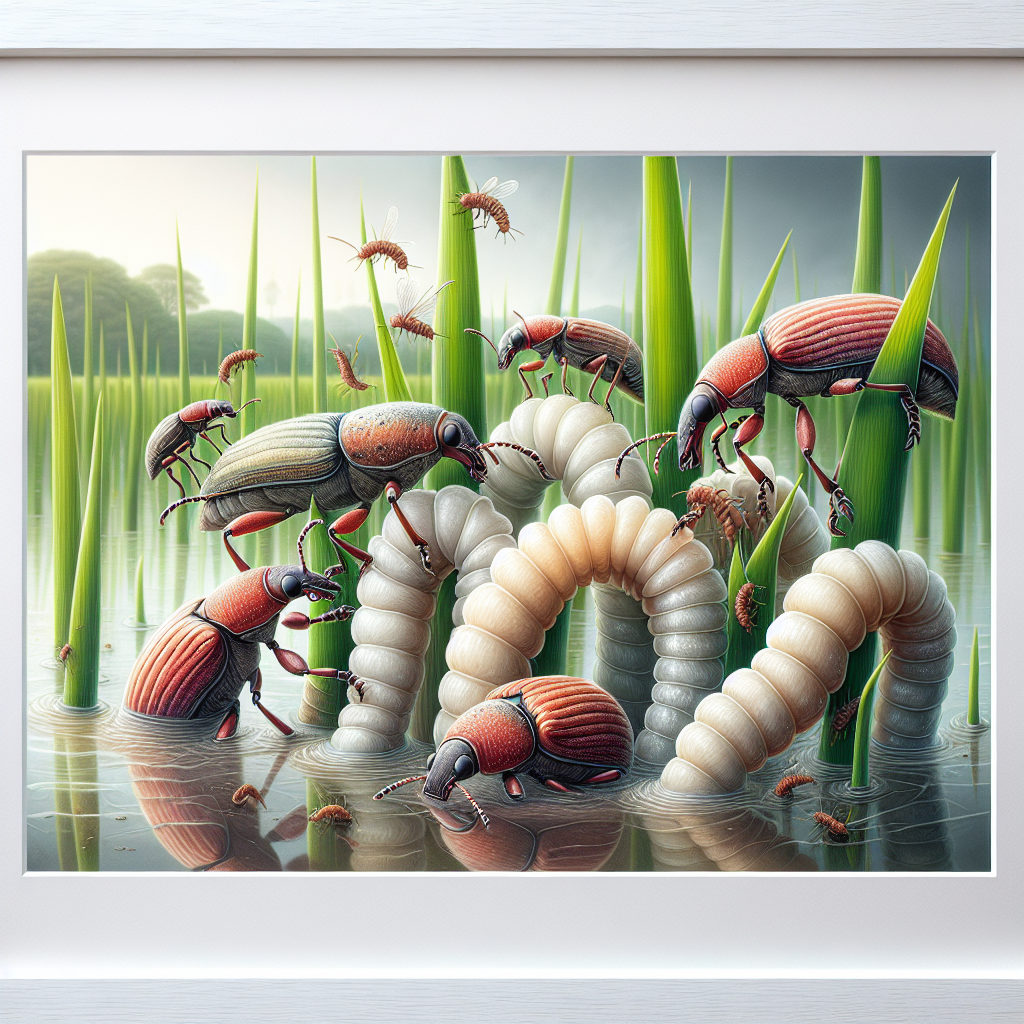
Spotting rice water weevil damage starts with aboveground signs that hint at belowground devastation. The hallmark symptom is straight-line rows of longitudinal scars on rice leaves, created by adult weevils chewing parallel to the leaf veins—often called 'stringing' or 'straw breaking.' These 2-4 mm long, reddish-brown adults with long snouts are most active at night and hide in leaf sheaths during the day, making them tricky to find without thorough inspection.
More critically, larval damage manifests indirectly: rice plants appear stunted, with fewer tillers, yellowing leaves, and poor root systems. Pull up affected plants to reveal the creamy-white, legless larvae (up to 6 mm long) coiled in the soil or on roots, where they scrape off root hairs and bore into crowns. Severely infested plants show 'hollow stems' or lodging, as weakened roots fail to support growth. Yield impacts are profound—larvae can consume up to 40% of root mass, reducing grain fill by 25-50%. Differentiate from root-knot nematodes or wireworms by the absence of galls or wire-like bodies; weevil larvae are soft and curved. Scout by taking 10-20 core samples per 0.1 hectare at 4-7 days post-flooding, counting larvae per plant—action thresholds are 5-10 larvae per plant for direct-seeded rice.
Lifecycle and Progression of Rice Water Weevils
The rice water weevil completes 2-4 generations per year, synchronized with rice phenology in tropical and subtropical zones. Adults overwinter in soil or crop residues, emerging in spring when soil temperatures hit 15-18°C. Females lay 100-200 eggs singly inside leaf sheaths of young rice (1-3 leaf stage), hatching in 4-7 days into tiny larvae that drop to flooded soil.
Larvae progress through four instars over 20-30 days, feeding on roots before pupating in earthen cells 2-5 cm deep. New adults emerge 7-10 days later, resuming feeding and oviposition. Peak larval densities occur 2-3 weeks after flooding, coinciding with tillering. In warmer climates, multiple overlapping generations amplify damage; cooler areas see one main generation. Flightless adults crawl between fields, spreading via irrigation water or machinery. Monitoring soil temperature and rice growth stage predicts infestations—use degree-day models (base 10°C) to time scouts. This lifecycle underscores the need for early interventions before larval establishment.
Environmental Triggers & Risk Factors
Rice water weevils thrive in continuously flooded fields with water depths of 5-15 cm, high nitrogen fertility, and temperatures above 20°C. Direct-seeded rice is most vulnerable, as staggered germination allows prolonged egg-laying windows compared to transplanted systems. High weed pressure, especially broadleaves like duck salad (not in list, but relevant), provides alternate hosts and shelters adults.
Susceptibility spikes with early-season nitrogen applications, promoting lush growth that attracts oviposition. Poor drainage, compacted soils, and ratoon crops (second harvests) harbor overwintering populations. Climate change exacerbates risks through warmer springs and extended growing seasons. Fields near previous infestations or untreated borders face higher immigration. For Basmati Rice or Jasmine Rice varieties, dense planting (high tillering) compounds damage. Mitigate by alternating with non-host crops like soybeans or wheat in rotation. Check out this Spring Pest Patrol blog post for timing insights.
Organic Control & Treatment Plans
Organic management hinges on cultural, biological, and mechanical tactics within an IPM framework. Cultural Controls: Drain fields for 3-5 days at 2-3 leaf stage to strand eggs and expose larvae to predators and desiccation—repeat if needed. Plant resistant varieties like 'Kokuhikari' or 'Tadukan,' which deter oviposition. Apply nitrogen in split doses post-tillering to avoid lush, attractive growth. Flood fields later (after 4-leaf stage) to miss peak egg-lay.
Biological Controls: Encourage natural enemies—wolves spiders (Lycosa pseudoannulata), carabid beetles, and parasitic wasps prey on larvae. Release predatory mites or nematodes (Steinernema carpocapsae) at 10^6 per hectare. Marigold borders repel adults via allelochemicals.
Mechanical: Core sampling guides hand-pulling or flooding borders. Trap adults with yellow sticky cards or light traps at dusk.
Organic Treatments: Neem oil (azadirachtin) sprays at 5-10 ml/L target adults; apply evenings to flooded fields. Bacillus thuringiensis (Bt) var. israelensis targets larvae—mix 1-2 kg/ha with floodwater. Silicon-based boosters like potassium silicate (50-100 kg/ha) strengthen roots against feeding. Monitor thresholds: treat at 10+ larvae/plant. Integrate with Soil Health Mastery blog for resilient fields. Rotate with clover cover crops to disrupt cycles. Success rates exceed 70% with consistent IPM.
Preventing Rice Water Weevils in the Future
Long-term prevention builds resilient systems through crop rotation, sanitation, and varietal selection. Rotate rice with non-hosts like corn, sorghum, or legumes every 2-3 years to starve overwintering adults. Destroy stubble promptly post-harvest via deep plowing (15-20 cm) to expose pupae. Use certified, weevil-free seeds and avoid ratooning.
Enhance field borders with repellents: plant thyme or yarrow as barriers. Maintain water hygiene—flush irrigation canals to prevent adult drift. Scout weekly from pre-flood to panicle initiation, using beat sheets for adults. Adopt water-seeded systems with early drainage protocols. For small farms, precision tools like AI scouting (see Why Misidentifying Plants Costs Small Farms Thousands) boost accuracy. Build soil organic matter >3% via compost to support beneficials. Resistant hybrids like 'CL151' reduce risks by 40%. Annual planning prevents 80-90% of outbreaks.
Crops Most Affected by Rice Water Weevils
Primarily targeting rice (Oryza sativa), including Basmati Rice, Jasmine Rice, Arborio Rice, and Koshihikari Rice, weevils occasionally damage wild rice (Zizania spp.) and aquatic grasses. Flooded paddies amplify issues, but dryland rice sees lower infestations. No major impacts on wheat, corn, or soybeans, though shared machinery spreads adults. In polycultures, proximity to rice heightens risks for adjacent sugarcane. Focus protection on rice-centric rotations.