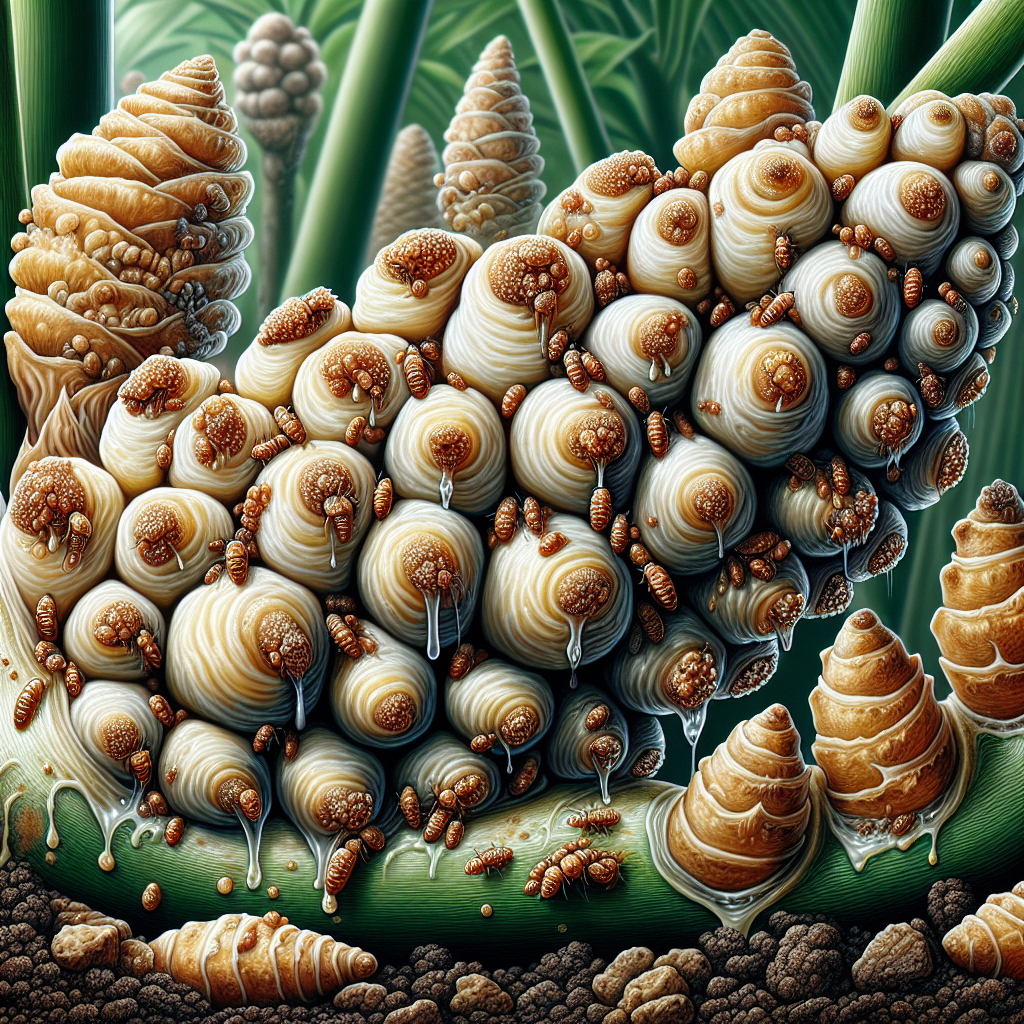
Introduction to Rhizome scale insects
Rhizome scale insects (primarily Aspidiotus rhizophilus and other scale insects in the family Diaspididae) represent a significant threat to underground plant structures in tropical agriculture. These small, sessile pests attach firmly to rhizomes, tubers, and root systems, piercing plant tissues to extract sap rich in nutrients. Unlike above-ground scales, rhizome scales are notoriously difficult to detect due to their subterranean habitat, often going unnoticed until severe damage manifests as wilting, stunted growth, or total plant collapse.
Farmers growing rhizomatous crops face unique challenges with these pests, as mechanical cultivation can spread infestations. Native to Southeast Asia, rhizome scales have spread globally through contaminated planting material, affecting high-value crops in humid regions. Their waxy, armored exoskeletons protect them from desiccation and many contact insecticides, making organic management a priority for sustainable farming. This guide provides professional-grade diagnostics, lifecycle insights, and proven organic strategies to protect yields. Understanding their biology is key to preventing economic losses that can exceed 50% in untreated fields.
Identifying Symptoms & Damage
Detecting rhizome scale insects requires careful inspection of underground parts, as above-ground symptoms mimic nutrient deficiencies or root rot. Initial signs include yellowing or chlorotic leaves, starting from older foliage and progressing inward. Plants exhibit stunted growth, with reduced tillering in ginger or poor pseudostem development in bananas. Severe infestations cause wilting during dry periods, as scales disrupt water and nutrient uptake.
Excavate affected plants to reveal the diagnostic hallmark: clusters of 1-2 mm oval, brownish-white armored scales encrusting rhizomes, often in fissures or at bud junctions. Heavy infestations produce sooty mold on exposed roots from honeydew excretion, though less visible underground. Cross-sections show vascular discoloration and gummosis. Differentiate from mealybugs by the hard, circular shell and lack of cottony wax. Yield impacts are profound: ginger rhizomes shrivel by 30-70%, turmeric fingers deform, and banana corms fail to sprout. Early scouting during division or harvest is essential; use a hand lens for confirmation.
Lifecycle and Progression of Rhizome scale insects
Rhizome scale insects complete 4-6 generations annually in optimal tropical conditions (25-32°C, 70-90% humidity). Females are wingless, sedentary, and armored, measuring 1.5 mm long with a circular, reddish-brown cover. They insert stylets into rhizome parenchyma, feeding and producing nymphs parthenogenetically—no males needed.
Eggs (20-50 per female) hatch in 7-10 days into crawlers—mobile, orange, vulnerable first-instars that settle within 24-48 hours, molting into immobile scales. Development from crawler to mature female takes 3-6 weeks, depending on temperature. Peak crawler activity aligns with rainy seasons, facilitating dispersal via irrigation or tools. Overwintering occurs as partially grown scales on dormant rhizomes.
Progression follows a boom-bust cycle: low populations explode post-planting from contaminated seed pieces. By 3-4 months, rhizomes are 80% infested, weakening plants pre-harvest. Ants farm scales for honeydew, worsening spread. Monitoring crawler emergence with yellow sticky traps near soil surface aids timing interventions.
Environmental Triggers & Risk Factors
Warm, humid climates (above 25°C, >80% RH) trigger rapid scale proliferation, especially in poorly drained fields. Overwatering or flooding promotes crawler dispersal, while drought stresses plants, making them susceptible. High soil organic matter retains moisture, favoring scales over natural enemies.
Key risk factors include using infested seed rhizomes—primary infestation source in 90% of cases. Monocropping depletes beneficial nematodes and predators. Excessive nitrogen fertilizers boost succulent growth, attracting females. Mechanical injury during planting creates entry points. Proximity to unmanaged ginger or turmeric fields heightens invasion risk. Climate change extends active seasons, with models predicting 20% more generations by 2050 in subtropical zones.
Organic Control & Treatment Plans
Integrated Pest Management (IPM) emphasizes cultural, biological, and minimal botanical controls for rhizome scales. Cultural: Hot water dip seed rhizomes at 48-50°C for 20 minutes, killing 95% of scales without viability loss. Solarize soil pre-planting (clear plastic, 6-8 weeks) to 45°C+. Rotate with non-hosts like corn or legumes for 2 years. Improve drainage with raised beds.
Biological: Release predatory beetles (Chilocorus spp.) and parasitic wasps (Aphytis spp.) at 1:100 scale ratios. Enhance native predators with neem mulch. Soil drench with Pythium-safe Beauveria bassiana (10^9 spores/ml) every 15 days.
Botanicals: Drench with 5% neem oil + 2% dish soap (3x, 10-day intervals), targeting crawlers. Garlic-chili extract (1:1:10) penetrates soil. For heavy infestations, combine with diatomaceous earth barriers.
Monitoring & Threshold: Scout 10% plants biweekly; treat at 5 scales/rhizome. Spring Pest Patrol: Organic AI Strategies to Shield Your Crops from Common Invaders offers tech-aided scouting tips. Expect 70-90% control with consistent IPM.
Preventing Rhizome scale insects in the Future
Prevention hinges on clean planting material: inspect and hot-dip all seed pieces. Quarantine new stock 3 months. Use certified, scale-free rhizomes from reputable sources. Crop rotation disrupts lifecycles—alternate with sweet potato or cassava.
Maintain soil health: balanced NPK (avoid excess N), pH 6.0-7.0, and cover crops like clover suppress via allelopathy. Weed meticulously to eliminate alternate hosts. Promote biodiversity with border hedges of marigold and thyme, repelling crawlers. Mulch with pine bark (acidity deters settling). Regular deep tillage exposes scales to predators and desiccation. Annual soil tests guide fertility, preventing stress-induced susceptibility. Vigilant prevention sustains yields long-term.
Crops Most Affected by Rhizome scale insects
Rhizome scales devastate tropical/subtropical rhizomatous perennials:
- Ginger (ginger): Primary host; 40-60% yield loss, rhizomes unmarketable.
- Turmeric (turmeric): Fingers crack, curcumin drops 30%; export rejection.
- Banana (banana, Dwarf Cavendish Banana): Corms infested, daughter plants fail.
- Taro (taro): Corms rot post-infestation.
- Arrowroot & Yam (yam): Minor but emerging threats.
Secondary hosts include pineapple crowns and ornamental gingers. Global impact: $500M+ annual losses in Asia-Pacific. Early IPM protects these staples.