Introduction to Potato (Blaue Anneliese)
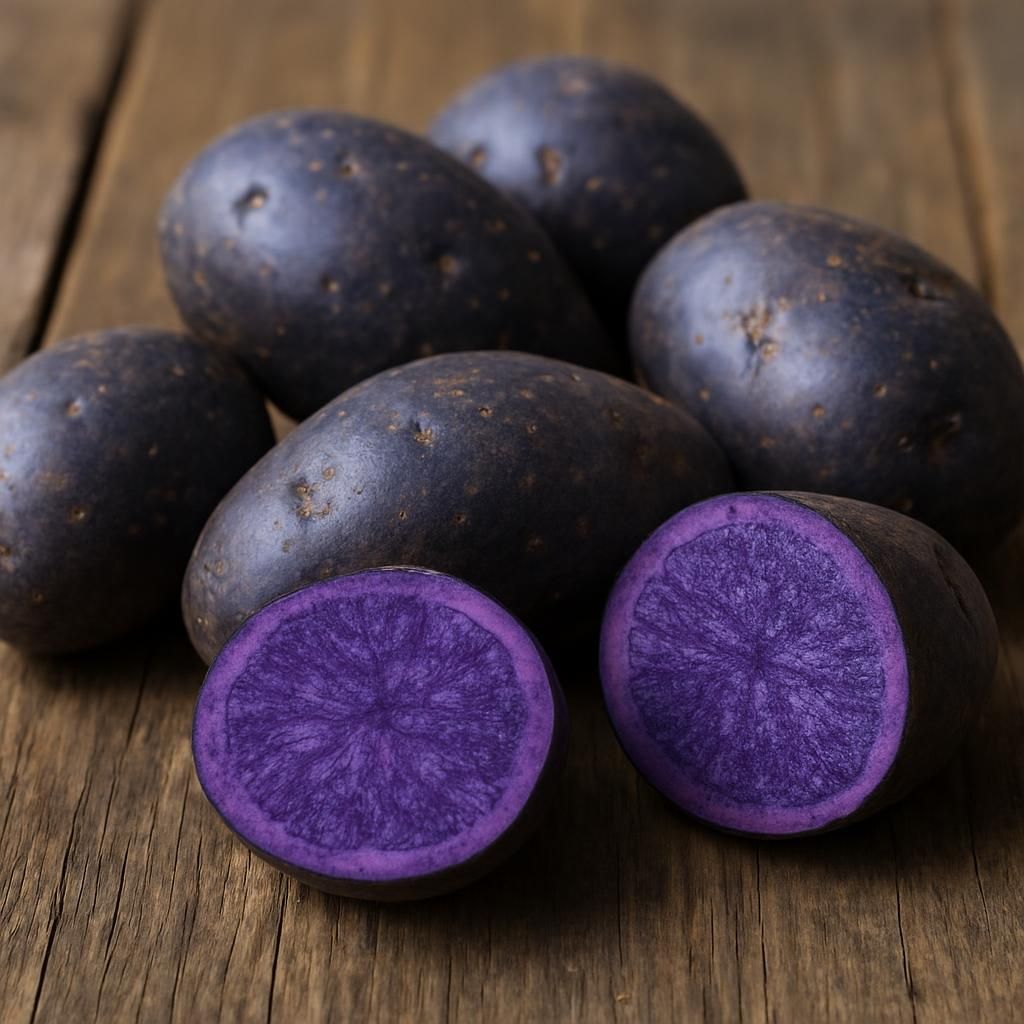
Blaue Anneliese is a distinctive German heritage potato (Solanum tuberosum) known for its intense blue-purple skin and vibrant flesh that stays true even after boiling, baking, or roasting. The variety delivers a rich, nutty flavor with slightly waxy texture that excels in gourmet presentations and nutritional dishes. Gardeners value Blaue Anneliese for its moderate disease resistance, attractive appearance, and ability to command premium prices at farmers' markets.
Developed in Germany, this cultivar belongs to the colored-flesh potato group that has gained popularity among chefs and health-conscious consumers. The anthocyanin pigments responsible for the striking color also provide higher antioxidant levels than standard white or yellow potatoes. With proper cultural practices, home and small-scale growers can expect reliable tuber production and excellent storage life.
Botanical Profile of Potato (Blaue Anneliese)
Blaue Anneliese produces compact, upright plants reaching 60-75 cm in height with dark green foliage and moderate flowering. The variety develops oval to oblong tubers averaging 80-150 g with smooth to slightly netted deep blue-purple skin and uniformly colored flesh. Eye distribution is moderate, and the tubers exhibit good resistance to greening.
As a member of the Solanaceae family, the plant follows the standard potato growth cycle: vegetative growth, tuber initiation, tuber bulking, and senescence. The variety matures in approximately 90-110 days from planting, classifying it as a mid-season type suitable for both spring and fall plantings in temperate climates.
Soil, pH, and Climate Requirements for Potato (Blaue Anneliese)
Blaue Anneliese performs best in well-drained, fertile loamy soils with consistent moisture. The variety tolerates a slightly wider pH range than many potatoes but still requires careful management to prevent common scab and nutrient lockout.
| Parameter | Ideal Range | Notes |
|---|---|---|
| Soil Type | Sandy loam to loam | Excellent drainage prevents tuber rot |
| Soil pH | 5.8 – 6.5 | Slightly acidic reduces common scab risk |
| Soil Temperature | 10–18 °C at planting | Warmer soils accelerate emergence |
| Air Temperature | 15–22 °C daytime | Cool nights improve tuber set |
| Frost Tolerance | Light frost only | Protect new shoots below –1 °C |
| Sunlight | Full sun (6–8 hours) | Essential for maximum tuber development |
| Annual Rainfall | 500–700 mm, well distributed | Supplemental irrigation often required |
Step-by-Step Planting & Propagation
Begin with certified disease-free seed potatoes of Blaue Anneliese. Cut larger tubers into pieces each containing at least one or two eyes, allowing cuts to suberize for 24–48 hours before planting. In cooler climates, pre-sprout (“chit”) seed pieces indoors at 12–15 °C for 2–4 weeks to hasten emergence.
Plant in early spring once soil reaches 10 °C, spacing seed pieces 25–30 cm apart in rows 75–90 cm wide and 10–15 cm deep. In regions with long seasons, a second planting 60–70 days before first frost can extend the harvest window. Maintain consistent soil moisture during the first 3–4 weeks to promote uniform sprouting.
Care & Maintenance regimes for Potato (Blaue Anneliese)
Proper hilling, irrigation, and fertility management are essential for high-quality tubers. Begin hilling when plants reach 15–20 cm, repeating every 2–3 weeks until vines begin to flower. This practice protects developing tubers from sunlight and supports additional stolon formation.
| Growth Stage | Watering Schedule | Fertilizer Application | Pruning / Hilling Notes |
|---|---|---|---|
| Pre-Emergence | Keep soil moist but not saturated | Incorporate 5-10-10 at 500 kg/ha | None |
| Vegetative (15–30 cm) | 25–30 mm/week | Side-dress with 10-10-10 at 200 kg/ha | First hilling when 15 cm tall |
| Tuber Initiation | 30–35 mm/week | Apply potassium-rich fertilizer (0-0-20) | Second hilling; remove weeds |
| Tuber Bulking | 35–40 mm/week | Light nitrogen top-dress if foliage pale | Third hilling; stop after flowering |
| Maturation | Reduce to 15–20 mm/week | Cease nitrogen applications | Allow natural vine senescence |
Pests, Diseases & Organic Management
Blaue Anneliese faces typical potato threats including Colorado potato beetle, aphids, wireworms, late blight, and early blight. Implement integrated pest management combining crop rotation, resistant varieties, and timely interventions.
Scout weekly for Colorado potato beetle larvae and handpick or apply Bacillus thuringiensis (Bt) sprays when thresholds are exceeded. Use floating row covers during early growth to exclude aphids and reduce virus transmission. Maintain 3–4 year rotations with non-host crops such as wheat or corn to break soil-borne disease cycles. Copper-based fungicides or approved organic alternatives can suppress late blight when applied preventively during humid periods.
Harvesting, Curing & Optimal Storage
Harvest Blaue Anneliese when vines begin to yellow, typically 90–110 days after planting. Use a garden fork to gently lift tubers, avoiding skin damage. Allow harvested potatoes to cure in a shaded, well-ventilated area at 12–15 °C and 85–90 % relative humidity for 10–14 days to heal minor wounds.
Store cured tubers in darkness at 4–7 °C with 85–90 % humidity. Avoid refrigeration below 4 °C to prevent sugar accumulation and subsequent browning during cooking. Properly stored Blaue Anneliese tubers maintain quality for 4–6 months.
Companion Planting for Potato (Blaue Anneliese)
Strategic companions improve pest management and soil health. Plant marigold or nasturtium between rows to repel Colorado potato beetle and aphids. Garlic and onion deter many soil pests while occupying minimal space.
Avoid planting near members of the Solanaceae family such as tomato and eggplant to reduce shared disease pressure. Leguminous green manures like clover or hairy vetch preceding the potato crop supply nitrogen and improve soil structure. After harvest, follow with brassicas or leafy greens to maximize land use and break pest cycles.